Frankincense Latest News
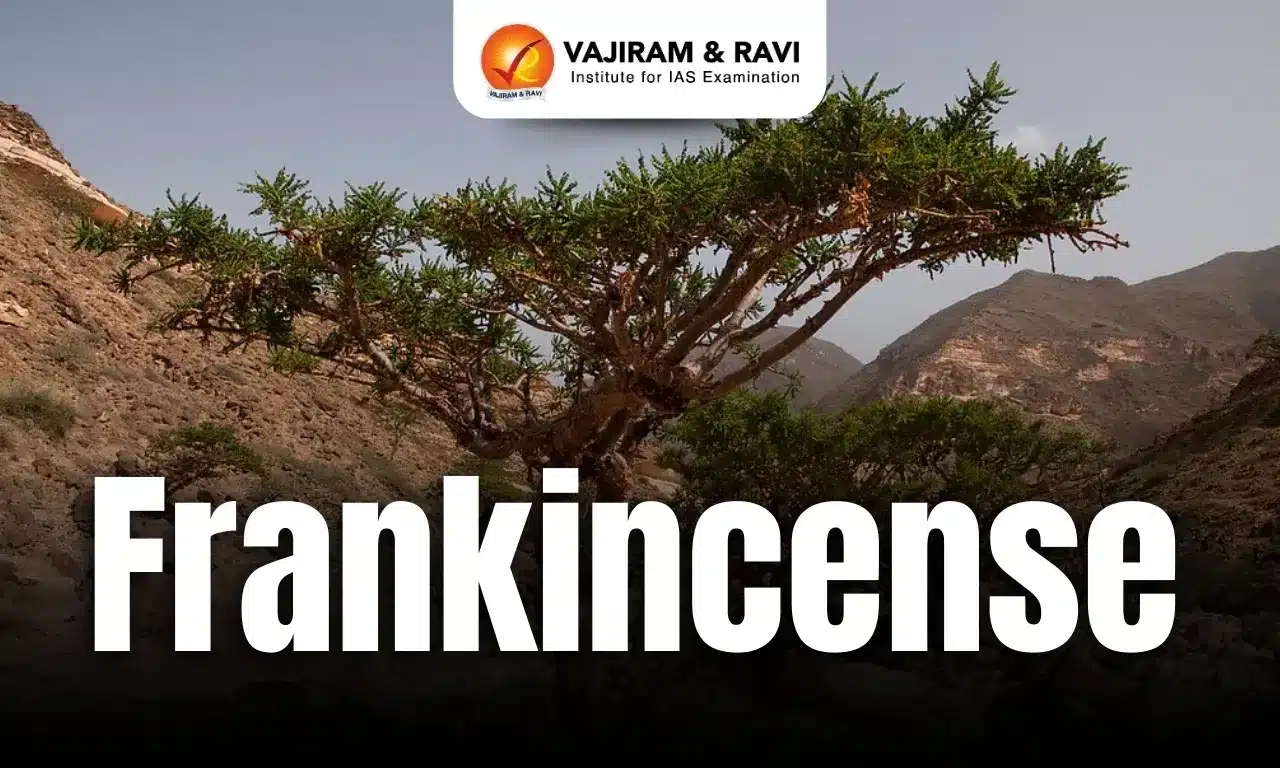
Recently, the International Union for Conservation of Nature (IUCN) has issued a warning that Frankincense-producing trees (Boswellia species) are at risk of extinction.
- Five species on Socotra Island (Yemen) have moved from Vulnerable to Endangered, one species is now Critically Endangered, and three others have been assessed as Critically Endangered for the first time.
What is Frankincense?
- Frankincense is an aromatic resin derived from trees of the Boswellia genus.
- It has been historically valued for use in incense, perfumes, and traditional medicine.
- Cultural significance: It was one of the three gifts (Gold, Frankincense, and Myrrh) presented to Jesus by the Magi, as mentioned in the Bible.
Major Species of Boswellia
|
Scientific Name |
Common Name |
Region Found |
|
Boswellia serrata |
Indian Frankincense |
India |
|
Boswellia carterii |
Somali Frankincense |
Somalia, Ethiopia |
|
Boswellia sacra |
Arabian Frankincense |
Oman, Yemen |
|
Boswellia papyrifera |
Sudanese Frankincense |
Sudan, Eritrea |
|
Boswellia frereana |
Maydi Frankincense |
Somalia |


Why is Frankincense at Risk?
- Habitat destruction & overgrazing: Goats graze on young saplings, preventing tree regeneration.
- Traditional rotational grazing practices have declined, leading to overgrazing.
- Climate change & extreme weather: Frequent cyclones, flash floods, and landslides (2015, 2018) have damaged and uprooted trees.
- Prolonged droughts hinder sapling growth.
- Unsustainable Harvesting: Excessive tapping for resin extraction weakens trees and reduces seed production.
- Limited conservation measures: Lack of effective protective measures like fencing and regulated harvesting has worsened the crisis.
Frankincense FAQs
Q1: What is Frankincense?
Ans: Frankincense is a resin obtained from the Boswellia tree, used in perfumes, incense, and traditional medicine.
Q2: Where is Frankincense primarily produced?
Ans: It is mainly produced in Oman, Yemen, Somalia, and parts of India.
Q3: What are the uses of Frankincense?
Ans: It is used in aromatherapy, religious rituals, medicine, and cosmetics.
Q4: Why is Frankincense considered valuable?
Ans: Due to its historical significance, medicinal properties, and role in religious ceremonies, it has high economic and cultural value.
Source: DTE

 Last updated on Oct, 2026
→ UPSC 2027 Notification will be released on 13 January 2027 at upsconline.nic.in.
→ Asian Games 2026 are being held in Aichi-Nagoya, Japan, from 19 September to 4 October.
→ Check Nobel Prize 2026 Winners List here.
→ Download PIB PRiSM Monthly Magazine 2026 here.
→ Check UPSC Monthly Current Affairs Magazine The Recitals here.
→ Check out the latest UPSC Syllabus here.
→ Download UPSC Model Answers for Mains 2026
→ UPSC Mains Question Paper 2026 is out now for Essay & GS Paper 1, 2, 3 & 4.
→ UPSC Calendar 2027 has been released.
→ Enroll in Vajiram & Ravi’s UPSC Mains Test Series 2027 for structured answer writing practice, expert evaluation, and exam-oriented feedback.
→ Join Vajiram & Ravi’s UPSC Mentorship Program 2027 for personalized guidance, strategy planning, and one-to-one support from experienced mentors.
→ Go through the UPSC Mains Previous Year Papers to enhance your preparation.
→ UPSC has released UPSC Toppers List 2025 with the Civil Services final result on its official website.
→ Also check Best UPSC Coaching in India