Critical Minerals Latest News
India’s first auction of deep-sea blocks of critical minerals, which are vital for electric vehicles, defence equipment and renewable energy, has been delayed indefinitely following a poor response from bidders.
About Critical Minerals
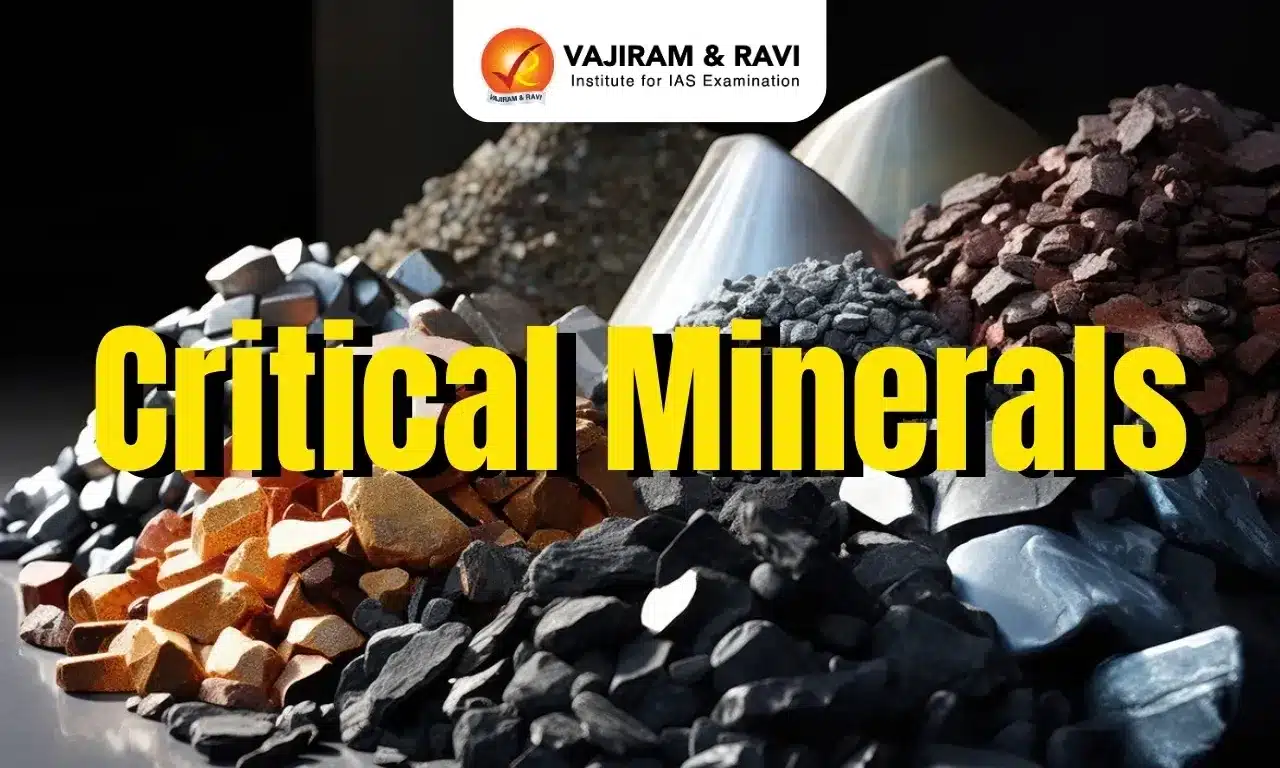
- Critical minerals are those that are essential for modern technologies and national security but have supply chain risks due to their limited availability or geographical concentration.
- Their ‘criticality’ changes over time depending on technological demand and supply dynamics.
- Applications:
- They are used to manufacture advanced technologies, including mobile phones, computers, fibre-optic cables, semiconductors, banknotes, and defence, aerospace, and medical applications.
- Many are used in low-emission technologies, such as electric vehicles, wind turbines, solar panels, and rechargeable batteries.
- Some are also crucial for common products, such as stainless steel and electronics.
- Top Producers: Chile, Indonesia, Congo, China, Australia, and South Africa.
- Countries identify minerals critical for them based on their national priorities.
- In 2023, the Ministry of Mines released a list of 30 critical minerals for India.
- These minerals are Antimony, Beryllium, Bismuth, Cobalt, Copper, Gallium, Germanium, Graphite, Hafnium, Indium, Lithium, Molybdenum, Niobium, Nickel, PGE, Phosphorous, Potash, REE, Rhenium, Silicon, Strontium, Tantalum, Tellurium, Tin, Titanium, Tungsten, Vanadium, Zirconium, Selenium, and Cadmium.
- 24 minerals added to Part D of Schedule I of the Mines and Minerals (Development and Regulation) Act, 1957 (MMDR Act), granting Central Government exclusive auctioning powers.
- A Centre of Excellence for Critical Minerals (CECM) will regularly review the mineral list and advise policy.


National Critical Mineral Mission (NCMM)
- The Government of India launched the NCMM in 2025 to establish a robust framework for self-reliance in the critical mineral sector.
- The NCMM encompasses all stages of the value chain, including mineral exploration, mining, beneficiation, processing, and recovery from end-of-life products.
- Exploration:
- Under this mission, the Geological Survey of India (GSI) has been tasked with conducting 1,200 exploration projects from 2024-25 to 2030-31, with an aim of ensuring domestic production of at least 15 critical minerals (such as graphite, lithium, potash, REEs).
- The NCMM also aims for Indian companies to acquire 50 mining assets worldwide.
- To achieve these targets, it seeks to create a fast-track regulatory approval process for mining projects.
- Recycling: The NCMM seeks to set up an incentive scheme for mineral recycling with a budget of INR 1500 crore (USD 170 million), with a target of recovering 400 kilotonnes (kt) of recycled material.
- Stockpiling: The NCMM foresees the creation of a National Critical Minerals Stockpile comprising at least 5 critical minerals to mitigate the risks from global supply chain disruptions.
- Research:
- The NCMM seeks to promote research in critical mineral technologies with a target of achieving self-sufficiency in processing at least 5 critical minerals and generating 1000 patents across the critical mineral value chains by 2031.
- It also proposes setting up 4 regional mineral processing parks and 3 Centres of Excellence on Critical Minerals.
- Governance: The NCMM envisages the formation of an Empowered Committee on Critical Minerals that would coordinate and implement the initiatives under the NCMM.
Source: MC

 Last updated on Sep, 2026
→ UPSC 2027 Notification will be released on 13 January 2027 at upsconline.nic.in.
→ Asian Games 2026 are being held in Aichi-Nagoya, Japan, from 19 September to 4 October.
→ Check out the latest UPSC Syllabus here.
→ Download UPSC Model Answers for Mains 2026
→ UPSC Mains Question Paper 2026 is out now for Essay & GS Paper 1, 2, 3 & 4.
→ UPSC Calendar 2027 has been released.
→ Enroll in Vajiram & Ravi’s UPSC Mains Test Series 2027 for structured answer writing practice, expert evaluation, and exam-oriented feedback.
→ Join Vajiram & Ravi’s UPSC Mentorship Program 2027 for personalized guidance, strategy planning, and one-to-one support from experienced mentors.
→ Go through the UPSC Mains Previous Year Papers to enhance your preparation.
→ UPSC has released UPSC Toppers List 2025 with the Civil Services final result on its official website.
→ Also check Best UPSC Coaching in India
Critical Minerals FAQs
Q1. Why does the criticality of minerals change over time?+
Q2. Which countries are the top global producers of critical minerals?+
Q3. How many critical minerals were identified by India’s Ministry of Mines in 2023?+
Tags: critical minerals