Bioluminescent Backwaters Latest News
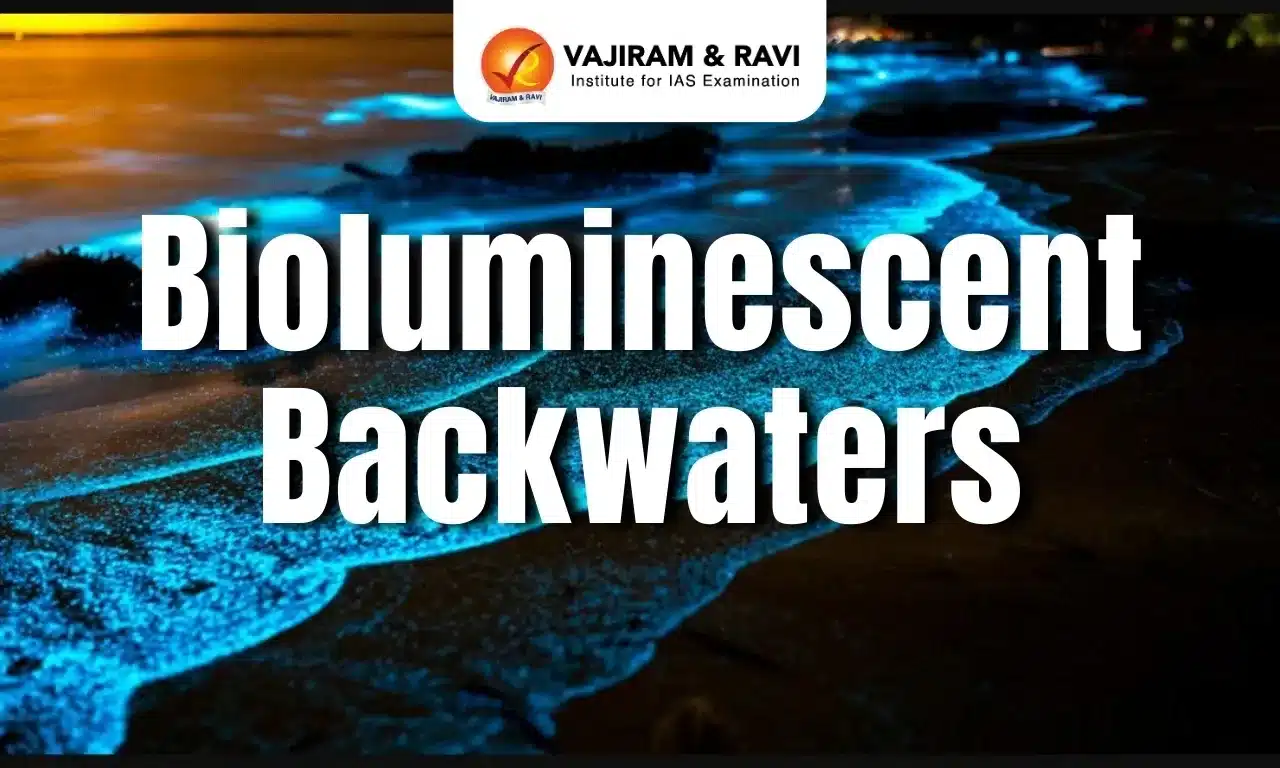
Recently, bioluminescent blue waves were observed in the backwaters of Kochi, Kerala, attracting tourists but raising concerns among ecologists and fishers due to underlying environmental degradation.
About Bioluminescence
- Bioluminescence refers to the natural emission of light by organisms such as bacteria, fungi, and algae triggered by mechanical disturbances in coastal and estuarine waters.
- The species most commonly responsible is Noctiluca scintillans, a type of dinoflagellate plankton, also known as “sea sparkle”.
- This glow results from chemical reactions inside specialized structures called scintillons and appears primarily blue but can also show red or brown hues depending on species concentration.
- The phenomenon is commonly observed from March to May, locally termed as “Kavaru” in Malayalam.


Scientific Background
- Eutrophication—caused by nutrient overload (especially nitrates and phosphates) from industrial runoff and sewage discharge—is a major driver.
- Salinity levels between 30-35 ppt, rising temperatures, and reduced rainfall contribute to bloom formation.
- When concentrations exceed 500,000 organisms per litre, it leads to red tides, which can severely disrupt marine ecosystems.
Ecological and Economic Impacts
- Plankton, while a key part of marine food chains, in large numbers release substances like dimethyl sulphide, ammonium, and dissolved organic carbon, causing Harmful Algal Blooms (HABs).
- HABs lead to hypoxia (oxygen depletion), resulting in mass fish mortality and affecting biodiversity and aquaculture operations.
- Fishing communities experience significant losses as fish migrate away from bloom-affected zones, leading to declining catches and reduced income.
- Toxins such as domoic acid and those from Alexandrium can cause amnesic or paralytic shellfish poisoning, harming both marine life and human health.
Bioluminescent Backwaters FAQs
Q1. What causes bioluminescence in backwaters?
Ans. Dinoflagellates (e.g., Noctiluca scintillans) emit light through chemical reactions when disturbed, creating glowing waters.
Q2. Where are bioluminescent backwaters found in India?
Ans. Kerala’s Alleppey and Tamil Nadu’s Pitchavaram mangroves are prime examples.
Q3. What ecological role do they play?
Ans. Indicate healthy marine ecosystems but signal algal blooms if excessive, threatening fish populations.
Source: DTE

 Last updated on Oct, 2026
→ UPSC 2027 Notification will be released on 13 January 2027 at upsconline.nic.in.
→ Asian Games 2026 are being held in Aichi-Nagoya, Japan, from 19 September to 4 October.
→ Check Nobel Prize 2026 Winners List here.
→ Download PIB PRiSM Monthly Magazine 2026 here.
→ Check UPSC Monthly Current Affairs Magazine The Recitals here.
→ Check out the latest UPSC Syllabus here.
→ Download UPSC Model Answers for Mains 2026
→ UPSC Mains Question Paper 2026 is out now for Essay & GS Paper 1, 2, 3 & 4.
→ UPSC Calendar 2027 has been released.
→ Enroll in Vajiram & Ravi’s UPSC Mains Test Series 2027 for structured answer writing practice, expert evaluation, and exam-oriented feedback.
→ Join Vajiram & Ravi’s UPSC Mentorship Program 2027 for personalized guidance, strategy planning, and one-to-one support from experienced mentors.
→ Go through the UPSC Mains Previous Year Papers to enhance your preparation.
→ UPSC has released UPSC Toppers List 2025 with the Civil Services final result on its official website.
→ Also check Best UPSC Coaching in India