What’s in today’s article:
- About the SMRs
- News Summary
Why In News:
- Recognising the critical role of nuclear power in India’s clean energy transition, the Dept of Atomic Energy (DAE) recently announced that the country is taking steps to develop small modular reactors (SMR).
- With capacities of up to 300 MW, SMR may not only be less expensive but also simpler and safer than large nuclear plants.
The Small modular reactors (SMRs):
About:

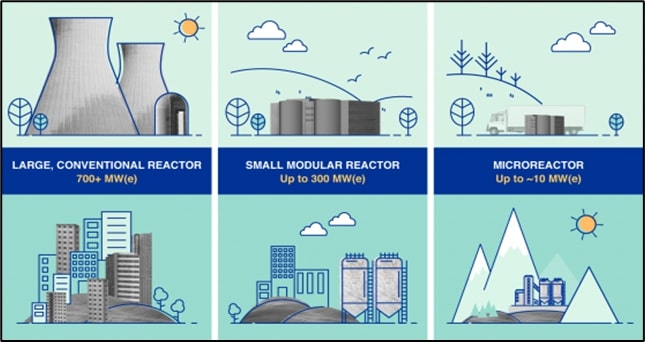
- They are advanced nuclear reactors that have a power capacity of up to 300 MW per unit, which is about one-third of the generating capacity of traditional nuclear power reactors.
- SMRs, which can produce a large amount of low-carbon electricity, are:
- Small: Means they are physically a fraction of the size of a conventional nuclear power reactor.
- Modular: Being mobile and agile technology, it makes it possible for systems and components to be factory-assembled and transported as a unit to a location for installation.
- Reactors: Which harnesses nuclear fission to generate heat to produce energy.

Advantages:
- They can be manufactured off-site – factory-built and can significantly save construction time, unlike the conventional nuclear reactors that are built on-site.
- This can contribute to reduced build-running costs and increased efficiency.
- SMRs have better control, generating less electricity when demand is down and are particularly useful for power generation in remote locations.
- Remote areas frequently have variable power generation requirements, however, large conventional reactors are generally inflexible in terms of power generation capability.
- SMRs are designed to require lesser fuel and fewer staff for location assembly, maintenance and operation.
- SMRs and sustainable development goals (SDGs):
- SMRs offer unique attributes in terms of efficiency, economics and flexibility, enabling them to play a key role in the clean energy transition, while also helping countries address the SDGs (SDG 7 – To achieve the target of universal access to energy).
- For example, SMRs could be paired with and increase the efficiency of renewable sources in a hybrid energy system.
Disadvantages:
- Lack of development: They do not currently exist as reactors for power generation.
- Cost-effectiveness depends on production: Large-scale production of SMRs is required to achieve its economic benefits.
- Licensing issues: Historically, the licensing process was developed for large commercial reactors and the licensing process for new reactor designs is a lengthy and costly process.
News Summary:
- Addressing a workshop on SMR, organised by government think tank Niti Aayog and DAE, Minister of State DAE said –
- The country has already taken steps for clean energy transition with penetration of non-fossil-based energy resources to achieve net-zero emission by 2070.
- India has made bold climate commitments which are reflected in the country’s updated ‘nationally determined contributions‘ (NDCs) – climate action targets – under the Paris Agreement.
- Nuclear power in terms of base load power can play a big role in the decarbonisation strategy.
- SMRs is a promising technology in industrial de-carbonisation, especially where there is a requirement of reliable and continuous supply of power.
- India has technological capabilities to develop such critical technology, as it operates a diversified fleet of reactors with different technologies.
- The private sector and start-ups need to explore development of this critical technology within India.


 Last updated on Oct, 2026
→ UPSC 2027 Notification will be released on 13 January 2027 at upsconline.nic.in.
→ Asian Games 2026 are being held in Aichi-Nagoya, Japan, from 19 September to 4 October.
→ Check Nobel Prize 2026 Winners List here.
→ Download PIB PRiSM Monthly Magazine 2026 here.
→ Check UPSC Monthly Current Affairs Magazine The Recitals here.
→ Check out the latest UPSC Syllabus here.
→ Download UPSC Model Answers for Mains 2026
→ UPSC Mains Question Paper 2026 is out now for Essay & GS Paper 1, 2, 3 & 4.
→ UPSC Calendar 2027 has been released.
→ Enroll in Vajiram & Ravi’s UPSC Mains Test Series 2027 for structured answer writing practice, expert evaluation, and exam-oriented feedback.
→ Join Vajiram & Ravi’s UPSC Mentorship Program 2027 for personalized guidance, strategy planning, and one-to-one support from experienced mentors.
→ Go through the UPSC Mains Previous Year Papers to enhance your preparation.
→ UPSC has released UPSC Toppers List 2025 with the Civil Services final result on its official website.
→ Also check Best UPSC Coaching in India