



What’s in today’s article?
- Why in News?
- The Process of Merger in India
- Reasons behind Mergers
- The Merger Proposal
- The NCLT and the NCLAT
- News Summary Regarding Zee-Sony Merger
Why in News?
- Providing major relief to Zee Entertainment Enterprises Ltd (ZEEL), the NCLAT set aside the NCLT order that had directed the NSE and BSE to reconsider their approval for the Zee-Sony merger.
The Process of Merger in India:
- A ‘Merger’ essentially means an arrangement whereby one or more existing companies merge their identity into another to form a new and different entity.
- It is a corporate strategy to enhance the financial and operational strengths of both organisations and has been carried out in accordance with the Companies Act 2013.


Reasons behind Mergers:
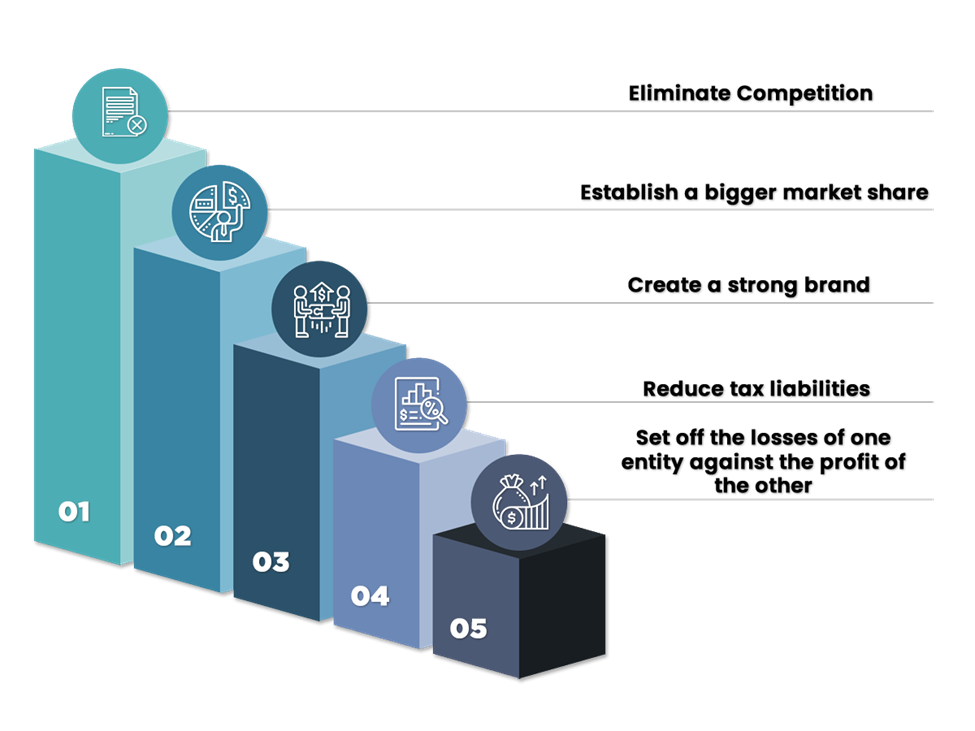
The Merger Proposal:
- It must be approved by the boards of directors of both companies and they must pass a special resolution authorising their Key Management Personnel to carry out the process.
- Then, an application is filed with the respective jurisdiction’s High Court.
- Under the Companies Act 2013, the National Company Law Tribunal (NCLT) is entrusted with the powers of merger, de-merger.
- The merger plan approved by the NCLT can be challenged in the National Company Law Appellate Tribunal (NCLAT) by the dissenting parties (if any).
The NCLT and the NCLAT:
- NCLT is a quasi-judicial body established (2016) under the Companies Act 2013 to adjudicate issues relating to Indian companies.
- It is based on the recommendation of the V. Balakrishna Eradi committee on law relating to the insolvency and the winding up of companies.
- Its bench is chaired by a Judicial member who is supposed to be a retired or a serving HC Judge and a Technical member who must be from the Indian Corporate Law Service.
- It is the adjudicating authority for the insolvency resolution process of companies and limited liability partnerships under the Insolvency and Bankruptcy Code, 2016
- NCLAT is a tribunal formed under the Companies Act 2013 as a body with an appellate jurisdiction on the decisions made by the NCLT.
- No criminal court shall have jurisdiction to entertain any suit or proceeding in respect of any matter which the Tribunal or the Appellate Tribunal is empowered to determine by or under this Act.
News Summary Regarding Zee-Sony Merger:
- Background:
- In 2021, Sony Pictures Networks India and ZEEL entered into a non-binding term sheet to bring together their linear networks, digital assets, production operations, etc.
- As per the scheme of the arrangement, Sony will indirectly hold 50.86% of the combined company.
- The founder of Zee will own around 4% and the rest will be with the other shareholders of ZEEL.
- Apart from the BSE and NSE approval and the Competition Commission of India’s nod, the shareholders of Zee had already given their assent to the merger.
- The NCLT order and challenge:
- The NCLT had directed NSE and BSE to reconsider their prior approvals for the merger of ZEEL and Culver Max Entertainment.
- The NCLT order was challenged by ZEEL before the appellate tribunal, contending that it was not granted adequate opportunity by the NCLT to present its side.
- It also contended that the NCLT doesn’t have jurisdiction over non-compete issues.
- The NCLAT order came on hearing the appeal filed by ZEEL against the order passed by the Mumbai bench of the NCLT.
Q1) What is the Insolvency and Bankruptcy Code, 2016 (IBC)?
It is an Indian law which creates a consolidated framework that governs insolvency and bankruptcy proceedings for companies, partnership firms, and individuals.
Q2) Why was the Company Act 2013 enacted?
The Companies Act 2013 was introduced to improve corporate governance and ease the process of doing business in India by providing business-friendly corporate regulation.
Source: NCLAT gives relief to Zee on Sony merger, sets aside tribunal order

 Last updated on Oct, 2026
→ UPSC 2027 Notification will be released on 13 January 2027 at upsconline.nic.in.
→ Check Nobel Prize 2026 Winners List here.
→ Download PIB PRiSM Monthly Magazine 2026 here.
→ Check UPSC Monthly Current Affairs Magazine The Recitals here.
→ Check out the latest UPSC Syllabus here.
→ Download UPSC Model Answers for Mains 2026
→ UPSC Mains Question Paper 2026 is out now for Essay & GS Paper 1, 2, 3 & 4.
→ UPSC Calendar 2027 has been released.
→ Enroll in Vajiram & Ravi’s UPSC Mains Test Series 2027 for structured answer writing practice, expert evaluation, and exam-oriented feedback.
→ Join Vajiram & Ravi’s UPSC Mentorship Program 2027 for personalized guidance, strategy planning, and one-to-one support from experienced mentors.
→ Go through the UPSC Mains Previous Year Papers to enhance your preparation.
→ UPSC has released UPSC Toppers List 2025 with the Civil Services final result on its official website.
→ Also check Best UPSC Coaching in India








