What’s in today’s article?
- Why in News?
- Need for the Draft Guidelines
- Draft Guidelines for Regulation of Fishing by Indian Flagged Fishing Vessels in the High Seas, 2022
- Concerns Regarding the Draft Guidelines
- Issues raised by the Kerala State Fisheries Coordination Committee
- The Government’s Argument
- Way Ahead
Why in News?
- The Union government had issued draft guidelines on high-seas fishing (fishing in international waters off India coast, beyond the 200 nautical mile jurisdiction) in 2022.
- The Kerala State Fisheries Coordination Committee is getting ready to launch a protest against what it called “anti-fisherman” guidelines for regulating fishing by Indian-flagged vessels on the high seas.
Need for the Draft Guidelines of Fishing :
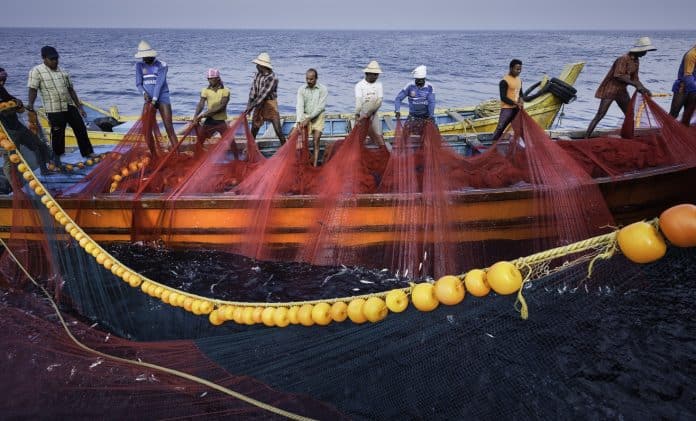
- The notification accepts that marine fisheries are the livelihood of 4 million people in the country, it stresses the need for regulation to avoid over-exploitation and ensure sustainable use of the resources.
- The guidelines are necessary as currently, a considerable number (900+) of Indian vessels are fishing in areas outside the Indian EEZ without any protection or security from the GoI.


The Draft Guidelines for Regulation of Fishing by Indian Flagged Fishing Vessels in the High Seas, 2022:
- Any person engaging in deep sea fishing should obtain a valid permit from the issuing authority.
- The permit fee for boats more than 24m long is Rs 5 lakh while that of boats between 15m and 24m is Rs 1 lakh. The fee for boats between 12m to 15m is Rs 50,000.
- The licence issuing authority is the Union Ministry of Agriculture and Fisheries, and the validity of the permit is two years.
Concerns Regarding the Draft Guidelines of Fishing :
- The regulations are issued as a guideline and not as part of the proposed Indian Marine Fisheries Regulation Act.
- The proposal to issue a permit to all Indian citizens for fishing on the high seas is also unacceptable.
- The licence fee is exorbitant and should be reduced by half so that it does not put a burden on the small-scale fishermen.
- Though the preamble talks highly about the small-scale fishers in India, the guideline goes on to support private players.
Issues raised by the Kerala State Fisheries Coordination Committee:
- The regulation will adversely affect around 650 small-scale deep sea fishing vessels operating from Kochi.
- Handing over the rights of high seas to monopolies would jeopardise the livelihoods of lakhs of traditional and small fishermen and work against the principles of sustainability.
- If the government goes ahead with this policy, there would be strong protests from fishermen’s unions and other stakeholders.
The Government’s Argument:
- The high seas resources are now being exploited by large vessels from countries like Japan, Korea, China, and the EU.
- These resources can be tapped effectively by Indian vessels with permits.
Way Ahead:
- The Union Ministry of Agriculture and Fisheries should cooperate with the fisheries department of respective maritime states for ease of issuing licences and conducting inspections.
- Formation of Regional Fisheries Management Organisation with neighbouring countries.
- Co-operatisation of the high seas fishing instead of corporatising the activities.
- The traditional fishermen want the government to support modernisation of the fishing fleet in existence and to bring them under a vessel monitoring system.
Q1) What is the exclusive economic zone (EEZ)?
It is an area of the ocean, generally extending 200 nautical miles (230 miles) beyond a nation’s territorial sea, within which a coastal nation has jurisdiction over both living and nonliving resources.
Q2) What is the Matsya Sampada Yojana?
It is a flagship scheme for focused and sustainable development of the fisheries sector in India. It will bring about the Blue Revolution by harnessing fisheries’ potential in a sustainable, responsible, inclusive and equitable manner.
Source: New high seas guidelines against our interests, say fishermen | DOF.gov.in

 Last updated on Sep, 2026
→ UPSC 2027 Notification will be released on 13 January 2027 at upsconline.nic.in.
→ Asian Games 2026 are being held in Aichi-Nagoya, Japan, from 19 September to 4 October.
→ Check out the latest UPSC Syllabus here.
→ Download UPSC Model Answers for Mains 2026
→ UPSC Mains Question Paper 2026 is out now for Essay & GS Paper 1, 2, 3 & 4.
→ UPSC Calendar 2027 has been released.
→ Enroll in Vajiram & Ravi’s UPSC Mains Test Series 2027 for structured answer writing practice, expert evaluation, and exam-oriented feedback.
→ Join Vajiram & Ravi’s UPSC Mentorship Program 2027 for personalized guidance, strategy planning, and one-to-one support from experienced mentors.
→ Go through the UPSC Mains Previous Year Papers to enhance your preparation.
→ UPSC has released UPSC Toppers List 2025 with the Civil Services final result on its official website.
→ Also check Best UPSC Coaching in India