What’s in today’s article?
- Why in news?
- What is Artemis programme?
- News Summary: First US lunar lander since 1972 launched
- Key highlights of the mission
Why in news?
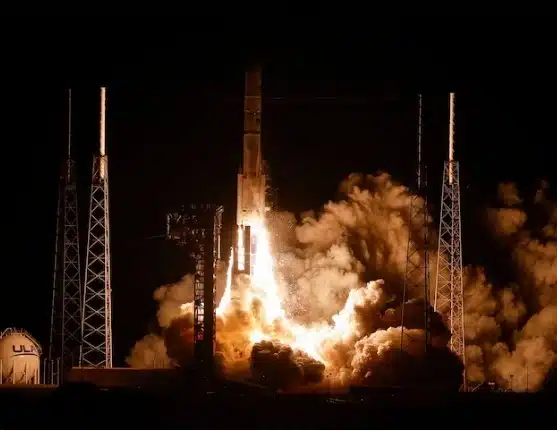
- A spacecraft developed by a private US company and carrying a bunch of scientific instruments from NASA, took off from Florida, USA.
- The aim of this launch is to become the first US spacecraft to land on the Moon in more than 50 years.


Artemis programme
- About
- The Artemis programme is a series of ongoing lunar missions run by NASA.
- Different phases under this programme
- One Artemis mission has already been completed. In late 2022, Artemis 1, an uncrewed test flight, orbited and flew beyond the Moon.
- Artemis 2 will be a crewed flight beyond the Moon which will take humans the farthest they’ve ever been in space.
- Artemis 3 will be the first crewed Moon landing mission since Apollo 17 in 1972.
- NASA aims to land the first female astronaut and first astronaut of colour on the lunar surface.
- They will spend a week on the Moon performing scientific studies, before returning to Earth.
- Artemis 4 will deliver a core part of a new lunar space station (named ‘Gateway’) into orbit around the Moon, and land another two astronauts on the Moon’s surface.
- Artemis 5 will add another important module to Gateway and involve a third crewed lunar landing to undertake further surface science.
- Aim
- It seeks to establish a permanent base camp on the Moon.
- It also aims to send astronauts and robots for longer stays for more comprehensive exploration, and scientific studies of the lunar surface and atmosphere.
- It would also explore opportunities for the utilisation of resources available on the Moon with the ultimate objective of launching deep space missions from the lunar surface.
News Summary: First US lunar lander since 1972 launched
- The first US lunar lander in more than 50 years rocketed to space recently, launching a race for private companies to deliver experiments and other items to the moon.
- If successful, this mission would also involve the first landing of a private spacecraft on the Moon.
- In 2023, a Japanese company had attempted a moon landing with its Hakuto-R mission but was unsuccessful.
- In 2019, the first Israeli attempt to land on the Moon was also engineered by a private company, but the spacecraft, Beresheet, had crash-landed.
Key highlights of the mission
- Involvement of private player
- The Peregrine lander module of the mission, as well as the Vulcan rocket that launched it, have both been built by private space companies in the US.
- The Mission is part of NASA’s Commercial Lunar Payload Services (CLPS) initiative that seeks to involve private space sector in its ambitious Artemis programme.
- This launch was the first under the CLPS initiative.
- Under CLPS, so far, at least 14 private companies have been contracted to carry NASA payloads to the Moon.
- This collaboration is aimed at creating the market and technology ecosystem in the private space industry with respect to science and technology needs of lunar exploration.
- The mission
- Five payloads from NASA sat inside the Peregrine lander that was launched by the Vulcan heavy rocket.
- The payloads are meant to carry out various exploratory activities, including detection of water.
- The spacecraft will take more than 40 days to reach the Moon, and is planned to make a landing on February 23.
- Five payloads from NASA sat inside the Peregrine lander that was launched by the Vulcan heavy rocket.
Q1) What is the Hakuto-R Mission 1 (Hakuto-R M1)?
The Hakuto-R Mission 1 (Hakuto-R M1) was a Japanese lunar landing mission that launched in December 2022. The mission was primarily a technology demonstrator and carried commercial and government payloads, including two lunar rovers. The spacecraft was scheduled to land near Atlas crater in April 2023. However, the mission appears to have crash landed on the surface.
Q)2 What is NASA?
NASA stands for National Aeronautics and Space Administration. It is a US government agency that manages science and technology related to air and space. NASA was established on October 1, 1958, and is responsible for the civil space program, aeronautics research, and space research.
Source: First US lunar lander since 1972 launched: The mission, significance | Royal Museums Greenwich | CNN

 Last updated on Sep, 2026
→ UPSC 2027 Notification will be released on 13 January 2027 at upsconline.nic.in.
→ Asian Games 2026 are being held in Aichi-Nagoya, Japan, from 19 September to 4 October.
→ Check out the latest UPSC Syllabus here.
→ Download UPSC Model Answers for Mains 2026
→ UPSC Mains Question Paper 2026 is out now for Essay & GS Paper 1, 2, 3 & 4.
→ UPSC Calendar 2027 has been released.
→ Enroll in Vajiram & Ravi’s UPSC Mains Test Series 2027 for structured answer writing practice, expert evaluation, and exam-oriented feedback.
→ Join Vajiram & Ravi’s UPSC Mentorship Program 2027 for personalized guidance, strategy planning, and one-to-one support from experienced mentors.
→ Go through the UPSC Mains Previous Year Papers to enhance your preparation.
→ UPSC has released UPSC Toppers List 2025 with the Civil Services final result on its official website.
→ Also check Best UPSC Coaching in India