About Visible Emission Line Coronagraph (VELC):
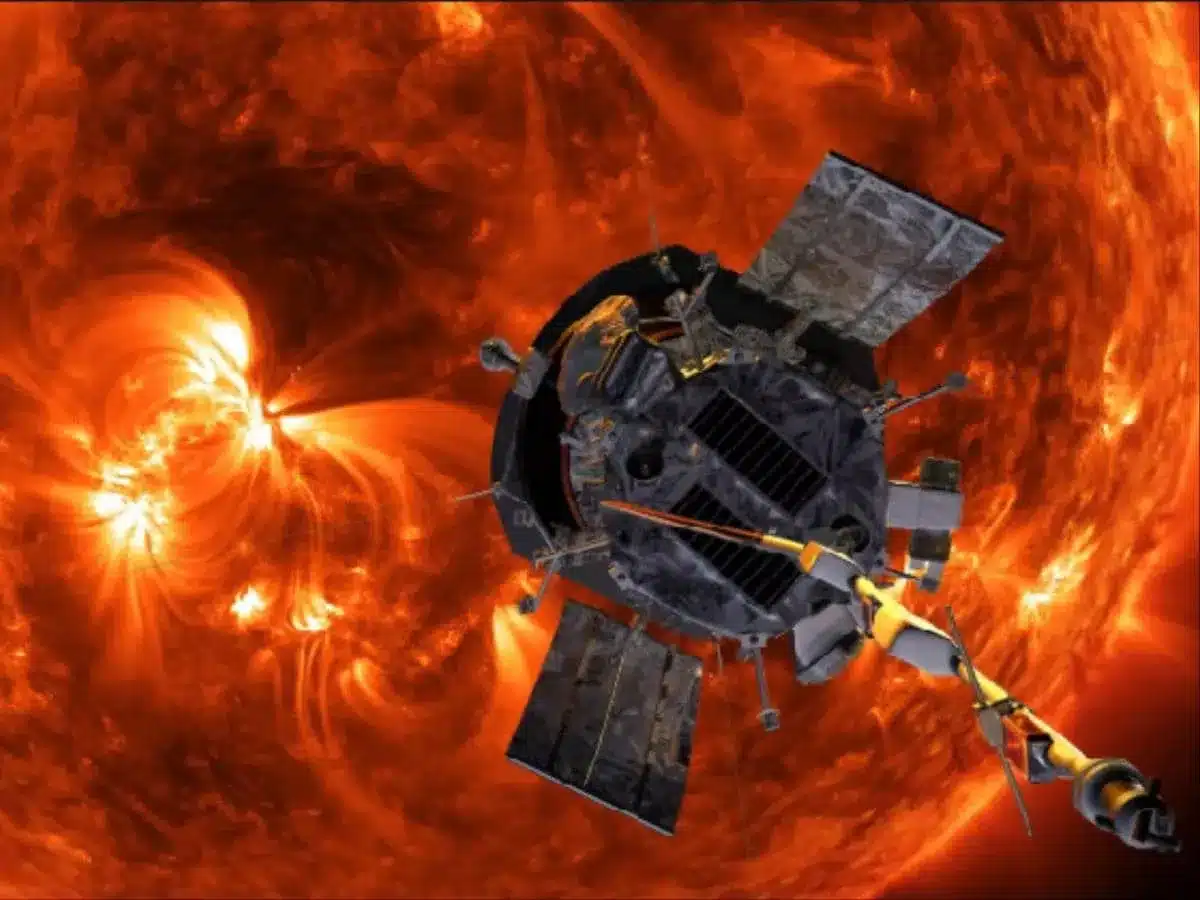
- It is the primary payload of the Aditya-L1 Mission–India’s first mission to observe the Sun from a vantage point 1.5 million kilometres from the earth.
- It is an internally occulted solar coronagraph capable of simultaneous imaging, spectroscopy, and spectro-polarimetry close to the solar limb.
- It is built by the Indian Institute of Astrophysics (IIA) at its CREST (Centre for Research and Education in Science and Technology) campus at Hosakote, Karnataka.
- The VELC consists of a coronagraph, spectrograph, polarimetry module, and detectors, aside from auxiliary optics.
- Purpose:
- It will observe the solar corona, which is the tenuous, outermost layer of the solar atmosphere.
- VELC can image the solar corona down to 1.05 times the solar radius, which is the closest any such payload has imaged.
- It will analyze the coronal temperature, plasma velocity, density, etc.
- It will also study Coronal Mass Ejections (CMEs) and the solar wind.
What is a Coronagraph?
- It is a specialized instrument designed to block out the light of the sun so that researchers can glimpse the burning star’s hot, thin, outermost layer, called the corona.
- The French astronomer Bernard Lyot invented the coronagraph in the 1930s.
- The sun’s corona is normally visible only during solar eclipses, when the moon’s shadow covers the bright central layers of our parent star and allows its dimmer corona to appear.
- A coronagraph mimics this natural phenomenon with a circular mask that sits inside a telescope and selectively blocks the bulk of the sun’s light.
- The specialized coronagraphs act as filters on the central star, allowing the tiny fragments of planetary light to shine through.
Q1: What are Coronal Mass Ejections (CMEs)?
CMEs are large expulsions of plasma and magnetic field from the sun’s atmosphere—the corona, that propagate outward into interplanetary space. During a CME, the sun releases a colossal amount of material, including electrons, protons, and heavier ions, as well as magnetic fields.
News: ‘First significant’ results from payload onboard maiden solar mission Aditya-L1


 Last updated on Sep, 2026
→ UPSC 2027 Notification will be released on 13 January 2027 at upsconline.nic.in.
→ Asian Games 2026 are being held in Aichi-Nagoya, Japan, from 19 September to 4 October.
→ Check out the latest UPSC Syllabus here.
→ Download UPSC Model Answers for Mains 2026
→ UPSC Mains Question Paper 2026 is out now for Essay & GS Paper 1, 2, 3 & 4.
→ UPSC Calendar 2027 has been released.
→ Enroll in Vajiram & Ravi’s UPSC Mains Test Series 2027 for structured answer writing practice, expert evaluation, and exam-oriented feedback.
→ Join Vajiram & Ravi’s UPSC Mentorship Program 2027 for personalized guidance, strategy planning, and one-to-one support from experienced mentors.
→ Go through the UPSC Mains Previous Year Papers to enhance your preparation.
→ UPSC has released UPSC Toppers List 2025 with the Civil Services final result on its official website.
→ Also check Best UPSC Coaching in India