What’s in Today’s Article?
- Understanding Exchange Rate Regimes
- India’s Exchange Rate Policy
- Implications of Rupee Devaluation
- Structural Constraints in the Indian Economy
- Policy Questions and Challenges
- Conclusion
Why in News?
- The Indian rupee recently witnessed a sharp devaluation against the dollar after a period of relative stability post-COVID.
- This article examines India’s exchange rate policies, structural constraints in the economy, and the broader implications of rupee depreciation.


Understanding Exchange Rate Regimes:
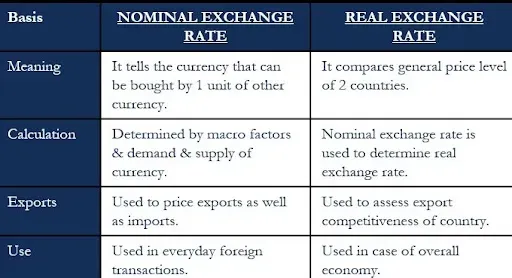
- Nominal and Real Exchange Rates: The nominal exchange rate is the official exchange rate that doesn’t account for inflation, while the real exchange rate is the nominal exchange rate adjusted for inflation.
- Determinants of Exchange Rates:
- Current Account: Influenced by net exports.
- Capital Account: Driven by foreign investment flows.
- Impact: Demand for foreign currency increases with a higher current account deficit and capital outflow.
- Types of Exchange Rate regimes:
- Fixed Exchange Rate: Central bank maintains a constant exchange rate by managing reserves.
- Floating Exchange Rate: Market-driven exchange rate with no central bank intervention.
- Managed-Floating Exchange Rate: A mix of market forces and central bank intervention.
India’s Exchange Rate Policy:
- Past trends:
- India has primarily followed a managed-float regime for three decades.
- From 2010, the Reserve Bank of India (RBI) managed the rupee asymmetrically:
- Under excess demand: Depreciated the rupee and sold foreign reserves.
- Under excess supply: Accumulated reserves to avoid appreciation.
- Post-COVID shifts:
- Between 2022 and late 2024, the RBI temporarily adopted a fixed exchange rate-like regime to stabilize the rupee.
- Recent sharp devaluation suggests a return to the managed-float approach, driven by:
- Capital outflows.
- Rising import costs amid high crude oil prices.
Implications of Rupee Devaluation:

- Positive effects:
- Boosting exports: Depreciation can make domestic goods cheaper, enhancing export competitiveness if:
- Net exports respond positively to a weaker real exchange rate.
- Nominal depreciation leads to real depreciation.
- Boosting exports: Depreciation can make domestic goods cheaper, enhancing export competitiveness if:
- Adverse effects:
- Inflationary pressures: Increased import costs raise domestic prices.
- Reduced purchasing power: Firms pass on higher costs to consumers, squeezing real incomes.
Structural Constraints in the Indian Economy:
- Divergence between NEER and REER:
- These indices reflect the weighted average exchange rate of India with respect to its multiple trade partners.
- According to the definitions of these indices, any increase or positive change indicates appreciation, whereas any drop or negative change indicates depreciation.
- Since the mid-2010s, the nominal effective exchange rate (NEER) has depreciated, while the real effective exchange rate (REER) has appreciated.
- This divergence undermines export competitiveness, as higher domestic prices offset the benefits of nominal depreciation.
- Rising markups:
- Non-financial firms have increased markups (ratio of output price to variable costs), contributing to domestic price inflation.
- Key cost drivers include raw materials, labor, fuel, and indirect taxes.
Policy Questions and Challenges:
- Policy dilemmas:
- Should India revert to the managed-float regime of the 2010s or adopt a new framework?
- How can policy address inflationary pressures while maintaining export competitiveness?
- RBI’s role:
- The RBI’s recent ad hoc policy shifts highlight the need for a systematic exchange rate strategy.
- Clearer objectives and consistent communication are essential for addressing current challenges.
Conclusion:
- The devaluation of the rupee underscores structural vulnerabilities in the Indian economy and raises critical questions about the future of exchange rate policy.
- A nuanced approach that balances inflation control with export growth is vital for sustainable economic recovery.
Q.1. What do you mean by currency depreciation?
Currency depreciation is when a currency’s value decreases in relation to another currency. This happens in a floating exchange rate system, where the value of a currency is determined by supply and demand in the forex market.
Q.2. What is the difference between currency depreciation and currency devaluation?
Currency depreciation is a natural decrease in a currency’s value, while devaluation is a deliberate government action to reduce the value of a currency.
Source: TH

 Last updated on Sep, 2026
→ UPSC 2027 Notification will be released on 13 January 2027 at upsconline.nic.in.
→ Asian Games 2026 are being held in Aichi-Nagoya, Japan, from 19 September to 4 October.
→ Check out the latest UPSC Syllabus here.
→ Download UPSC Model Answers for Mains 2026
→ UPSC Mains Question Paper 2026 is out now for Essay & GS Paper 1, 2, 3 & 4.
→ UPSC Calendar 2027 has been released.
→ Enroll in Vajiram & Ravi’s UPSC Mains Test Series 2027 for structured answer writing practice, expert evaluation, and exam-oriented feedback.
→ Join Vajiram & Ravi’s UPSC Mentorship Program 2027 for personalized guidance, strategy planning, and one-to-one support from experienced mentors.
→ Go through the UPSC Mains Previous Year Papers to enhance your preparation.
→ UPSC has released UPSC Toppers List 2025 with the Civil Services final result on its official website.
→ Also check Best UPSC Coaching in India