Bullseye Galaxy Latest News
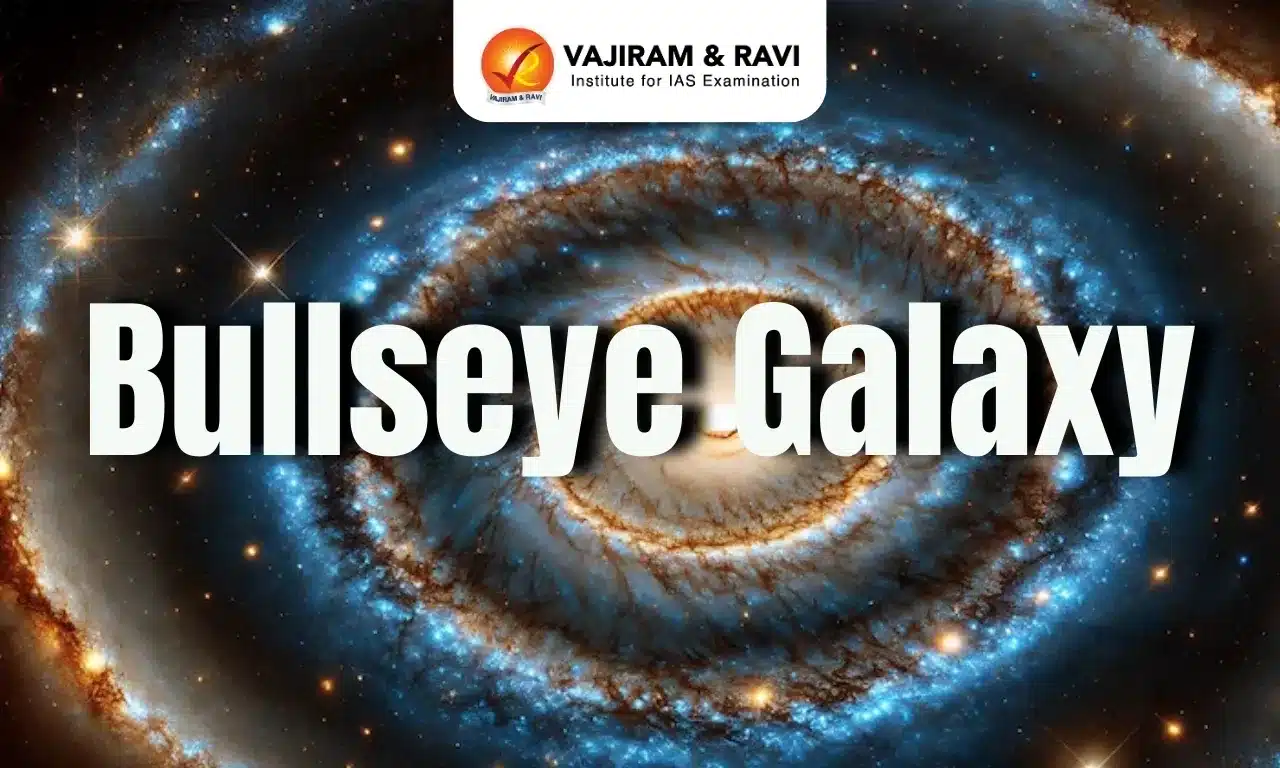
The Bullseye Galaxy (LEDA 1313424) was recently discovered by an international team of researchers using the Hubble Space Telescope and W.M. Keck Observatory.
About Bullseye Galaxy
- The Bullseye Galaxy (LEDA 1313424) is a collisional ring galaxy (CRG) located approximately 534 million light-years away in the constellation Pisces..
- The galaxy’s distinct ringed structure is believed to have formed approximately 50 million years ago due to a head-on collision with a blue dwarf galaxy.
- This head-on collision is believed to have caused rippling gas waves, leading to star formation in ring-like patterns.
- This discovery was termed “serendipitous” as ringed galaxies usually have only two or three rings.
- Observed Through Multiple Telescopes:
- The Hubble Space Telescope confirmed eight rings.
- The W.M. Keck Observatory in Hawaii confirmed a ninth ring, revealing the full structure.
- The Bullseye Galaxy spans 250,000 light-years in diameter — nearly 2.5 times larger than the Milky Way. Despite a current separation of 130,000 light-years, a thin trail of gas still connects it to the colliding dwarf galaxy.
- The Bullseye may evolve into a Giant Low Surface Brightness (GLSB) Galaxy, a rare, massive galaxy type believed to hold clues about dark matter.
- Giant Low Surface Brightness (GLSB) Galaxy features:
- Composed of diffuse, low-density stellar disks.
- Contain large amounts of neutral hydrogen but exhibit low star formation rates.
- Include examples like Malin 1, which is 6.5 times wider than the Milky Way.
- GLSB galaxies are believed to be rich in dark matter, and their unusual mass distribution challenges the Standard Model of Cosmology.
- These galaxies display a uniform central mass instead of a dense core, suggesting discrepancies in current models.
Source: TH


 Last updated on Sep, 2026
→ UPSC 2027 Notification will be released on 13 January 2027 at upsconline.nic.in.
→ Asian Games 2026 are being held in Aichi-Nagoya, Japan, from 19 September to 4 October.
→ Check out the latest UPSC Syllabus here.
→ Download UPSC Model Answers for Mains 2026
→ UPSC Mains Question Paper 2026 is out now for Essay & GS Paper 1, 2, 3 & 4.
→ UPSC Calendar 2027 has been released.
→ Enroll in Vajiram & Ravi’s UPSC Mains Test Series 2027 for structured answer writing practice, expert evaluation, and exam-oriented feedback.
→ Join Vajiram & Ravi’s UPSC Mentorship Program 2027 for personalized guidance, strategy planning, and one-to-one support from experienced mentors.
→ Go through the UPSC Mains Previous Year Papers to enhance your preparation.
→ UPSC has released UPSC Toppers List 2025 with the Civil Services final result on its official website.
→ Also check Best UPSC Coaching in India
Bullseye Galaxy FAQs
Q1. What is the Bullseye Galaxy?+
Q2. How far is the Bullseye Galaxy from Earth?+
Tags: bullseye galaxy prelims pointers upsc prelims current affairs