Lagrangian Growth Advection Model Latest News
Researchers from the Monterey Bay Aquarium Research Institute (MBARI) and Florida State University have developed a new method to estimate oceanic carbon export using satellite data.
About Lagrangian Growth-Advection Model
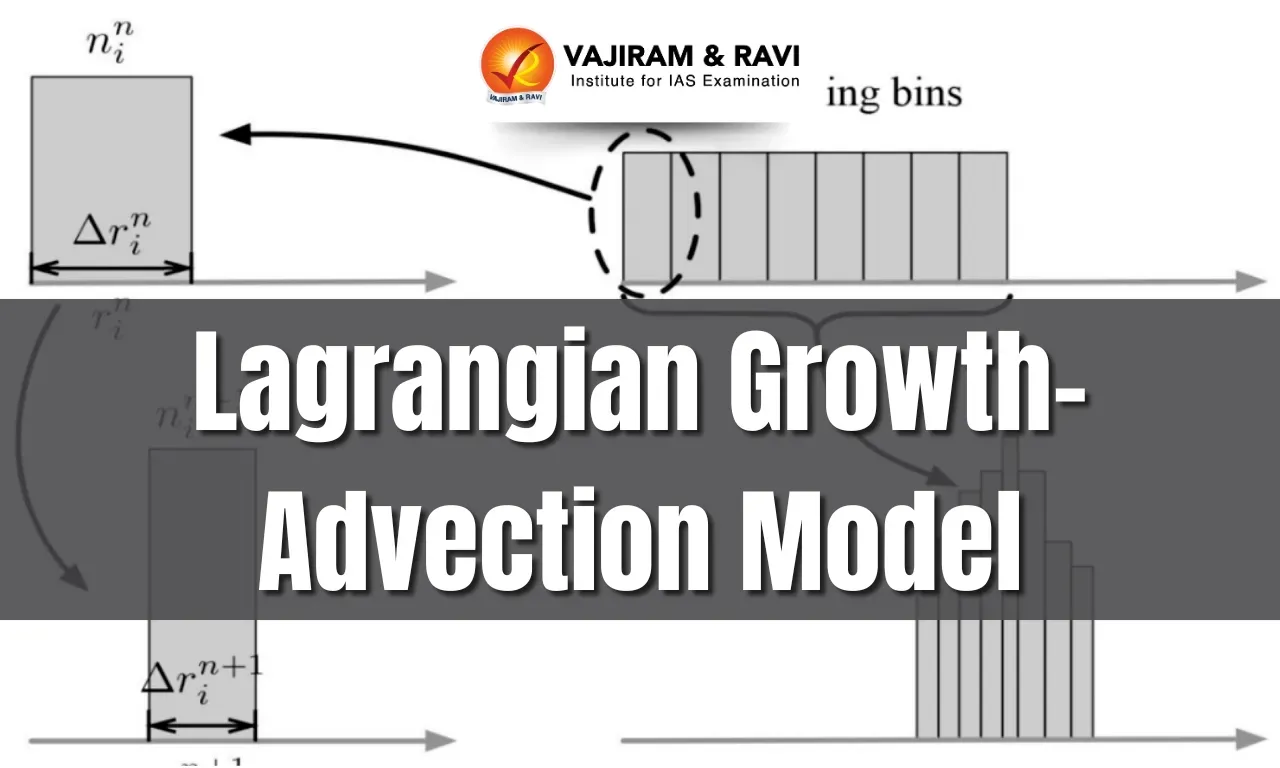
- A Lagrangian Growth-Advection Model combines Lagrangian methods, which track individual fluid particles, with the concept of advection (the movement of a fluid) and growth (changes in a particle’s properties).
- It maps phytoplankton succession and carbon export by following surface ocean currents, particularly in upwelling regions like the California Current.
- Key Innovations:
- Incorporates spatial and temporal lags between carbon production and export.
- Accounts for zooplankton activity, ocean advection (movement of plankton), and biological succession.
- Does not rely solely on ocean color, providing a complementary alternative.
- Performance and Validation: The new model’s predictions matched results from deep-sea carbon monitoring, such as those at Station M (a long-term MBARI seafloor observatory).
- Pulses of carbon flux observed previously, unexplained by earlier models, are better captured by this approach.
- The ocean absorbs a significant portion of atmospheric CO₂, playing a key role in regulating Earth’s climate.
- Marine organisms convert dissolved CO₂ into organic carbon, which eventually sinks to the deep ocean, a process known as carbon sequestration via the biological pump.
- Existing satellite-based models depend primarily on ocean colour data, which measures phytoplankton productivity via surface chlorophyll concentrations. However, these models fail to account for subsurface and temporal lags in carbon transfer.
Lagrangian Growth-Advection Model FAQs
Q1. What is the Lagrangian Growth-Advection Model used for?
Ans. It is used in oceanography and climate modelling to simulate the movement and growth of biological or chemical tracers in ocean currents.
Q2. What does “Lagrangian” refer to in this model?
Ans. “Lagrangian” refers to tracking the movement of individual particles or water parcels as they flow with ocean currents.
Source: PHY


 Last updated on Oct, 2026
→ UPSC 2027 Notification will be released on 13 January 2027 at upsconline.nic.in.
→ Check Nobel Prize 2026 Winners List here.
→ Download PIB PRiSM Monthly Magazine 2026 here.
→ Check UPSC Monthly Current Affairs Magazine The Recitals here.
→ Check out the latest UPSC Syllabus here.
→ Download UPSC Model Answers for Mains 2026
→ UPSC Mains Question Paper 2026 is out now for Essay & GS Paper 1, 2, 3 & 4.
→ UPSC Calendar 2027 has been released.
→ Enroll in Vajiram & Ravi’s UPSC Mains Test Series 2027 for structured answer writing practice, expert evaluation, and exam-oriented feedback.
→ Join Vajiram & Ravi’s UPSC Mentorship Program 2027 for personalized guidance, strategy planning, and one-to-one support from experienced mentors.
→ Go through the UPSC Mains Previous Year Papers to enhance your preparation.
→ UPSC has released UPSC Toppers List 2025 with the Civil Services final result on its official website.
→ Also check Best UPSC Coaching in India
Tags: Lagrangian Growth-Advection Model prelims pointers upsc prelims current affairs