First-Person View Drones Latest News
Recently, Ukraine used First-person view drones to attack Russia and destroyed more than 40 planes.
About First-Person View Drones
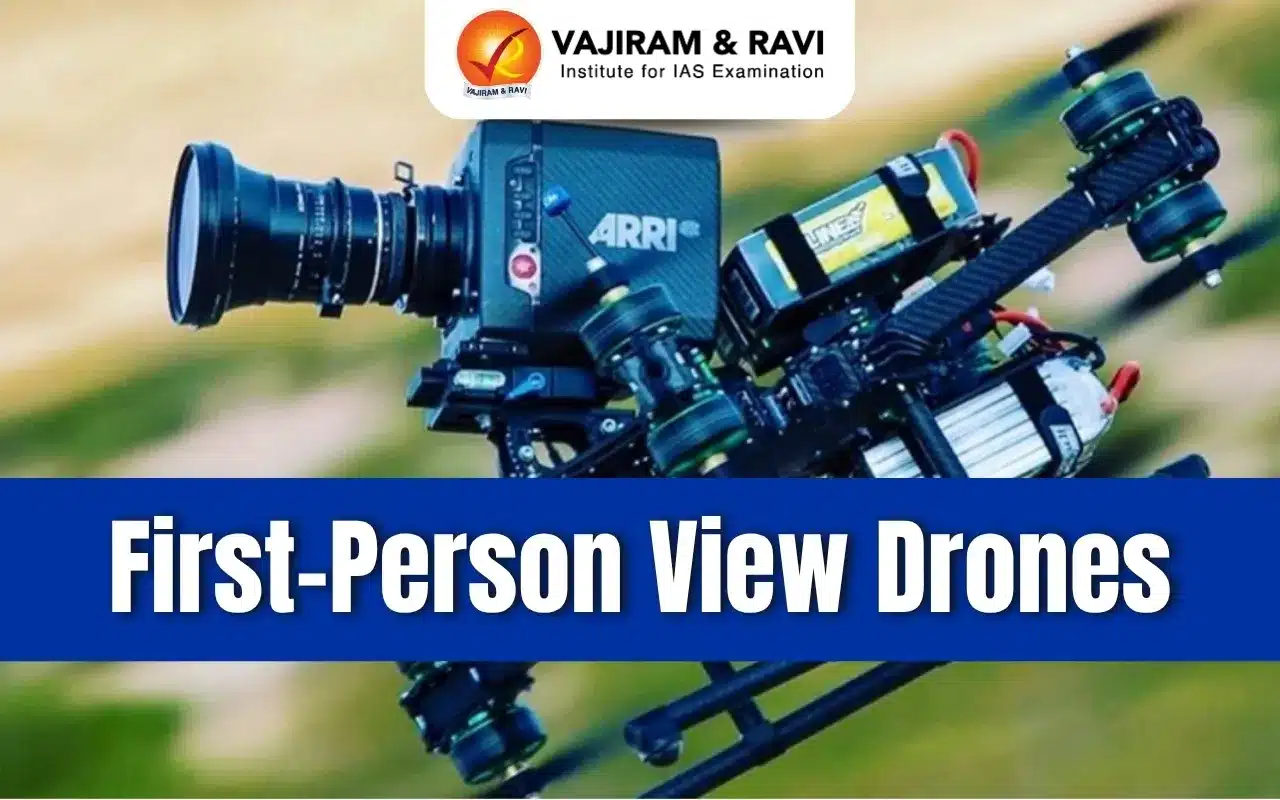
- These drones are unmanned aerial vehicles enhanced with artificial intelligence to perform advanced tasks with greater precision and autonomy.
- By processing real-time video data through AI algorithms, FPV drones are able to avoid obstacles, and carry out mission-specific operations such as surveillance and search and rescue.
- First-person view (FPV) means that a person piloting a drone can see what the drone sees, through a camera attached to its body.
- The live video can be seen through specialised goggles, or on smartphones and other kinds of screens, and the drone can be manoeuvred remotely.
- Before FPV drones are deployed, a reconnaissance drone with a larger range first goes to survey the area and zero in on a specific region that needs to be targeted.
- FPV drones have a much smaller range, of a few kilometres.
- Advantage: The key advantages are cost and deep strike capabilities while remaining largely undetected.
- Challenge: One major challenge is that the drones’ movement through their surroundings cannot be seen by the drone operator.
- This can limit situational awareness and may lead to disorientation. At times, another person, a visual observer, may be needed to guide the person controlling the drone.
- Uses: Such drones are also used in filming and other non-defence purposes.


Features of First-Person View Drones
- GPS-independent navigation: Operates without relying on satellite-based GPS, enhancing resilience against jamming or signal loss.
- SmartPilot system: Utilises advanced visual-inertial navigation, interpreting camera data to determine position and movement.
- LiDAR technology: LiDAR technology complements the SmartPilot system, boosting precision in complex or cluttered environments.
First-Person View Drones FAQs
Q1: What is a nano drone?
Ans: A nano drone is a type of unmanned aerial vehicle (UAV) that typically weighs less than 250 grams and measures less than 20 centimeters in size.
Q2: What is a drone used for?
Ans: Drones now have many functions, ranging from monitoring climate change to carrying out search operations after natural disasters, photography, filming, and delivering goods.
Source: IE

 Last updated on Oct, 2026
→ UPSC 2027 Notification will be released on 13 January 2027 at upsconline.nic.in.
→ Check Nobel Prize 2026 Winners List here.
→ Download PIB PRiSM Monthly Magazine 2026 here.
→ Check UPSC Monthly Current Affairs Magazine The Recitals here.
→ Check out the latest UPSC Syllabus here.
→ Download UPSC Model Answers for Mains 2026
→ UPSC Mains Question Paper 2026 is out now for Essay & GS Paper 1, 2, 3 & 4.
→ UPSC Calendar 2027 has been released.
→ Enroll in Vajiram & Ravi’s UPSC Mains Test Series 2027 for structured answer writing practice, expert evaluation, and exam-oriented feedback.
→ Join Vajiram & Ravi’s UPSC Mentorship Program 2027 for personalized guidance, strategy planning, and one-to-one support from experienced mentors.
→ Go through the UPSC Mains Previous Year Papers to enhance your preparation.
→ UPSC has released UPSC Toppers List 2025 with the Civil Services final result on its official website.
→ Also check Best UPSC Coaching in India
Tags: first-person view drones prelims pointers upsc current affairs upsc prelims current affairs