Kounis Syndrome Latest News
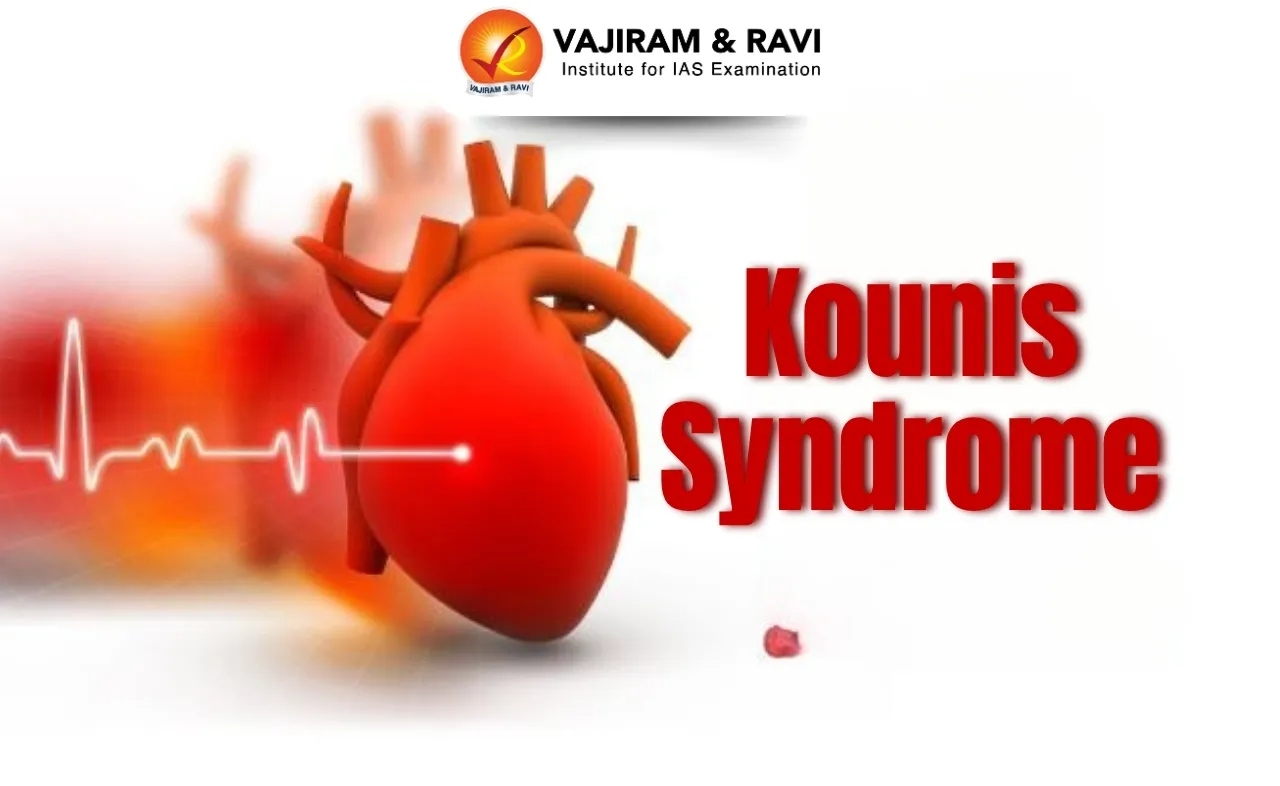
Recently, a prominent Indian industrialist died due to bee sting which raised questions about rare allergic reactions named Kounis Syndrome and sudden heart attacks in healthy adults.
About Kounis Syndrome
- It is a rare medical condition where an allergic reaction triggers a heart problem.
- It is classified as a form of acute coronary syndrome (ACS)–a term typically used for conditions like heart attacks–brought on by an allergic or hypersensitivity response.
- It is sometimes referred to as allergic angina or allergic myocardial infarction.
- It occurs when a person is exposed to a trigger–such as an insect sting, drug, or food–the body’s immune system activates mast cells, which release chemicals including histamine and cytokines.
- These substances cause sudden spasm or tightening of coronary arteries, may rupture or erode existing plaque, worsening any blockages and reduce blood flow to the heart, leading to ischemia (lack of oxygen) or infarction (tissue death).
- Symptoms: Chest pain, Rash, hives, or swelling (angioedema), shortness of breath or wheezing, low blood pressure, ECG changes such as ST-segment elevation or depression


Types of Kounis Syndrome
- Type I: Occurs in individuals with normal coronary arteries. The allergic reaction causes spasms, reducing blood flow and potentially leading to a heart attack.
- Type II: Affects those with existing coronary disease. The allergic reaction destabilises plaques, causing rupture and a full heart attack.
- Type III: Seen in patients with coronary stents. The allergic response may lead to clot formation within the stent.
What can Trigger it?
- Insect stings or bites (such as bees and wasps)
- Certain medications, particularly antibiotics and NSAIDs (painkillers)
- Foods, such as shellfish, nuts, or kiwi
- Environmental allergens such as latex or contrast dyes
- Underlying health conditions like mastocytosis (a disorder involving excess mast cells)
Treatment for Kounis Syndrome
- For the allergic reaction: antihistamines, corticosteroids, and sometimes epinephrine is given
- For the heart: standard cardiac care like oxygen, nitrates, and blood thinners
Source: FE

 Last updated on August, 2026
→ UPSC Mains Question Paper 2026 is out now for Essay & GS Paper 1, 2, 3 & 4.
→ UPSC Mains GS Paper 1 2026 is out now.
→ UPSC Mains GS Paper 2 2026 is out now.
→ UPSC Mains GS Paper 3 2026 is out now.
→ UPSC Mains GS Paper 4 2026 is out now.
→ UPSC Mains Indian Language Paper & English Compulsory Paper are out now.
→ Check out the latest UPSC Syllabus 2026 here.
→ UPSC Mains Admit Card 2026 is now out.
→ Enroll in Vajiram & Ravi’s UPSC Mains Test Series 2027 for structured answer writing practice, expert evaluation, and exam-oriented feedback.
→ Join Vajiram & Ravi’s UPSC Mentorship Program 2027 for personalized guidance, strategy planning, and one-to-one support from experienced mentors.
→ Go through the UPSC Mains Previous Year Papers to enhance your preparation.
→ Download UPSC Mains Essay Paper 2025, UPSC Mains GS Paper-I 2025, UPSC Mains GS Paper-II 2025, UPSC Mains GS Paper-III 2025, UPSC Mains GS Paper-IV 2025, UPSC Mains English (Compulsory) Paper 2025, UPSC Mains Hindi (Qualifying) Paper 2025 here.
→ UPSC has released UPSC Toppers List 2025 with the Civil Services final result on its official website.
→ UPSC Calendar 2027 has been released.
→ Also check Best UPSC Coaching in India
Kounis Syndrome FAQs
Q1. What drugs cause Kounis syndrome?+
Q2. What is the pathology of Kounis syndrome?+
Q3. What is histamine and its function?+
Tags: kounis syndrome prelims pointers upsc current affairs upsc prelims current affairs