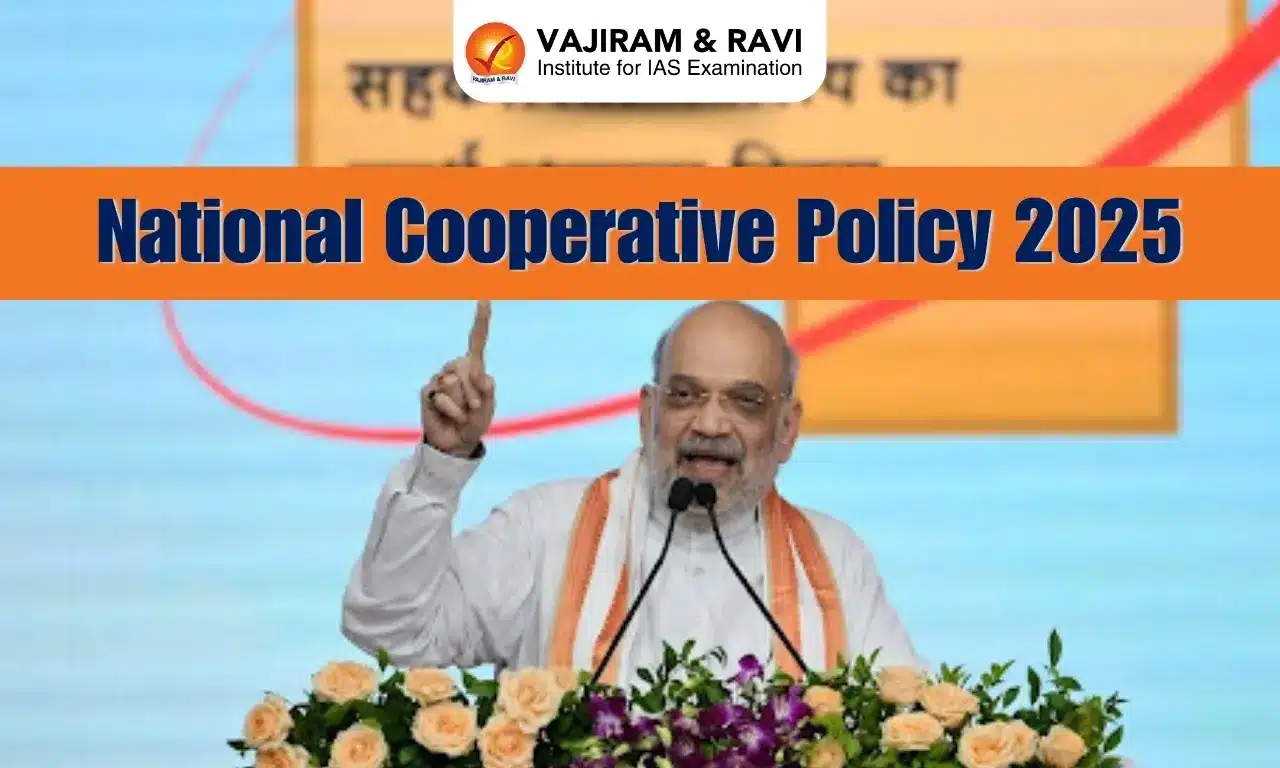
National Cooperative Policy 2025 Latest News
- Union Home Minister Amit Shah has unveiled a new national cooperative policy, replacing one in place for the past 23 years.
National Cooperative Policy 2025
- Union Home and Cooperation Minister Amit Shah launched the National Cooperative Policy 2025 in New Delhi, replacing the earlier framework introduced in 2002.
- The policy aims to strengthen the cooperative sector’s institutional capacity, expand its reach into new areas, and align its role with India’s broader development goals.
- Anchored in the vision of Sahkar se Samriddhi (Prosperity through Cooperation), the policy outlines a roadmap for the sector’s growth over the next 20 years, focusing on inclusivity, transparency, technological adoption, and village-level economic empowerment.


Political and Historical Context
- The National Cooperative Policy 2025 comes after a 23-year gap since the last policy was announced in 2002.
- The Union government’s decision to create a separate Ministry of Cooperation in 2021 signalled a renewed commitment to revitalising this sector.
- With over 8.4 lakh cooperative societies (and a target to increase this by 30%), the sector reaches over 31 crore people, especially in states like Maharashtra and Gujarat.
- The policy also seeks to expand this network into other states like Uttar Pradesh and Bihar, thereby decentralising political and economic benefits.
Key Features of the Policy
- The new policy is structured around six pillars:
- Strengthening foundational systems
- Promoting vibrancy in existing cooperatives
- Preparing for future challenges through digitalisation and innovation
- Enhancing inclusivity and outreach
- Expanding into emerging sectors
- Engaging youth and building capacity for future generations
- It aims to increase the sector’s contribution to GDP threefold by 2034, establish at least one cooperative society in every village, and bring 50 crore citizens into active cooperative participation.
Expanding into New Sectors
- Under the new policy, cooperatives will now be supported in non-traditional sectors, including:
- Green energy
- Tourism
- Taxi services (Sahkar Taxi)
- Insurance
- PACS (Primary Agricultural Credit Societies) are being enabled to undertake diversified activities like managing fuel outlets, LPG distribution, Jan Aushadhi Kendras, CSCs, and even implementing schemes such as Har Ghar Jal and PM Surya Ghar Yojana.
- A dedicated roadmap has been prepared for sector-specific cooperative development, particularly in rural India.
Model Cooperative Villages and Rural Integration
- A major highlight is the Model Cooperative Village initiative. Every tehsil will host five such villages, implemented in coordination with state cooperative banks and NABARD.
- These villages will be centres of excellence in cooperative-led development, integrating:
- Dairy
- Fishery
- Floriculture
- Agri-services
- Women and tribal participation (via White Revolution 2.0)
- The goal is to localise economic activity while fostering inclusive growth and community ownership.
Institutional Strengthening and Reforms
- To ensure efficiency and transparency, the policy mandates:
- Full computerisation of PACS operations
- Technology-driven governance for all types of cooperatives
- Cluster monitoring systems for institutional tracking
- Legal reviews every 10 years to keep policy aligned with evolving needs
- As of 2025, over 83 intervention points have been identified for reform, 58 implemented, three completed, and others underway.
- Additionally, a nationwide cooperative university (Tribhuvan Sahkari University) has been established for professional training and capacity building.
Economic Impact and Inclusive Vision
- The cooperative sector currently contributes significantly to India’s rural economy:
- 20% of the total agricultural credit
- 35% of fertiliser distribution
- Over 30% of sugar and 10% of milk production
- Over 21% of the fishing sector
- 13% of wheat and 20% of paddy procurement
- With these foundations, the policy envisions a member-centric model where even the smallest cooperative units become self-reliant and future-ready, contributing to employment generation, income stability, and social dignity.

 Last updated on Sep, 2026
→ UPSC 2027 Notification will be released on 13 January 2027 at upsconline.nic.in.
→ Asian Games 2026 are being held in Aichi-Nagoya, Japan, from 19 September to 4 October.
→ Check out the latest UPSC Syllabus here.
→ Download UPSC Model Answers for Mains 2026
→ UPSC Mains Question Paper 2026 is out now for Essay & GS Paper 1, 2, 3 & 4.
→ UPSC Calendar 2027 has been released.
→ Enroll in Vajiram & Ravi’s UPSC Mains Test Series 2027 for structured answer writing practice, expert evaluation, and exam-oriented feedback.
→ Join Vajiram & Ravi’s UPSC Mentorship Program 2027 for personalized guidance, strategy planning, and one-to-one support from experienced mentors.
→ Go through the UPSC Mains Previous Year Papers to enhance your preparation.
→ UPSC has released UPSC Toppers List 2025 with the Civil Services final result on its official website.
→ Also check Best UPSC Coaching in India
National Cooperative Policy 2025 FAQs
Q1. What is the National Cooperative Policy 2025?+
Q2. What are the key goals of the policy?+
Q3. What new sectors will cooperatives now operate in?+
Q4. What is the Model Cooperative Village initiative?+
Q5. How will transparency be ensured in cooperatives?+
Tags: mains articles national cooperative policy 2025 upsc current affairs upsc mains current affairs