India-U.S. Trade Standoff Escalates Latest News
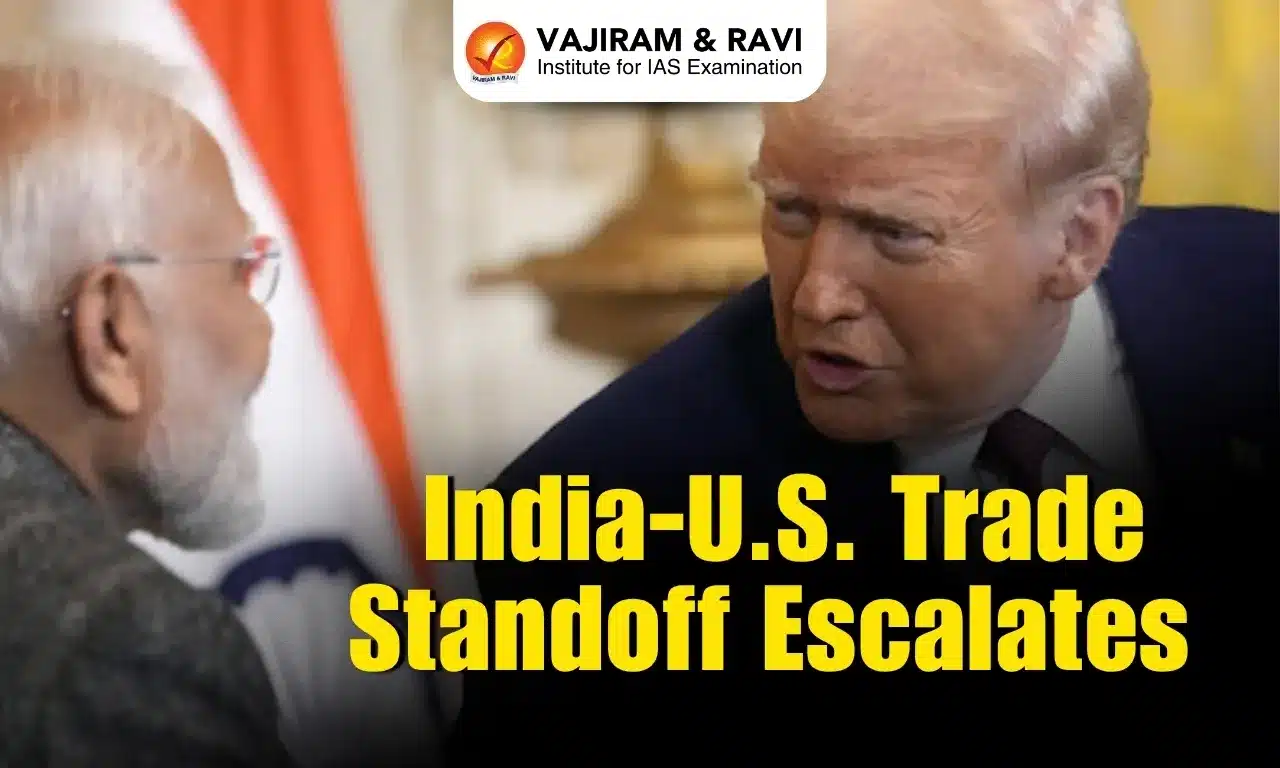
- U.S. President Donald Trump’s imposition of a 25% tariff on Indian imports, along with a potential 100% penalty for India’s continued purchase of Russian oil and defense equipment, comes just ahead of the August 1 deadline to finalize a bilateral trade deal.
- As a result, India-U.S. trade standoff escalates, putting ongoing trade negotiations at risk, and complicating India’s trade positioning vis-à-vis its global competitors, especially China.
Background – U.S.-India Trade Relations
- Ongoing negotiations: India and the U.S. have been in talks since February 2025 to finalize a Bilateral Trade Agreement (BTA) aimed at establishing a mutually beneficial trade framework.
- Mini-deal attempts:
- Alongside the broader BTA, efforts were underway to create a “mini-deal” to roll back retaliatory tariffs.
- However, this deal has not materialized before the U.S.-imposed deadline of August 1.


New Tariff Measures
- Announcement by U.S. President: Trump declared a 25% tariff and an unspecified “penalty” on Indian imports, effective August 1, 2025.
- Reasons cited:
- High Indian tariffs and non-tariff barriers.
- India’s continued defense and energy purchases from Russia (India is the second-largest buyer of Russian oil after China).
- Geopolitical concerns over India’s ties with Russia during the Ukraine conflict.
- Penalty tied to Trump’s pressure campaign to force countries to reduce dependence on sanctioned Russian oil and arms.
- Public statement: Trump criticized India’s trade practices on Truth Social, labeling them “strenuous and obnoxious.”
India’s Response
- Commerce Ministry reaction: The Indian government is “studying the implications” and reiterated its commitment to a fair and balanced trade agreement.
- Protection of domestic interests: The ministry emphasized safeguarding the interests of farmers, MSMEs, and entrepreneurs, drawing parallels with its stance during the India-UK Comprehensive Economic and Trade Agreement (CETA) negotiations.
Global Context – Trump’s Retaliatory Trade Policy
- Liberation day tariffs: In April 2025, Trump imposed blanket tariffs on countries he accused of levying disproportionately high tariffs on U.S. goods.
- 90-day pause and bilateral deals: A pause was provided to negotiate individual deals. Agreements were reached with –
- UK: Reduced car tariffs to 10% and removed aerospace tariffs
- Indonesia & Philippines: 19% tariff
- Japan & EU: 15% tariff
- India left out: India’s inability to secure a deal has now subjected it to higher tariffs and potential trade isolation.
Key Concerns for India
- Strategic autonomy vs. trade realpolitik: The case underscores challenges India faces in balancing strategic autonomy (especially defense and energy ties with Russia) and economic pragmatism in dealing with major powers.
- China’s first-mover advantage:
- China has already concluded advanced-stage negotiations and could secure better terms, including waivers on secondary tariffs.
- China cut tariffs on U.S. goods from 125% to 10%; the U.S. reciprocated by cutting tariffs from 145% to 30%.
- Impact on MSMEs and agriculture: Heightened tariffs may affect exports from India’s MSME sector and agricultural goods, which are highly price-sensitive.
- Growing trend of bilateralism: This episode highlights the growing trend of bilateralism in global trade and the declining relevance of multilateral platforms like the WTO.
Conclusion
- India stands at a crossroads where principled trade diplomacy is tested against economic imperatives.
- While New Delhi’s refusal to accept a one-sided deal has protected key domestic sectors, the pressure to conclude a deal has intensified due to mounting external tariffs and strategic maneuvering by China.
- The final shape of the India-U.S. deal may now hinge on top-level intervention, especially a conversation between PM Modi and President Trump, with the goal of minimizing economic damage while preserving strategic interests.

 Last updated on Oct, 2026
→ UPSC 2027 Notification will be released on 13 January 2027 at upsconline.nic.in.
→ Check Nobel Prize 2026 Winners List here.
→ Download PIB PRiSM Monthly Magazine 2026 here.
→ Check UPSC Monthly Current Affairs Magazine The Recitals here.
→ Check out the latest UPSC Syllabus here.
→ Download UPSC Model Answers for Mains 2026
→ UPSC Mains Question Paper 2026 is out now for Essay & GS Paper 1, 2, 3 & 4.
→ UPSC Calendar 2027 has been released.
→ Enroll in Vajiram & Ravi’s UPSC Mains Test Series 2027 for structured answer writing practice, expert evaluation, and exam-oriented feedback.
→ Join Vajiram & Ravi’s UPSC Mentorship Program 2027 for personalized guidance, strategy planning, and one-to-one support from experienced mentors.
→ Go through the UPSC Mains Previous Year Papers to enhance your preparation.
→ UPSC has released UPSC Toppers List 2025 with the Civil Services final result on its official website.
→ Also check Best UPSC Coaching in India
India-U.S. Trade Standoff Escalates FAQs
Q1. How do U.S. tariffs affect India's strategic autonomy and trade stance?+
Q2. Are India's tariffs and trade practices WTO-compliant?+
Q3. What is the likely economic impact of U.S. tariffs on India?+
Q4. How do China’s trade talks with the U.S. affect India?+
Q5. What may India offer in an interim trade deal with the U.S.?+
Tags: India-u.s. trade standoff escalates