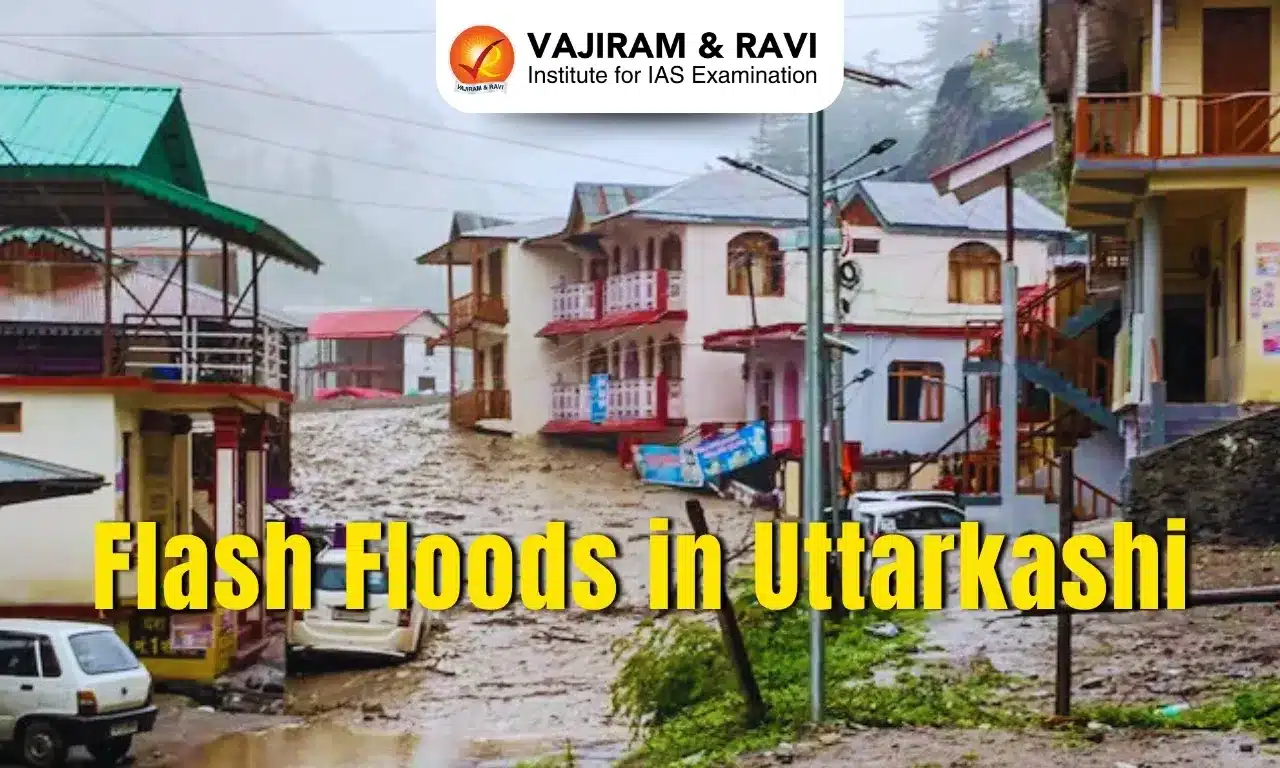
Flash Floods in Uttarkashi Latest News
- At least four people died as flash floods and mudslides struck Dharali village in Uttarkashi, Uttarakhand, damaging several buildings, shops, and hotels.
- While cloudbursts are common triggers of flash floods in Uttarakhand’s hilly regions, the recent incident was not due to a technical cloudburst but rather sustained heavy rainfall over the past three days.
- The region’s topography, prone to landslides during intense rains, caused mud and debris to surge into rivers, leading to destructive flash floods downstream.
Topography of Uttarkashi
- Uttarkashi district ranges from 800 to 6,900 metres above sea level, with vast snow-covered areas and several glaciers.
- It houses the source regions of the Ganga (Gangotri) and Yamuna (Yamunotri) rivers.
- The terrain is rugged, with high ridges, perennial rivers, narrow valleys, and deep gorges.
- Land slopes sharply southwest, with valley drops of up to 800 metres.


Rainfall Pattern in Uttarkashi
- Uttarkashi receives an average annual rainfall of 1,289 mm, with the southwest monsoon (June-September) bringing maximum rainfall, especially in southern areas.
- The highest recorded rainfall was 2,436 mm in 1969. July is the wettest month, averaging 312 mm.
- The district is also prone to frequent thunderstorms in its hilly regions.
Flash Flood
- A flash flood is a sudden, intense flood that occurs within a very short period (usually within 6 hours) of heavy rainfall, dam/levee failure, or sudden release of water (like glacier bursts or cloudbursts).
- Flash floods are characterized by:
- Rapid onset and high intensity.
- Localized impact, often affecting mountainous or hilly terrains.
- Triggered by localized heavy rain, cloudbursts, glacial lake outbursts (GLOFs), or infrastructure failures.
- The distinguishing factor between a flood and a flash flood is the amount of time it takes for the flood to occur.
- A flash flood occurs within minutes or hours. A flood occurs more gradually.
- Flash floods are often more dangerous because they occur with little warning.
- Their quick nature makes them much more powerful than floods, and they often become raging torrents of water, sweeping away everything in their path.
Factors Behind Uttarkashi Flash Floods
- Continuous rainfall over the past few days, combined with Uttarkashi’s fragile topography, triggered mudslides, debris flows, and flash floods.
- Climate change-induced intense rainfall and accelerated glacier melting further worsened the situation.
- Rainfall of any intensity, if continuous, recorded over such high altitudes where Uttarkashi is located, can be disastrous.
- That is because this region is built on layers of mudslides over the past several centuries.
- Uttarkashi district is situated along the southern Himalayan slope, where there is limited vegetation and no significant obstruction.
- Mild triggers such as rainfall or earthquakes can cause loose moraine and soil to easily slither downhill, swallowing homes and roads along its path.
Glacial Avalanche or Lake Breach Suspected
- Satellite imagery confirmed the presence of large glaciers and at least two glacial lakes directly above the affected area.
- Experts suspect a sudden release of water from a glacier burst or a GLOF could have unleashed the destructive torrent, similar to the 2021 Raini disaster in Chamoli.
- In that incident, a rock-ice avalanche devastated hydropower projects and caused over 200 deaths.
- According to the Wadia Institute of Himalayan Geology, Uttarakhand has 1,266 glacial lakes, many of which pose severe risks to downstream communities.
- The National Disaster Management Authority (NDMA) has identified 13 glacial lakes as high-risk, with five classified as extremely dangerous due to their potential for sudden breaches.
Why Uttarkashi Rainfall Was Not a Cloudburst
- According to IMD, a cloudburst requires 100 mm rainfall in an hour over a 10×10 km area.
- Uttarkashi recorded only 2.7 mm in 24 hours till 8:30 am on August 5, with rainfall throughout the day remaining below cloudburst thresholds.
- Though heavy rains occurred in Uttarakhand, such as 300 mm in Haridwar, Uttarkashi’s event did not meet cloudburst criteria.
- Cloudbursts cause widespread destruction—collapsing houses, disrupting transport, and leading to significant casualties.
- The growing frequency of these events necessitates robust disaster management policies, better infrastructure planning, and proactive global and national intervention, as urged by the 2023 research paper.

 Last updated on Oct, 2026
→ UPSC 2027 Notification will be released on 13 January 2027 at upsconline.nic.in.
→ Asian Games 2026 are being held in Aichi-Nagoya, Japan, from 19 September to 4 October.
→ Check Nobel Prize 2026 Winners List here.
→ Download PIB PRiSM Monthly Magazine 2026 here.
→ Check UPSC Monthly Current Affairs Magazine The Recitals here.
→ Check out the latest UPSC Syllabus here.
→ Download UPSC Model Answers for Mains 2026
→ UPSC Mains Question Paper 2026 is out now for Essay & GS Paper 1, 2, 3 & 4.
→ UPSC Calendar 2027 has been released.
→ Enroll in Vajiram & Ravi’s UPSC Mains Test Series 2027 for structured answer writing practice, expert evaluation, and exam-oriented feedback.
→ Join Vajiram & Ravi’s UPSC Mentorship Program 2027 for personalized guidance, strategy planning, and one-to-one support from experienced mentors.
→ Go through the UPSC Mains Previous Year Papers to enhance your preparation.
→ UPSC has released UPSC Toppers List 2025 with the Civil Services final result on its official website.
→ Also check Best UPSC Coaching in India
Flash Floods in Uttarkashi FAQs
Q1. What caused the flash floods in Uttarkashi?+
Q2. Why was it not considered a cloudburst event?+
Q3. What makes Uttarkashi prone to flash floods?+
Q4. How does climate change worsen such disasters?+
Q5. What are glacial lakes, and why are they risky?+
Tags: flash floods in Uttarkashi mains articles upsc current affairs upsc mains current affairs