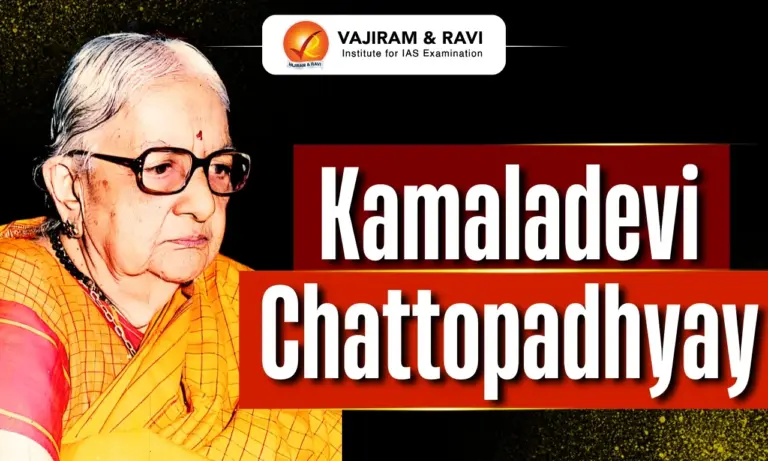
Kamaladevi Chattopadhyay was a freedom fighter, social reformer, women’s rights advocate and institution-builder who connected India’s freedom struggle with social equality, economic self-reliance and cultural revival. Her contributions ranged from the Salt Satyagraha and women’s political participation to refugee rehabilitation and the promotion of Indian handicrafts, handlooms and performing arts.
Kamaladevi Chattopadhyay Early Life and Social Reform
Kamaladevi Chattopadhyay was born on 3 April 1903 in Mangalore, Karnataka, into a progressive family.
- She was married at a young age and widowed as a child, which exposed her to the social restrictions and stigma faced by widows in colonial India.
- In 1919, she remarried Harindranath Chattopadhyay, a poet and playwright, challenging the prevailing social norms surrounding widow remarriage and women’s choices.
- Her mother, Girijabai, was involved in social reform and women’s organisations, which also influenced Kamaladevi’s early thinking.
- She studied at Queen Mary’s College, Madras, and later travelled to England, where she studied sociology at Bedford College, London, and gained exposure to social work and urban poverty.
These experiences shaped Kamaladevi Chattopadhyay’s commitment to women’s equality, social justice and reform of discriminatory social practices.
Kamaladevi Chattopadhyay and Women’s Political Participation
Kamaladevi Chattopadhyay was among the earliest Indian women to enter electoral politics and organise women for greater participation in public life.
- In 1926, she became the first woman in India to contest a legislative election, standing for the Madras Provincial Legislative Council.
- She joined the Indian National Congress in 1927 and later became associated with the All India Congress Committee.
- She played an important role in the All India Women’s Conference, which worked for women’s education, political rights and social reform.
- Her activism challenged the idea that women should remain confined to domestic roles.


Kamaladevi Chattopadhyay and the Freedom Struggle
Kamaladevi Chattopadhyay played an important role in the Civil Disobedience Movement and advocated greater participation of women in the national movement.
- During the Salt Satyagraha in 1930, she argued for the active participation of women in civil disobedience and herself participated in the campaign.
- She was arrested for selling salt in violation of colonial law and faced imprisonment during the freedom struggle.
- She was among the founders of the Congress Socialist Party in 1934, linking political freedom with social and economic justice.
Kamaladevi Chattopadhyay and Women’s Empowerment
For Kamaladevi Chattopadhyay, national freedom was incomplete without the freedom and empowerment of women.
- She advocated equal political rights and economic independence for women.
- She supported reforms concerning marriage, inheritance, employment and women’s working conditions.
- She promoted employment and cooperative opportunities to help women achieve greater economic independence.
- Her own life challenged social conventions surrounding widowhood, marriage and women’s participation in public affairs.
Kamaladevi Chattopadhyay and Partition Refugee Rehabilitation
After Independence, Kamaladevi Chattopadhyay shifted much of her attention from electoral politics to the rehabilitation of people displaced by Partition.
- She helped organise refugee rehabilitation through the Indian Cooperative Union, founded in 1948.
- She was closely associated with the development of Faridabad as a cooperative-based settlement for refugees.
Her approach went beyond providing shelter by focusing on employment, productive work and community institutions. She believed rehabilitation should help displaced people become self-reliant rather than remain dependent on relief.
Kamaladevi Chattopadhyay and Handicrafts and Handlooms
One of Kamaladevi Chattopadhyay’s most lasting contributions was the revival of Indian handicrafts and handlooms.
- She promoted handicrafts as both cultural heritage and a source of sustainable livelihoods, particularly for rural communities and artisans.
- She encouraged cooperative organisation and better market access for craftspeople.
- She played a major role in developing the All India Handicrafts Board and the Central Cottage Industries Emporium.
- She was a founding figure in the Crafts Council movement in India and was associated with the international crafts movement.
- Her approach connected cultural preservation with employment and rural development.
Kamaladevi Chattopadhyay and Indian Performing Arts
Kamaladevi Chattopadhyay also contributed significantly to the institutional development of Indian theatre and performing arts.
- She founded the Indian National Theatre in 1944, promoting Indian theatrical and folk traditions.
- She was closely associated with the development of the Sangeet Natak Akademi, established in 1953 as India’s national academy for music, dance and drama.
- She was associated with the development of the National School of Drama and served as its Chairperson during 197778.
Her efforts strengthened institutional support for India’s traditional and contemporary performing arts.
Kamaladevi Chattopadhyay Vision of Freedom and Social Justice
Kamaladevi Chattopadhyay believed that freedom should extend beyond political independence to social equality, cultural awareness and human dignity.
- She supported linking education with India’s cultural heritage and was associated with efforts to promote cultural education and awareness.
- Through her international engagements, she opposed colonialism, racism and discrimination, connecting India’s freedom struggle with wider struggles for human rights.
- Her vision linked freedom, equality, cultural identity and social justice, making her approach broader than political nationalism.
Kamaladevi Chattopadhyay Awards and Recognition
Kamaladevi Chattopadhyay received several national and international honours for her contributions to social work, culture and community development.
- Padma Bhushan – 1955
- Ramon Magsaysay Award for Community Leadership – 1966
- Sangeet Natak Akademi Fellowship – 1974
- Padma Vibhushan – 1987
She passed away on 29 October 1988 in Bombay (now Mumbai).
Kamaladevi Chattopadhyay Legacy
The legacy of Kamaladevi Chattopadhyay lies in her contribution to both the freedom struggle and post-Independence nation-building.
- She helped strengthen women’s participation in public and political life.
- She connected handicrafts and handlooms with cultural preservation and sustainable livelihoods.
- Her institution-building contributed to the development of India’s theatre, crafts and performing arts ecosystem.
- Her cooperative approach to refugee rehabilitation and community development reflected her belief in self-reliance.
- Her life continues to represent a broader vision of freedom based on equality, dignity, social justice and cultural identity.

 Last updated on Oct, 2026
→ UPSC 2027 Notification will be released on 13 January 2027 at upsconline.nic.in.
→ Asian Games 2026 are being held in Aichi-Nagoya, Japan, from 19 September to 4 October.
→ Check Nobel Prize 2026 Winners List here.
→ Download PIB PRiSM Monthly Magazine 2026 here.
→ Check UPSC Monthly Current Affairs Magazine The Recitals here.
→ Check out the latest UPSC Syllabus here.
→ Download UPSC Model Answers for Mains 2026
→ UPSC Mains Question Paper 2026 is out now for Essay & GS Paper 1, 2, 3 & 4.
→ UPSC Calendar 2027 has been released.
→ Enroll in Vajiram & Ravi’s UPSC Mains Test Series 2027 for structured answer writing practice, expert evaluation, and exam-oriented feedback.
→ Join Vajiram & Ravi’s UPSC Mentorship Program 2027 for personalized guidance, strategy planning, and one-to-one support from experienced mentors.
→ Go through the UPSC Mains Previous Year Papers to enhance your preparation.
→ UPSC has released UPSC Toppers List 2025 with the Civil Services final result on its official website.
→ Also check Best UPSC Coaching in India
Kamaladevi Chattopadhyay FAQs
Q1. Who was Kamaladevi Chattopadhyay?+
Q2. When and where was Kamaladevi Chattopadhyay born?+
Q3. What was Kamaladevi Chattopadhyay’s role in the Salt Satyagraha?+
Q4. Which organisation did Kamaladevi Chattopadhyay help establish in 1934?+
Q5. What was Kamaladevi Chattopadhyay’s contribution to women’s political participation?+
Q6. What was Kamaladevi Chattopadhyay’s contribution to refugee rehabilitation?+
Q7. Which cultural institutions were associated with Kamaladevi Chattopadhyay?+
Q8. Which major awards did Kamaladevi Chattopadhyay receive?+
Tags: kamaladevi chattopadhyay