EV Charging Latest News
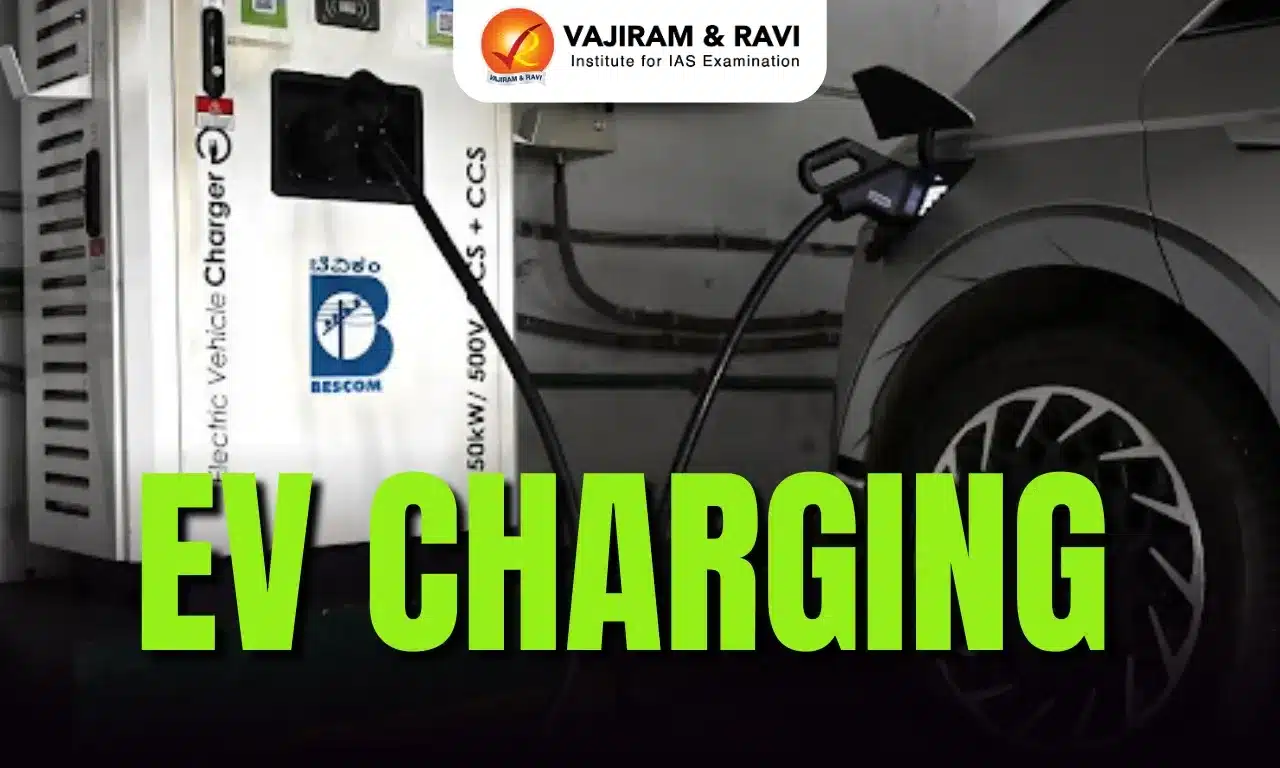
- The government has launched guidelines under the Rs. 10,000 crore PM E-Drive scheme, offering 100% subsidy for EV charging infrastructure to accelerate India’s transition to clean mobility.
Introduction
- India has set ambitious targets for transitioning towards sustainable transportation, with electric vehicles (EVs) positioned at the centre of its clean mobility vision.
- To bridge the critical infrastructure gap, the government has rolled out guidelines under the Rs. 10,000 crore PM E-Drive scheme, offering up to 100% subsidy for setting up EV charging stations and battery swapping stations.
- The move aims to accelerate EV adoption by addressing one of the sector’s biggest challenges, inadequate charging infrastructure.


India’s Push for EV Adoption
- The EV sector in India has gained momentum over the past decade, supported by policies such as the Faster Adoption and Manufacturing of Hybrid and Electric Vehicles (FAME) scheme and state-level incentives.
- However, the lack of sufficient charging points continues to deter buyers. India currently has fewer than 20,000 public charging stations, far behind global EV leaders like China and the U.S.
- The PM E-Drive scheme seeks to address this bottleneck by prioritising subsidies for high-density urban areas, smart cities, and critical transport corridors.
- By linking subsidies to demand aggregation, the scheme ensures a coordinated approach between ministries, state governments, and public sector enterprises.
Key Features of the PM E-Drive Subsidy Scheme
- The new guidelines allocate Rs. 2,000 crore out of the Rs. 10,000 crore scheme exclusively for charging infrastructure. Some of the notable features include:
- 100% Subsidy Coverage: Eligible entities will receive full financial support for upstream infrastructure like transformers, cables, circuit breakers, and civil works. In some cases, even the cost of EV supply equipment (EVSE), including charging guns, will be subsidised.
- Priority Areas: Focus on cities with populations above one million, notified smart cities, satellite towns near metros, and cities under the National Clean Air Programme (NCAP).
- Highways Integration: Selected inter-city and inter-state highways will be made EV-ready through coordinated planning with the Ministry of Road Transport and Highways.
- Eligible Entities: Central ministries, State governments, PSUs, and CPSEs can submit proposals. Companies like IOCL, BPCL, HPCL, NHAI, AAI, and metro rail corporations are also eligible.
- Operational Flexibility: Entities may directly operate charging stations or appoint Charge Point Operators (CPOs).
Expected Impact on EV Ecosystem
- The subsidy scheme is designed to create a network of charging stations that matches the pace of EV adoption in India. The immediate benefits include:
- Boost to EV Sales: Assured availability of charging infrastructure is expected to encourage more consumers to switch from internal combustion engine vehicles to EVs.
- Public Sector Leadership: Involving large PSUs such as IOCL and NHAI ensures that the scheme benefits from established networks and infrastructure expertise.
- Pollution Reduction: By prioritising NCAP cities and capital cities, the scheme aligns EV infrastructure growth with India’s clean air goals.
- Economic Opportunities: The expansion of charging networks will create business opportunities for Charge Point Operators, equipment manufacturers, and service providers.
Challenges Ahead
- While the subsidy plan is a breakthrough, its success will depend on implementation. Some key challenges include:
- Land Acquisition: Identifying and securing suitable sites for charging stations in densely populated urban areas.
- Grid Readiness: Strengthening India’s power distribution systems to handle increased EV charging load without causing disruptions.
- Private Sector Participation: Encouraging private players to complement PSU-led efforts for a balanced rollout.
- Consumer Awareness: Educating users about charging locations, pricing models, and safety standards.
Source: TH

 Last updated on Sep, 2026
→ UPSC 2027 Notification will be released on 13 January 2027 at upsconline.nic.in.
→ Asian Games 2026 are being held in Aichi-Nagoya, Japan, from 19 September to 4 October.
→ Check out the latest UPSC Syllabus here.
→ Download UPSC Model Answers for Mains 2026
→ UPSC Mains Question Paper 2026 is out now for Essay & GS Paper 1, 2, 3 & 4.
→ UPSC Calendar 2027 has been released.
→ Enroll in Vajiram & Ravi’s UPSC Mains Test Series 2027 for structured answer writing practice, expert evaluation, and exam-oriented feedback.
→ Join Vajiram & Ravi’s UPSC Mentorship Program 2027 for personalized guidance, strategy planning, and one-to-one support from experienced mentors.
→ Go through the UPSC Mains Previous Year Papers to enhance your preparation.
→ UPSC has released UPSC Toppers List 2025 with the Civil Services final result on its official website.
→ Also check Best UPSC Coaching in India
EV Charging FAQs
Q1. What is the PM E-Drive scheme?+
Q2. Who is eligible for the EV charging subsidy?+
Q3. How much subsidy is offered under the scheme?+
Q4. Which areas will be prioritized for EV charging stations?+
Q5. What is the expected impact of this scheme?+
Tags: ev charging mains articles upsc current affairs upsc mains current affairs