Electrolyser Market Latest News
- China is capturing nearly 85% of the global alkaline electrolyser market, raising concerns about its dominance in green hydrogen supply chains.
Introduction
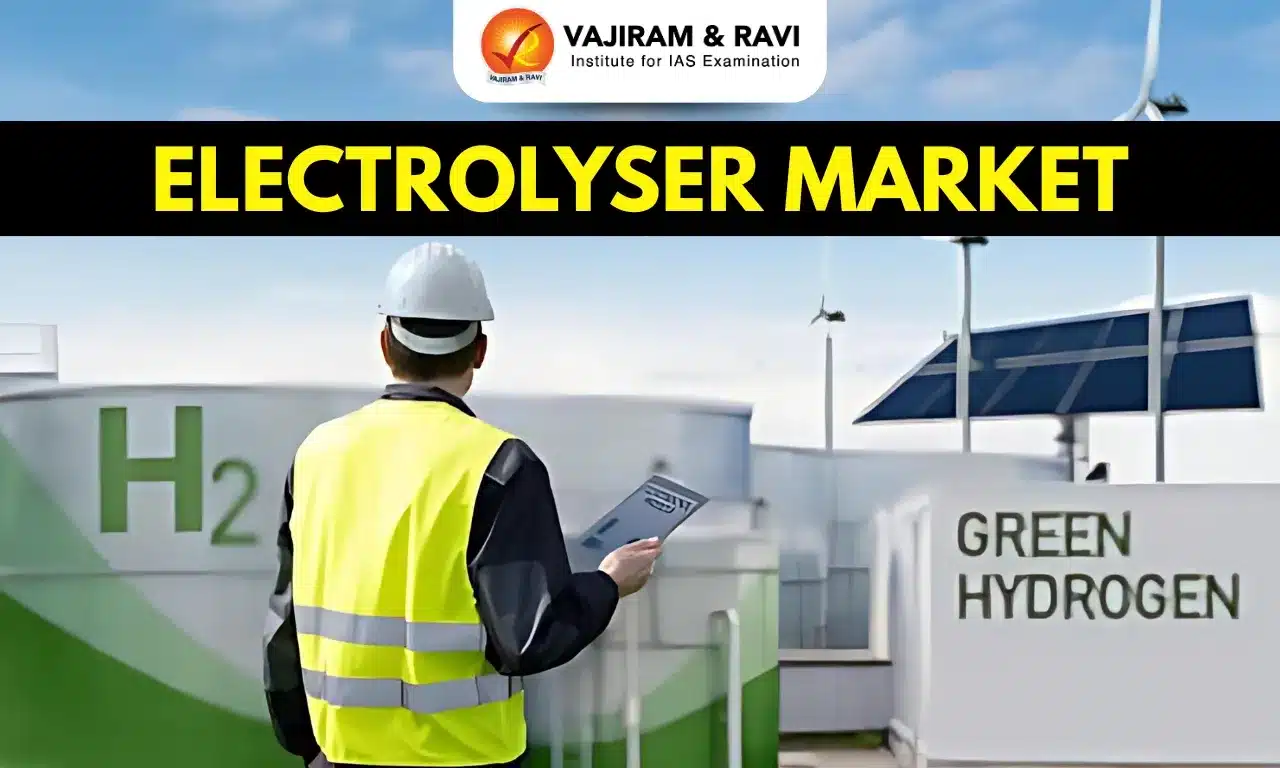
- As the world transitions towards clean energy, green hydrogen has emerged as a central pillar of decarbonisation strategies.
- Electrolysers, which split water into hydrogen and oxygen using electricity, are at the heart of this revolution.
- Much like photovoltaic (PV) modules in solar energy, electrolysers are becoming critical in determining the pace and cost-effectiveness of green hydrogen adoption.
- A new debate has surfaced around China’s growing dominance in electrolyser manufacturing and whether it can replicate its success from the solar industry in this new sector.


The Role of Electrolysers in Green Hydrogen
- Green hydrogen is produced when electrolysers use renewable electricity, such as from wind or solar, to split water. Currently, two main types of electrolysers are commercially used:
- Alkaline Electrolysers (ALK): A mature technology with lower costs but less efficient under fluctuating loads, making them less suited for renewables.
- Proton Exchange Membrane (PEM) Electrolysers: More efficient at variable loads and capable of producing high-purity hydrogen, though significantly costlier due to reliance on rare metals like platinum and iridium.
- Electrolysers are thus crucial in scaling up global green hydrogen production, especially as industries such as refining, steelmaking, and ammonia production pivot towards decarbonisation.
China’s Dominance in the Electrolyser Market
- By 2024, China had become the world’s leading hydrogen producer with 36.5 million tonnes annually, including 1,20,000 tonnes of green hydrogen, nearly half the global share. Its dominance in the electrolyser market stems largely from:
- Manufacturing Scale: China controls about 85% of global alkaline electrolyser capacity.
- Cost Advantage: Chinese alkaline electrolysers are up to 45% cheaper for international buyers, especially in Europe.
- Integrated Supply Chains: Abundant domestic access to raw materials like nickel and steel lowers costs.
- Rapid Deployment: Chinese firms such as LONGi and Envision Energy are not only producing electrolysers but also constructing overseas hydrogen plants.
Price Reductions and Market Push
- Electrolyser prices in China have fallen steeply, aided by economies of scale and supply chain maturity:
- A 5 MW ALK electrolyser system cost six million yuan (~$167/kW) in 2024, a 20% drop from 2023.
- A 1 MW PEM electrolyser system was priced at the same six million yuan (~$838/kW), reflecting a 32% fall in one year.
- These reductions enhance China’s competitiveness, mirroring the strategy it adopted in the solar PV industry.
Challenges to China’s Global Expansion
- Despite its momentum, China faces hurdles in capturing the electrolyser market outright:
- Resource Constraints: PEM electrolysers need precious metals like platinum and iridium, where China depends heavily on imports.
- System Integration Requirements: Hydrogen systems must be tailored to purity and end-use, limiting the benefits of scale alone.
- Geopolitical Pushback: Unlike the solar sector, many countries view green hydrogen as strategic and are building domestic capabilities, creating resistance to Chinese imports.
- Regulatory Scrutiny: Concerns over supply chain security and national energy independence are likely to restrict China’s free entry into global markets.
Global Competition in Green Hydrogen
- While China is scaling aggressively, other nations are also ramping up efforts. The EU, U.S., Japan, and India have launched national hydrogen missions to secure domestic manufacturing capacity and reduce reliance on imports.
- This creates a more contested environment than the solar PV industry, where China’s entry was relatively unchallenged.
Source: TH

 Last updated on Sep, 2026
→ UPSC 2027 Notification will be released on 13 January 2027 at upsconline.nic.in.
→ Asian Games 2026 are being held in Aichi-Nagoya, Japan, from 19 September to 4 October.
→ Check out the latest UPSC Syllabus here.
→ Download UPSC Model Answers for Mains 2026
→ UPSC Mains Question Paper 2026 is out now for Essay & GS Paper 1, 2, 3 & 4.
→ UPSC Calendar 2027 has been released.
→ Enroll in Vajiram & Ravi’s UPSC Mains Test Series 2027 for structured answer writing practice, expert evaluation, and exam-oriented feedback.
→ Join Vajiram & Ravi’s UPSC Mentorship Program 2027 for personalized guidance, strategy planning, and one-to-one support from experienced mentors.
→ Go through the UPSC Mains Previous Year Papers to enhance your preparation.
→ UPSC has released UPSC Toppers List 2025 with the Civil Services final result on its official website.
→ Also check Best UPSC Coaching in India
Electrolyser Market FAQs
Q1. What role do electrolysers play in green hydrogen production?+
Q2. Which electrolyser technology is cheaper and widely produced by China?+
Q3. Why are PEM electrolysers costlier than ALK electrolysers?+
Q4. How much of the global alkaline electrolyser manufacturing does China control?+
Q5. What challenges could restrict China’s dominance in the electrolyser market?+
Tags: electrolyser market mains articles upsc current affairs upsc mains current affairs