TET Mandate Latest News
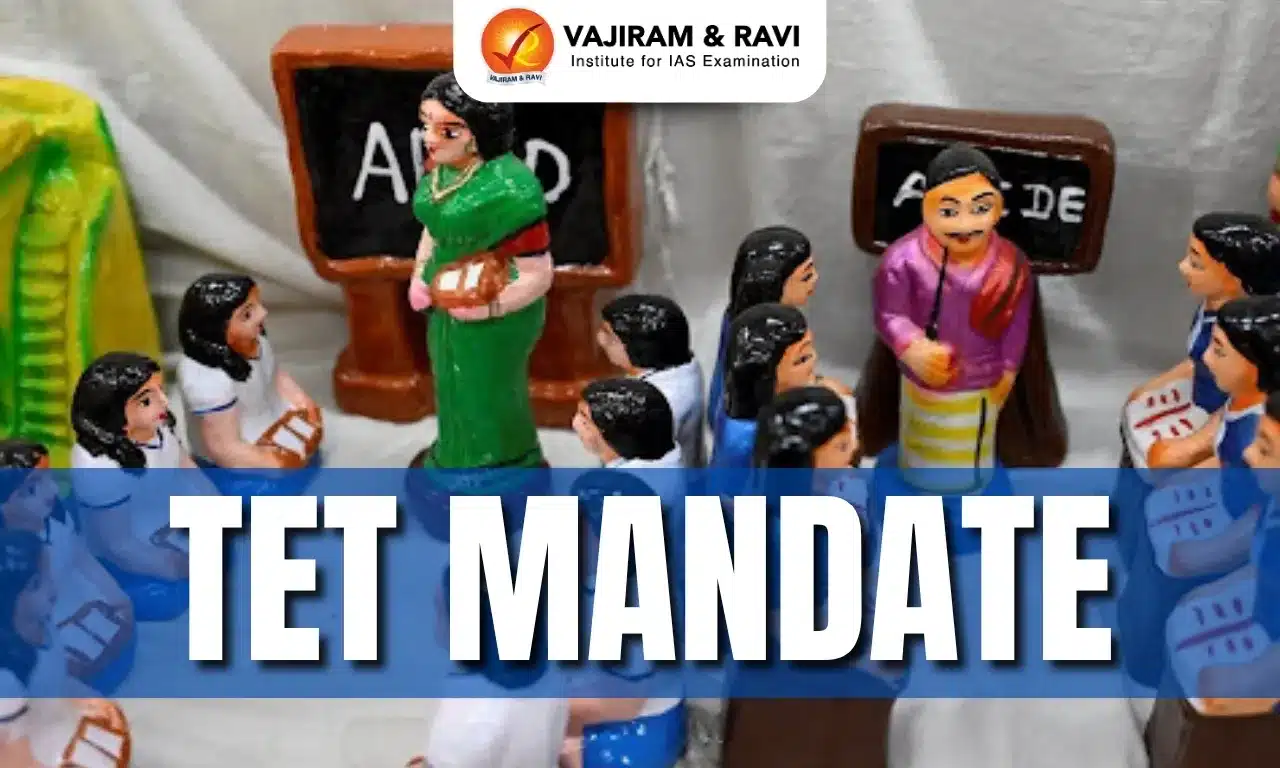
- The Supreme Court’s directive has mandated all in-service teachers in non-minority schools to clear the Teachers’ Eligibility Test (TET) within two years.
Introduction
- The Supreme Court’s recent directive mandating that all in-service teachers for Classes 1 to 8 in non-minority schools must clear the Teachers’ Eligibility Test (TET) within two years has sparked widespread concern among States.
- Tamil Nadu, in particular, has filed a review petition warning that the ruling could trigger a crisis of “empty classrooms,” as lakhs of unqualified teachers face disqualification or forced retirement.
- The issue has opened a deeper debate on balancing the constitutional right to quality education with the practical realities of India’s vast school system.


Understanding the Teachers’ Eligibility Test
- The Teachers’ Eligibility Test (TET) was introduced as a key quality benchmark under the Right of Children to Free and Compulsory Education (RTE) Act, 2009.
- Conducted by both the Central and State governments, it serves as a minimum qualification for appointment as a teacher in elementary schools (Classes 1-8).
- The National Council for Teacher Education (NCTE), under Section 23(1) of the RTE Act, mandates passing the TET to ensure national standards in teacher quality.
- The rationale behind this test is to strengthen teacher competency and bring consistency in the recruitment process across States.
- However, the challenge arises with its retrospective implementation for teachers already in service before the RTE came into effect.
Key Highlights of the Supreme Court Judgment
- In its September 1, 2025 judgment, a two-judge Bench of the Supreme Court ruled that all in-service teachers in non-minority schools who have more than five years of service left must clear the TET within two years or face compulsory retirement.
- Teachers with less than five years of service are exempted but will need a TET qualification if they seek promotion.
- While acknowledging that the decision may appear “harsh,” the Bench emphasised that ensuring qualified teaching personnel is central to the constitutional mandate of Article 21A, which guarantees the right to free and compulsory education for children aged 6 to 14.
- Additionally, the judgment referred to a larger Bench the question of whether minority educational institutions, currently exempt from the RTE Act under the 2014 Pramati Educational and Cultural Trust case, should also be brought under its purview to prevent misuse of minority status to bypass teacher qualification norms.
State Concerns and the Risk of Classroom Vacancies
- Tamil Nadu, which employs over 4.49 lakh teachers in government and aided schools, has highlighted that nearly 3.9 lakh of them are not TET-qualified.
- Implementing the Supreme Court order, therefore, risks mass teacher disqualification, potentially crippling the State’s school education system and affecting millions of students.
- The State argues that the ruling creates a direct conflict with Article 21A, as it could simultaneously uphold quality standards while undermining the availability of teachers and disrupting classroom learning.
- Other States are likely to follow Tamil Nadu in seeking judicial review, given the magnitude of potential disruption.
Legal and Constitutional Dimensions
- The controversy primarily revolves around Section 23 of the RTE Act.
- While Section 23(1) empowers the NCTE to set minimum teacher qualifications, Section 23(2) allows the Central government to relax these qualifications for up to five years if States face a shortage of trained teachers.
- Tamil Nadu argues that this flexibility clause was introduced precisely to address transitional issues in States where teachers were appointed before the introduction of TET.
- It contends that applying TET retrospectively to already-appointed teachers goes beyond legislative intent and violates the principle of proportionality.
- The State’s review petition further suggests alternative methods, such as in-service training, capacity-building programs, and refresher courses, as more balanced ways to enhance teaching standards without destabilising the education system.
Broader Implications for Teacher Policy and Education Quality
- The judgment underscores a national policy dilemma: how to reconcile the need for qualified teachers with the practical realities of teacher shortages, especially in rural and remote areas.
- While TET aims to improve education quality, enforcing it rigidly on in-service teachers, many of whom have decades of experience, raises equity and livelihood concerns.
- Education experts have warned that an abrupt implementation could lead to a wave of teacher retirements, reducing teacher-student ratios, particularly in public schools already struggling with staffing shortages.
- Moreover, the call to reconsider the exemption of minority institutions from the RTE Act could reshape the landscape of school regulation in India by standardising teacher qualification requirements across all types of institutions.
Balancing Educational Rights and Practical Realities
- At the heart of the issue lies the constitutional balance between quality education and access to education.
- Article 21A of the Constitution guarantees both the right to education and the expectation that such education must meet reasonable quality standards.
- The Supreme Court judgment, while motivated by the need for uniform teacher standards, risks undermining the accessibility aspect of this right if not implemented pragmatically.
- States, therefore, seek a phased or alternative approach, focusing on training rather than disqualification, to prevent classroom paralysis.
- The outcome of the review petitions will likely redefine the contours of India’s teacher qualification framework and the interplay between federal authority, quality benchmarks, and education as a fundamental right.
Source: TH

 Last updated on Sep, 2026
→ UPSC 2027 Notification will be released on 13 January 2027 at upsconline.nic.in.
→ Check out the latest UPSC Syllabus here.
→ Download UPSC Model Answers for Mains 2026
→ UPSC Mains Question Paper 2026 is out now for Essay & GS Paper 1, 2, 3 & 4.
→ UPSC Calendar 2027 has been released.
→ Enroll in Vajiram & Ravi’s UPSC Mains Test Series 2027 for structured answer writing practice, expert evaluation, and exam-oriented feedback.
→ Join Vajiram & Ravi’s UPSC Mentorship Program 2027 for personalized guidance, strategy planning, and one-to-one support from experienced mentors.
→ Go through the UPSC Mains Previous Year Papers to enhance your preparation.
→ UPSC has released UPSC Toppers List 2025 with the Civil Services final result on its official website.
→ Also check Best UPSC Coaching in India
TET Mandate FAQs
Q1. What is the Supreme Court’s TET judgment about?+
Q2. How many teachers in Tamil Nadu are affected by the ruling?+
Q3. What exemption does the Supreme Court provide under the judgment?+
Q4. What constitutional issue does the judgment raise?+
Q5. What alternative approach do States propose?+
Tags: mains articles tet mandate upsc current affairs upsc mains current affairs