Naked Mole Rat Latest News
A new study of the naked mole rat shows that these animals have evolved a DNA repair mechanism that could explain their longevity.
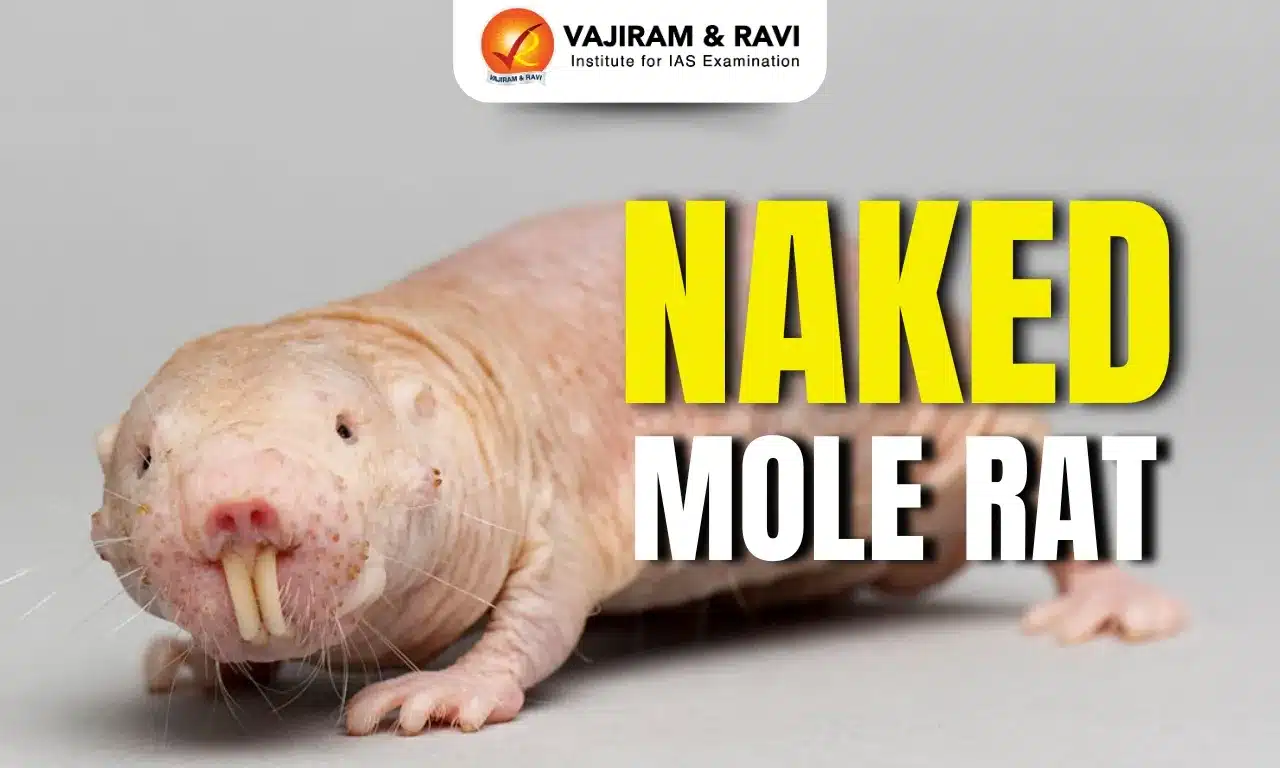
About Naked Mole Rat
- It is a small, hairless burrowing rodent native to parts of East Africa.
- Distribution: They are predominantly found in southern Ethiopia, Kenya, Somalia, and Djibouti.
- Habitat: They inhabit drier parts of the tropical grasslands and savanna.
- Food: They are herbivores and feed primarily on very large tubers.
- Social Structure: It is eusocial, meaning they live in large colonies in which only one female breeds and the majority of workers (both males and females) spend their entire lives working for the colony.
- Conservation Status: IUCN: Least Concern


Characteristics of Naked Mole Rat
- It is famous for living an astonishingly long time, up to around 37 years, nearly 10x longer than mammals of similar size.
- It lacks pain sensitivity in its skin and has very low metabolic and respiratory rates.
- It is also remarkable for its longevity and its resistance to cancer and oxygen deprivation.
- Their lifestyle is more akin to that of bees and wasps and other eusocial insects.
- They live in underground burrows that may stretch to 5 km, in colonies of around 70 animals.
- It is cold-blooded, unable to control their body temperature and dependent on the prevailing outside temperature.
Key Findings of Researchers
- The cyclic GMP-AMP synthase (cGAS) functions differently in naked mole rats compared to humans and mice. (GMP –AMP synthesis which modulates various cellular processes)
- Key differences in cGAS function
- Humans and Mice: cGAS interferes with DNA repair, increasing the risk of aging and cancer
- Naked Mole Rats: cGAS enhances DNA repair, promoting genome stability and potentially contributing to their longevity.
- This is due to four amino acid substitutions in the cGAS structure that allow it to bind to DNA longer and facilitate repair by bringing together repair proteins FANCI and RAD50.
Source: TH

 Last updated on Oct, 2026
→ UPSC 2027 Notification will be released on 13 January 2027 at upsconline.nic.in.
→ Check Nobel Prize 2026 Winners List here.
→ Download PIB PRiSM Monthly Magazine 2026 here.
→ Check UPSC Monthly Current Affairs Magazine The Recitals here.
→ Check out the latest UPSC Syllabus here.
→ Download UPSC Model Answers for Mains 2026
→ UPSC Mains Question Paper 2026 is out now for Essay & GS Paper 1, 2, 3 & 4.
→ UPSC Calendar 2027 has been released.
→ Enroll in Vajiram & Ravi’s UPSC Mains Test Series 2027 for structured answer writing practice, expert evaluation, and exam-oriented feedback.
→ Join Vajiram & Ravi’s UPSC Mentorship Program 2027 for personalized guidance, strategy planning, and one-to-one support from experienced mentors.
→ Go through the UPSC Mains Previous Year Papers to enhance your preparation.
→ UPSC has released UPSC Toppers List 2025 with the Civil Services final result on its official website.
→ Also check Best UPSC Coaching in India
Naked mole rat FAQs
Q1. What is the habitat of Naked Mole Rats?+
Q2. What is unique about naked mole rats' pain perception?+
Tags: naked mole rat