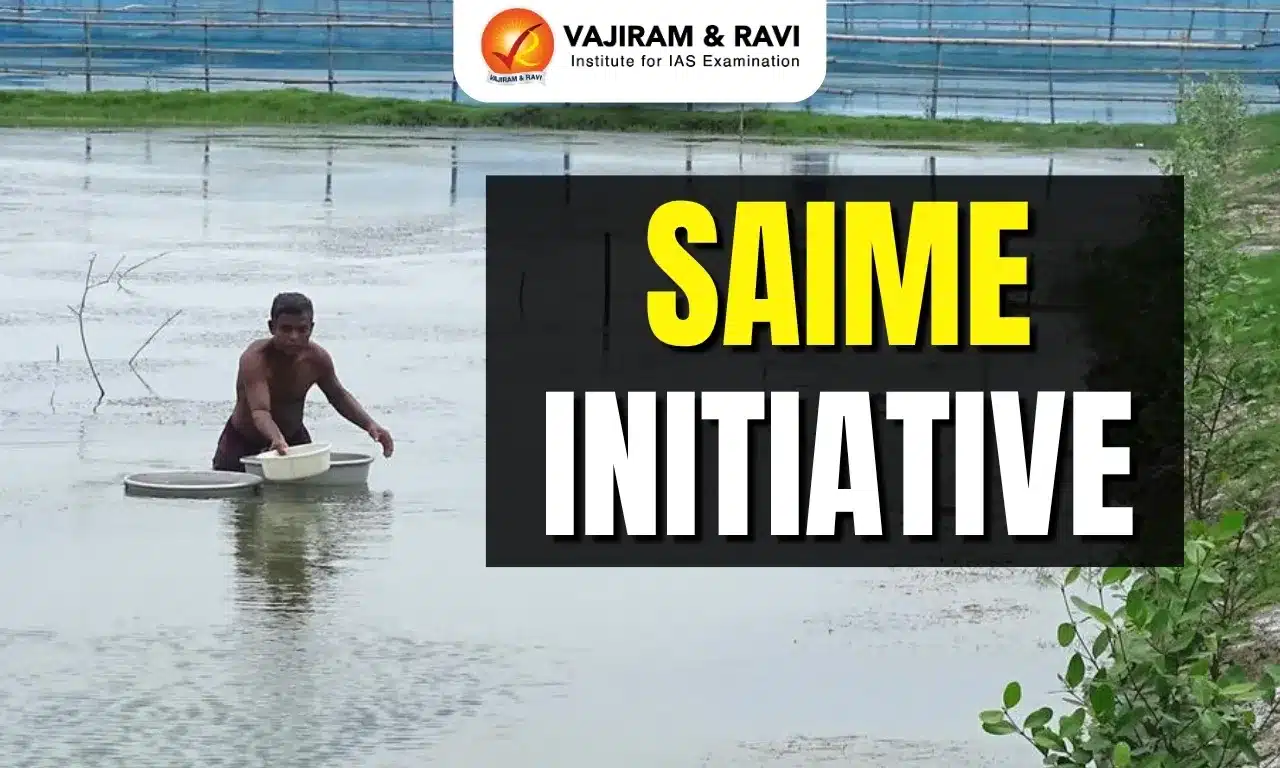
SAIME Initiative Latest News
Recently, a model of Sustainable Aquaculture in Mangrove Ecosystems (SAIME) in West Bengal’s Sundarbans has been conferred Global Technical Recognition by the Food and Agriculture Organization (FAO) of the United Nations.
About SAIME Initiative
- The Sustainable Aquaculture in Mangrove Ecosystems (SAIME) is a multi-stakeholder partnership (MSP) to strengthen transformative processes in shrimp trade as a basis for the protection of mangrove ecosystems in West Bengal.
- It is a climate-adaptive and conservation-linked livelihood initiative that integrates brackish water shrimp-based aquaculture with mangrove restoration.
- It is an ecosystem-based, climate-adaptive, and conservation-linked livelihood approach.
- Implemented by: It has been implemented in collaboration with Global Nature Fund (GNF), Nature Environment and Wildlife Society (NEWS), Naturland, and Bangladesh Environment & Development Society (BEDS),
What are Mangroves?
- Mangroves are salt-tolerant trees and shrubs that grow in coastal intertidal zones, primarily in tropical and subtropical regions.
Characteristics of Mangroves
- Salt Tolerance: They possess specialised root structures, such as salt-filtering roots and salt-excreting leaves, to manage high salinity levels.
- Aerial Roots (Pneumatophores): These roots help in respiration by obtaining oxygen from the air in waterlogged soils.
- Prop Roots: Provide stability against tidal waves and storm surges.
- Vivipary (Seed Germination): Seeds germinate while still attached to the parent tree to overcome the challenge of germination in saline water.
- Efficient Carbon Sequestration: Mangroves are among the most carbon-rich ecosystems, playing a vital role in mitigating climate change.
- Ecological Significance: Mangrove forests act as a crucial buffer between land and sea, providing habitat for various marine and terrestrial species.
Source: TH


 Last updated on August, 2026
→ UPSC Mains 2026 commenced on 21st August 2026 and will continue through 30th August 2026, as per the official examination schedule.
→ UPSC Mains Question Paper 2026 is out now for Essay & GS Paper 1, 2, 3 & 4.
→ UPSC Mains GS Paper 1 2026 is out now.
→ UPSC Mains GS Paper 2 2026 is out now.
→ UPSC Mains GS Paper 3 2026 is out now.
→ UPSC Mains GS Paper 4 2026 is out now.
→ Check out the latest UPSC Syllabus 2026 here.
→ UPSC Mains Admit Card 2026 is now out.
→ Enroll in Vajiram & Ravi’s UPSC Mains Test Series 2027 for structured answer writing practice, expert evaluation, and exam-oriented feedback.
→ Join Vajiram & Ravi’s UPSC Mentorship Program 2027 for personalized guidance, strategy planning, and one-to-one support from experienced mentors.
→ Go through the UPSC Mains Previous Year Papers to enhance your preparation.
→ Download UPSC Mains Essay Paper 2025, UPSC Mains GS Paper-I 2025, UPSC Mains GS Paper-II 2025, UPSC Mains GS Paper-III 2025, UPSC Mains GS Paper-IV 2025, UPSC Mains English (Compulsory) Paper 2025, UPSC Mains Hindi (Qualifying) Paper 2025 here.
→ UPSC has released UPSC Toppers List 2025 with the Civil Services final result on its official website.
→ UPSC Calendar 2027 has been released.
→ Also check Best UPSC Coaching in India
SAIME Initiative FAQs
Q1. Where is the SAIME initiative being implemented?+
Q2. What is the main objective of the SAIME initiative?+
Tags: saime initiative