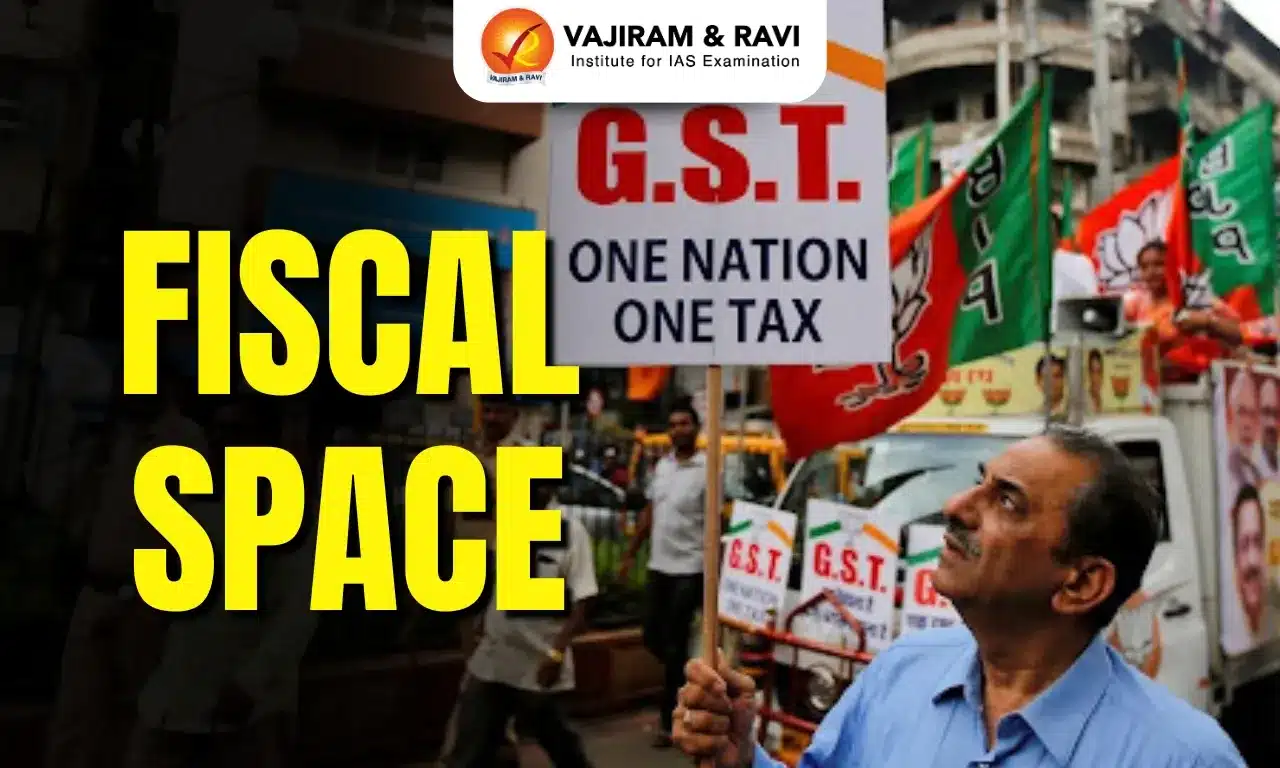
Fiscal Space Latest News
- The growing fiscal imbalance between the Centre and States has reignited debates on restoring fiscal autonomy and equitable tax devolution to States.
Changing Fiscal Dynamics in India
- India’s fiscal architecture is built upon a multi-tiered system of governance, where the Centre and States share both taxation powers and expenditure responsibilities.
- However, this balance has been steadily shifting toward centralisation, particularly after the introduction of the Goods and Services Tax (GST) in 2017.
- While GST simplified indirect taxation and improved tax efficiency, it also altered the resource autonomy of States.
- The abolition of the GST compensation cess, a five-year mechanism that ensured States were reimbursed for potential revenue losses, has intensified debates on the erosion of fiscal space available to States.
- The restructuring of GST slabs in 2025, expected to pass on over Rs. 2 lakh crore in tax benefits to consumers, has further strained State finances.
- Although it may boost consumption and tax revenue indirectly, States argue that no proper estimation of revenue loss has been made, and the abolition of the compensation system leaves them fiscally vulnerable.


Fiscal Federalism and Constitutional Framework
- Fiscal relations between the Centre and the States are governed by Articles 268 to 293 of the Constitution. These provisions delineate taxation powers through the Union and State Lists, with the residuary power resting with Parliament.
- The Finance Commission, established under Article 280, determines the principles of tax devolution and grants-in-aid.
- Historically, India’s fiscal system has evolved from tax-by-tax sharing to a global sharing principle, which allocates a fixed percentage of the Centre’s gross tax revenue to the States.
- The 80th Constitutional Amendment (2000) initiated this system, with the 11th Finance Commission recommending a 29.5% devolution to States.
- The share was successively raised, 30.5% (12th FC), 32% (13th FC), and 42% (14th FC), before being revised to 41% after the reorganisation of Jammu and Kashmir.
- However, the actual devolution has often fallen short due to the Centre’s increasing reliance on cesses and surcharges, which are excluded from the divisible pool of revenue.
- In FY 2025-26, cesses and surcharges are projected at Rs. 4.23 lakh crore, giving the Union government additional fiscal leverage while limiting the States’ shareable resources.
The Impact of GST on States’ Fiscal Autonomy
- Before GST, States had independent authority to levy taxes such as Value Added Tax (VAT), octroi, and entry taxes, which provided them significant control over their own revenues.
- With GST, taxation powers have been pooled into a common system, jointly managed by the GST Council, where the Centre holds greater voting weight.
- GST also introduced a destination-based tax model, replacing the earlier origin-based system, meaning revenues accrue to the State where goods are consumed rather than where they are produced.
- This shift adversely affects industrialised States such as Maharashtra, Tamil Nadu, and Gujarat, which were traditionally net producers and major revenue contributors.
- While studies show that the compensation mechanism initially benefited all States, the post-compensation regime has reignited concerns about revenue adequacy and fiscal dependence.
- The cess and surcharge system, which allows the Centre to mobilise non-divisible revenue, further accentuates asymmetry in fiscal power.
Declining Fiscal Independence and Central Transfers
- Central transfers constitute around 44% of total State revenue receipts, varying from 72% for Bihar to 20% for Haryana.
- Wealthier and industrialised States, including Maharashtra, Tamil Nadu, Karnataka, and Gujarat, receive substantially less, underscoring unequal fiscal dependence.
- Comparing the pre- and post-GST periods also reveals a stagnation in fiscal balance:
- The Centre collected 67% of total tax revenue, while the States collected 33%, both before and after GST.
- Expenditure responsibilities, however, remained skewed, with States accounting for over 52% of total public spending, primarily in areas like health, education, agriculture, and local governance.
- This imbalance, coupled with increasing Centrally Sponsored Schemes (CSS) that often overlap with State subjects, reduces fiscal flexibility.
- States have expressed frustration over delayed fund transfers, conditional grants, and political bias in allocations, particularly in opposition-ruled regions.
Rethinking Fiscal Devolution and Autonomy
- Many States and economists advocate revisiting the principles of fiscal federalism. One proposal suggests sharing the personal income tax base with States, akin to GST revenue sharing.
- If States were allowed a 50:50 share of the personal income tax base (estimated at Rs. 13.57 lakh crore for FY 2025-26), their fiscal dependence on central transfers could be significantly reduced.
- Alternatively, States could be empowered to ‘top-up’ income tax rates, allowing them to mobilise additional revenue without altering the central tax structure. Such measures would:
- Strengthen States’ fiscal capacity and liquidity.
- Reward progressive and high-performing States for their revenue generation.
- Enhance accountability by aligning tax collection with expenditure responsibilities.
- Another suggested model, inspired by Canada’s federal structure, envisions the Centre collecting 46% of total revenue and spending 40%, while sub-national governments collect 54% and spend 60%.
Way Ahead
- The erosion of fiscal space for States is not merely a financial issue; it strikes at the core of India’s cooperative federalism.
- With rising developmental aspirations and expanding welfare responsibilities, States require greater financial autonomy to deliver efficient public services.
- Going forward, reforms should focus on:
- Incorporating cesses and surcharges into the divisible pool.
- Revising Finance Commission criteria to balance equity with efficiency.
- Strengthening GST Council deliberations to ensure parity in decision-making.
- Encouraging fiscal innovations, such as State bonds and public-private partnerships.
Source: TH

 Last updated on Oct, 2026
→ UPSC 2027 Notification will be released on 13 January 2027 at upsconline.nic.in.
→ Check Nobel Prize 2026 Winners List here.
→ Download PIB PRiSM Monthly Magazine 2026 here.
→ Check UPSC Monthly Current Affairs Magazine The Recitals here.
→ Check out the latest UPSC Syllabus here.
→ Download UPSC Model Answers for Mains 2026
→ UPSC Mains Question Paper 2026 is out now for Essay & GS Paper 1, 2, 3 & 4.
→ UPSC Calendar 2027 has been released.
→ Enroll in Vajiram & Ravi’s UPSC Mains Test Series 2027 for structured answer writing practice, expert evaluation, and exam-oriented feedback.
→ Join Vajiram & Ravi’s UPSC Mentorship Program 2027 for personalized guidance, strategy planning, and one-to-one support from experienced mentors.
→ Go through the UPSC Mains Previous Year Papers to enhance your preparation.
→ UPSC has released UPSC Toppers List 2025 with the Civil Services final result on its official website.
→ Also check Best UPSC Coaching in India
Fiscal Space FAQs
Q1. What does fiscal federalism mean in India?+
Q2. What led to the loss of fiscal autonomy for States after GST?+
Q3. Why are States demanding inclusion of cesses and surcharges in the divisible pool?+
Q4. What is the Finance Commission’s role in fiscal devolution?+
Q5. What reforms can enhance States’ fiscal autonomy?+
Tags: fiscal space mains articles upsc current affairs upsc mains current affairs