Dogri Language Latest News
- A recent study has highlighted the sharp decline in the use and literacy of the Dogri language in Jammu and Kashmir, raising concerns over the erosion of regional linguistic heritage despite its official recognition.
Preserving Dogri Language: Reviving India’s Endangered Linguistic Heritage
- The Dogri language, once a vibrant symbol of Jammu’s cultural identity, is now at a critical juncture.
- Despite being recognised as one of the 22 official languages of India and one of the five official languages of Jammu and Kashmir, the language is experiencing a gradual erosion from public life, particularly among the younger generation and urban populations.
- According to a recent study, the decline of Dogri reflects a broader global trend of linguistic homogenisation, where smaller regional and indigenous languages are disappearing under the dominance of global and national tongues.
- India, as per UNESCO’s report, leads the world in the number of dialects at risk of extinction, having lost over 220 languages in the past five decades.


The Cultural and Linguistic Significance of Dogri
- Dogri belongs to the Indo-Aryan branch of the Indo-European language family and is mainly spoken in the Jammu region of Jammu and Kashmir, parts of Himachal Pradesh, and by diaspora communities across North India.
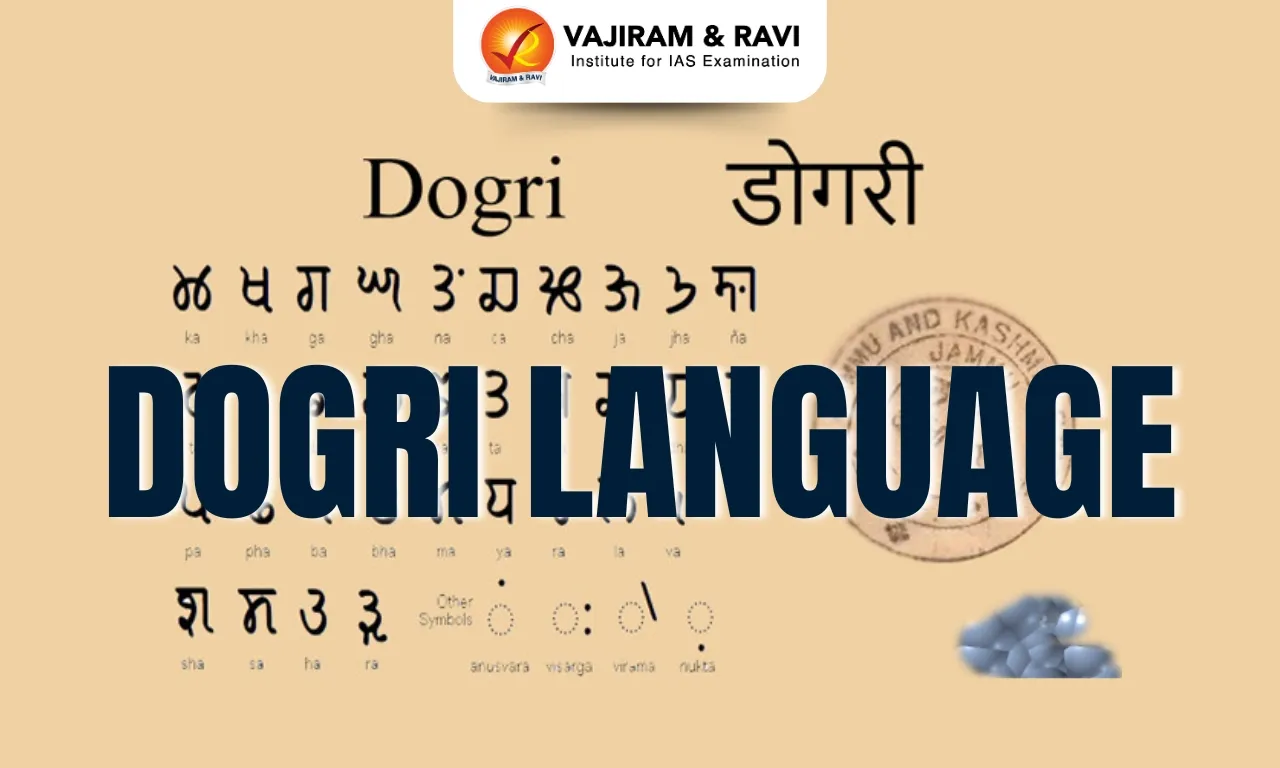
- It is written in both Devanagari and Takri scripts, and is deeply embedded in the Dogra culture, expressed through its literature, folklore, crafts, and oral traditions.
- The inclusion of Dogri in the Eighth Schedule of the Constitution in 2003 and its recognition under the Jammu and Kashmir Official Languages Act, 2020, marked significant milestones in its journey.
- However, linguistic recognition on paper has not translated into functional visibility. Dogri remains largely absent from school curricula, administrative communication, and media content.
Causes Behind the Decline
- The decline of Dogri in Jammu and surrounding regions can be understood through three interlinked factors: policy neglect, generational disconnect, and urban influence.
- Policy Gaps and Limited Institutional Support
- Dogri received formal recognition much later than other regional languages such as Urdu and Hindi.
- This delay resulted in a lack of infrastructure for linguistic promotion, from teacher training to the development of textbooks and cultural programming.
- A survey conducted across 20 locations in the Jammu region revealed that 48% of respondents believed the government had failed to provide adequate support for Dogri’s inclusion in education and public discourse.
- 43% said the language offered little economic relevance, which disincentivised younger generations from learning it.
- Generational Disconnect
- Dogri’s decline is particularly visible across generations. Respondents above 60 years of age showed full proficiency in speaking and moderate reading and writing skills, while the 21-40 age group showed near-zero literacy in Dogri.
- Among those under 20 years of age, no proficiency in reading or writing Dogri was recorded, signalling a complete breakdown in intergenerational transmission.
- The Rural-Urban Divide
- The linguistic divide between rural and urban populations further compounds the issue.
- While 56% of rural respondents said they actively speak Dogri, only 45% of urban respondents reported the same.
- Writing proficiency was even lower, 15% in rural areas and merely 4% in urban settings.
Broader Linguistic Context in India
- Dogri’s decline is part of a wider linguistic crisis in India.
- The People’s Linguistic Survey of India (PLSI) estimates that nearly half of India’s 780 languages could vanish in the next 50 years if current trends persist.
- Factors such as migration, economic aspirations, and cultural homogenisation have weakened local linguistic ecosystems.
- Experts argue that the hegemony of English as the academic and aspirational language has pushed regional languages to the periphery.
- This has created a cultural paradox where multilingualism thrives superficially, but linguistic diversity weakens structurally.
Revival Strategies and the Way Forward
- Reviving Dogri requires a multi-pronged cultural and policy approach that focuses on education, awareness, and community engagement.
- Integration into Education
- Dogri must be introduced at the primary and secondary education levels, ensuring that children develop early familiarity with the language.
- The National Education Policy (NEP) 2020 already advocates the use of mother tongues as mediums of instruction, a provision that could benefit Dogri if implemented effectively in Jammu’s schools.
- Digital and Media Promotion
- Dogri’s visibility can be enhanced through digital archives, online courses, and media content in Dogri, including films, radio shows, and social media platforms.
- The Dogri Sanstha and the Sahitya Akademi have made notable contributions, but a sustained state-backed effort is necessary to expand their reach.
- Cultural Incentives and Employment Opportunities
- Language preservation efforts must tie linguistic skills to economic and cultural incentives.
- Government jobs, tourism initiatives, and creative industries could reward bilingualism in Dogri and Hindi, reinforcing the idea that preserving one’s language can have practical advantages.
- Census and Linguistic Data Updates
- The absence of updated linguistic data due to the delay in the 2021 Census has hindered precise policy formulation.
- Reviving census-based linguistic mapping is essential to identify endangered dialects and allocate funding accordingly.
Source: TH

 Last updated on Sep, 2026
→ UPSC 2027 Notification will be released on 13 January 2027 at upsconline.nic.in.
→ Asian Games 2026 are being held in Aichi-Nagoya, Japan, from 19 September to 4 October.
→ Check out the latest UPSC Syllabus here.
→ Download UPSC Model Answers for Mains 2026
→ UPSC Mains Question Paper 2026 is out now for Essay & GS Paper 1, 2, 3 & 4.
→ UPSC Calendar 2027 has been released.
→ Enroll in Vajiram & Ravi’s UPSC Mains Test Series 2027 for structured answer writing practice, expert evaluation, and exam-oriented feedback.
→ Join Vajiram & Ravi’s UPSC Mentorship Program 2027 for personalized guidance, strategy planning, and one-to-one support from experienced mentors.
→ Go through the UPSC Mains Previous Year Papers to enhance your preparation.
→ UPSC has released UPSC Toppers List 2025 with the Civil Services final result on its official website.
→ Also check Best UPSC Coaching in India
Dogri Language FAQs
Q1. What is the Dogri language?+
Q2. When did Dogri receive constitutional recognition?+
Q3. What are the key reasons for Dogri’s decline?+
Q4. How does Dogri proficiency differ between rural and urban areas?+
Q5. What steps can help revive Dogri?+
Tags: dogri language mains articles upsc current affairs upsc mains current affairs