Black Carbon Latest News
A new report has identified black carbon as a significant contributor to Himalayan glacier melt.
About Black Carbon
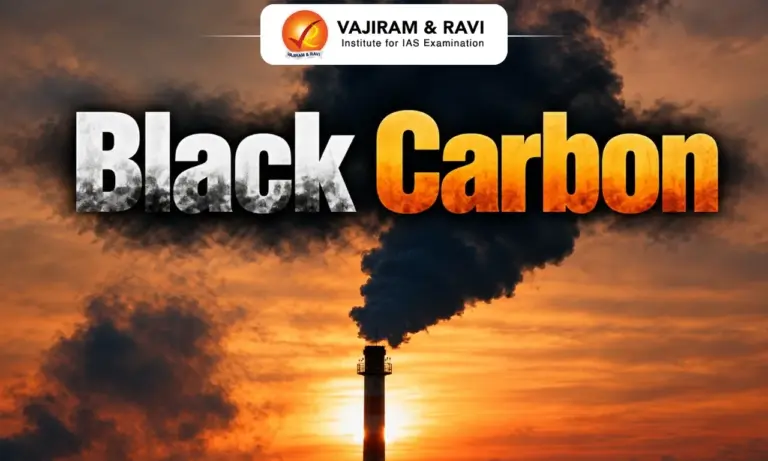
- Black carbon is a dark sooty material emitted during both natural and anthropogenic activities.
- It results from incomplete combustion of fossil fuels, biofuels and biomass.
- It is a component of PM 2.5.
- It is a short-lived climate pollutant (SLCP) due to its atmospheric lifetime of only a few days to weeks, yet it has a substantial impact on global warming.
- After CO₂ black carbon is the second most significant contributor to global warming. Unlike CO₂, it is a particle, not a greenhouse gas.
- b: Primary sources include coal-fired power plants, cookstoves, diesel engines, and the burning of biomass fuels such as wood, other fossil fuels, forest fires, crop-residue burning, and brick kilns.
- It does not remain confined to its source region.


Impact of Black Carbon
- Human Health: It has a significant adverse effect on human health and leads to premature mortality.
- Regional atmospheric heating: It remains in the atmosphere for only days to weeks, but during that period it strongly absorbs sunlight and can produce substantial atmospheric heating.
- Responsible for glacial melt: Black carbon particles deposited on snow and ice darken the surface, reduce its albedo, and cause it to absorb more solar radiation. This can accelerate snow and ice melt.
- Environment: It affects climate, agriculture, and ecosystems.
- It can alter rainfall patterns, regional atmospheric circulation, and cloud formation, accelerate glacier melting, influence freshwater supplies for millions, and contribute to rising sea levels.
Source: IE

 Last updated on Oct, 2026
→ UPSC 2027 Notification will be released on 13 January 2027 at upsconline.nic.in.
→ Check Nobel Prize 2026 Winners List here.
→ Download PIB PRiSM Monthly Magazine 2026 here.
→ Check UPSC Monthly Current Affairs Magazine The Recitals here.
→ Check out the latest UPSC Syllabus here.
→ Download UPSC Model Answers for Mains 2026
→ UPSC Mains Question Paper 2026 is out now for Essay & GS Paper 1, 2, 3 & 4.
→ UPSC Calendar 2027 has been released.
→ Enroll in Vajiram & Ravi’s UPSC Mains Test Series 2027 for structured answer writing practice, expert evaluation, and exam-oriented feedback.
→ Join Vajiram & Ravi’s UPSC Mentorship Program 2027 for personalized guidance, strategy planning, and one-to-one support from experienced mentors.
→ Go through the UPSC Mains Previous Year Papers to enhance your preparation.
→ UPSC has released UPSC Toppers List 2025 with the Civil Services final result on its official website.
→ Also check Best UPSC Coaching in India
Black Carbon FAQs
Q1. What is Black carbon?+
Q2. How does Black carbon form?+
Tags: black carbon prelims pointers upsc current affairs upsc prelims current affairs