


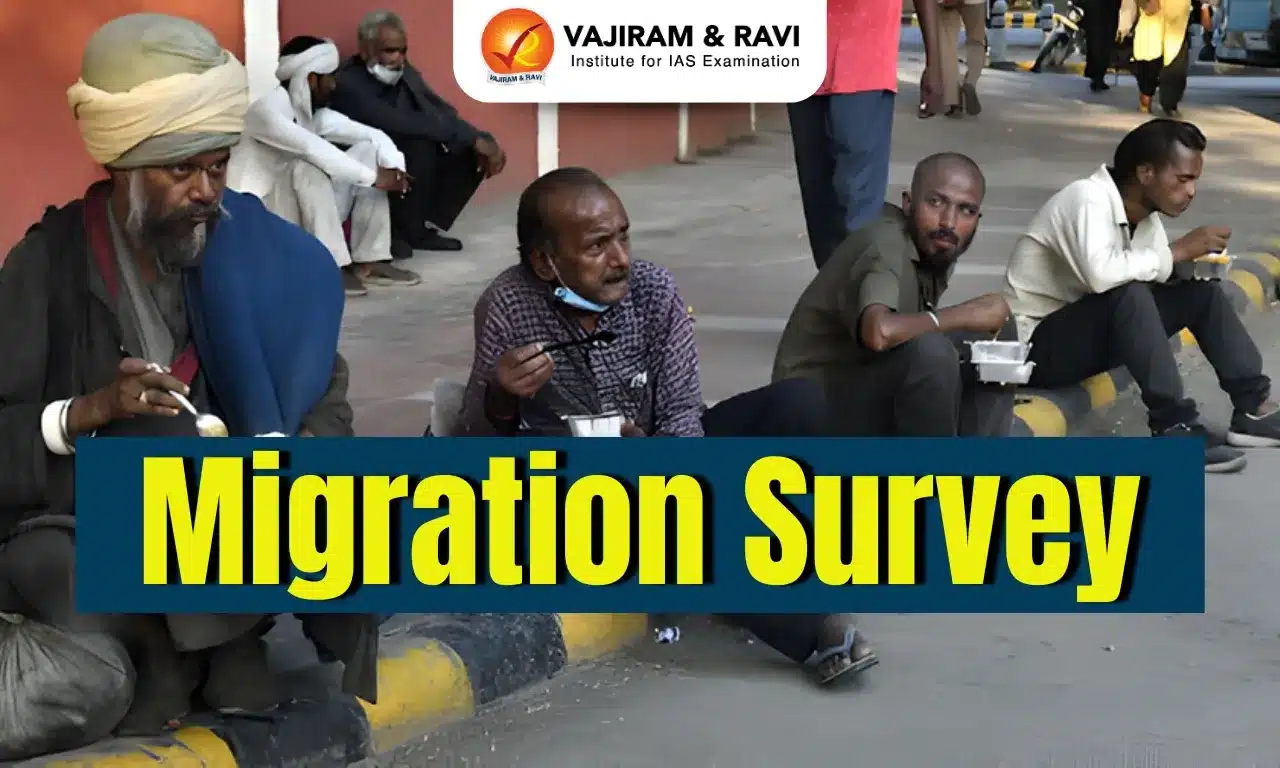
Migration Survey Latest News
- The Ministry of Statistics and Programme Implementation (MoSPI) has announced a year-long National Migration Survey to be conducted from July 2026 to June 2027.
Migration in India
- Migration in India refers to the movement of people from one place to another within the country for reasons such as employment, marriage, education, or better living conditions.
- As per the Periodic Labour Force Survey (PLFS) 2020-21, 28.9% of India’s population were migrants.
- Female migration (48%) is far higher than male migration (5.9%) in rural areas, mainly due to marriage, while most male migration is employment-driven (67%).
- Major migration flows are rural-to-urban (for jobs and education) and inter-state, especially from states like Bihar, Uttar Pradesh, and Odisha to industrial hubs such as Delhi, Maharashtra, and Gujarat.
- Migration contributes to urbanisation, labour market flexibility, and remittance flows, but also poses challenges like informal employment, housing shortages, and social security gaps.


About the National Migration Survey 2026
- The survey will be conducted under the aegis of the National Sample Survey (NSS), which has been India’s principal source of household-level socio-economic data since 1950.
- It will cover almost all states and union territories, except the Andaman and Nicobar Islands, due to logistical constraints.
- The objective of the survey is to generate reliable and up-to-date estimates of:
- Migration rates and trends (rural-to-urban, inter-state, and intra-state)
- Short-term and seasonal migration patterns
- Reasons for migration (economic, social, educational, or marital)
- Employment and income profiles of migrants
- Return migration and its socio-economic effects
- Impact of migration on household welfare and community development
- MoSPI has already released a draft questionnaire and concept note on its website and invited public feedback and expert comments by November 30, 2025.
Evolution of Migration Surveys in India
- India has a long history of tracking internal migration through the NSS system.
- Migration data was first collected in the 9th NSS round (1955), followed by dedicated surveys such as the 18th round (1963-64) and the 64th round (2007-08).
- Since 2008, migration data has only been gathered intermittently through:
- The PLFS 2020-21 estimated India’s migration rate at 28.9% of the total population.
- The Multiple Indicator Survey (2020-21) offered limited insights into internal mobility.
- However, experts have noted that India lacks a continuous and updated dataset on migration, especially post-pandemic, when labour displacement and reverse migration became major socio-economic concerns. The new survey seeks to bridge this gap.
Key Features of the 2026 Migration Survey
- Revised Definitions and Improved Coverage
- The upcoming survey introduces updated definitions to capture modern migration trends more accurately.
- A person will now be classified as a short-term migrant if they have stayed away from their usual residence for 15 days to six months within the last year for employment or job search, a shift from the previous threshold of one to six months.
- The survey will also focus on individual migration patterns rather than entire households, as the proportion of households migrating together has historically been low.
- Comprehensive Scope of Data
- The questionnaire includes new questions designed to assess the broader impact of migration on the individual’s quality of life, such as:
- Changes in income, healthcare access, and social stability post-migration.
- Experiences with housing, employment, and local integration.
- Challenges faced at the destination and the intent to relocate again.
- Integration with Policy Planning
- MoSPI has emphasised that the data will support evidence-based policymaking in critical sectors:
- Urban Development: Informing city-level housing, transport, and infrastructure planning.
- Employment Generation: Identifying labour shortages and skill gaps across regions.
- Social Protection: Enhancing portability of welfare benefits for migrant workers.
- Regional Development: Assessing how migration affects remittance flows and rural economies.
Significance of the Migration Survey
- Migration is a vital dimension of India’s economic and social landscape. Internal migration contributes to:
- Urbanisation and industrial growth by supplying labour to construction, manufacturing, and services.
- Rural resilience through remittances that support education, healthcare, and household consumption.
- However, migration also poses challenges such as informal employment, lack of social security, and urban congestion. Comprehensive data is essential to address these issues effectively.
- The upcoming survey will fill a critical data gap since the last dedicated migration study conducted in 2007-08, helping policymakers design more targeted interventions in urban planning, labour mobility, housing, and social security.

 Last updated on Oct, 2026
→ UPSC 2027 Notification will be released on 13 January 2027 at upsconline.nic.in.
→ Check Nobel Prize 2026 Winners List here.
→ Download PIB PRiSM Monthly Magazine 2026 here.
→ Check UPSC Monthly Current Affairs Magazine The Recitals here.
→ Check out the latest UPSC Syllabus here.
→ Download UPSC Model Answers for Mains 2026
→ UPSC Mains Question Paper 2026 is out now for Essay & GS Paper 1, 2, 3 & 4.
→ UPSC Calendar 2027 has been released.
→ Enroll in Vajiram & Ravi’s UPSC Mains Test Series 2027 for structured answer writing practice, expert evaluation, and exam-oriented feedback.
→ Join Vajiram & Ravi’s UPSC Mentorship Program 2027 for personalized guidance, strategy planning, and one-to-one support from experienced mentors.
→ Go through the UPSC Mains Previous Year Papers to enhance your preparation.
→ UPSC has released UPSC Toppers List 2025 with the Civil Services final result on its official website.
→ Also check Best UPSC Coaching in India
Migration Survey FAQs
Q1. What is the purpose of the National Migration Survey 2026?+
Q2. Who will conduct the survey?+
Q3. When will the survey take place?+
Q4. What are the key focus areas of the survey?+
Q5. How will the survey benefit policymakers?+
Tags: mains articles migration survey upsc current affairs upsc mains current affairs








