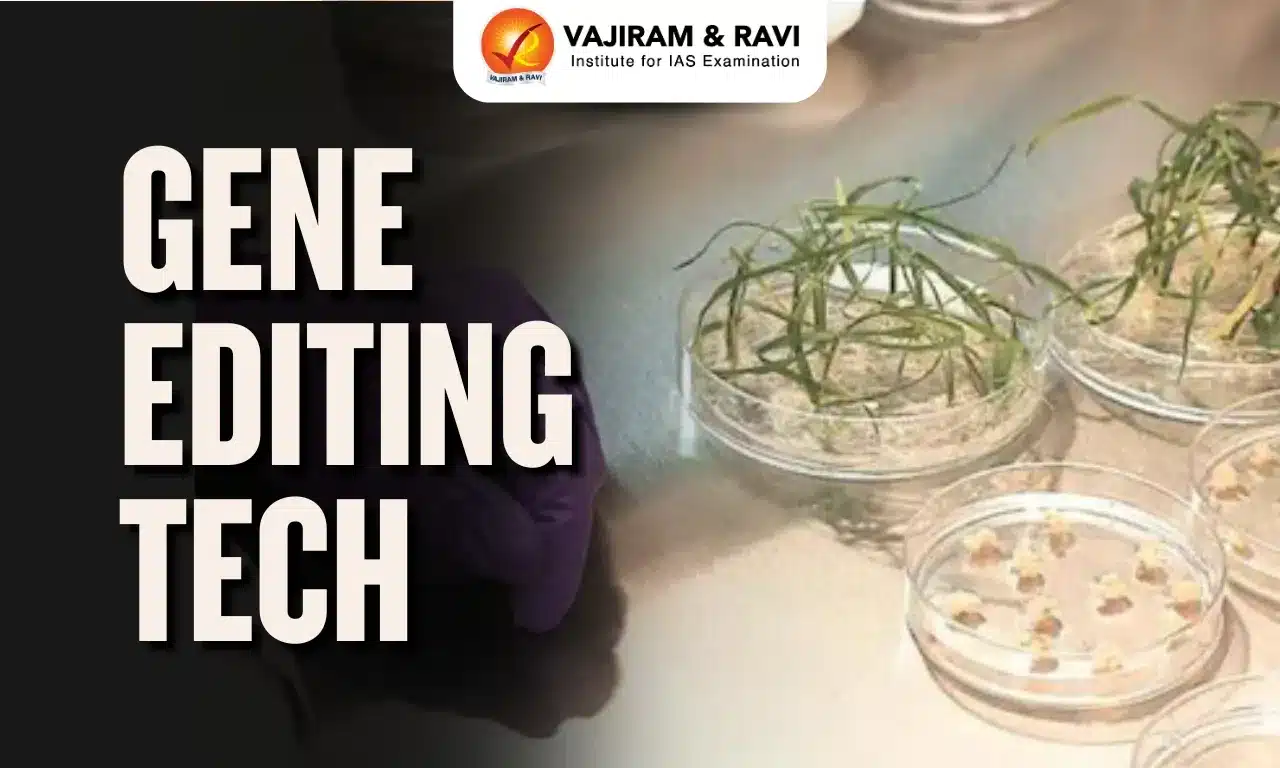
Gene Editing Tech Latest News
- Indian scientists have created a homegrown, “miniature” alternative to the globally patented CRISPR-Cas system for precise genome editing in plants.
- CRISPR-Cas is a natural bacterial defense system adapted for genome editing.
- It uses a guide RNA to lead a Cas enzyme, such as Cas9, to a specific DNA sequence.
- The Cas enzyme cuts the DNA at that exact spot, and the cell’s repair machinery is then used to insert, delete, or modify genes with precision.
- The new technology, recently patented by the Indian Council of Agricultural Research (ICAR), uses TnpB — transposon-associated proteins — to cut and modify plant DNA.
- This development strengthens India’s ability to produce genome-edited (GE) crops at lower cost while reducing dependence on foreign proprietary tools.
Gene Modification Vs Gene Editing
- Gene Modification – GM introduces foreign DNA from a different species into an organism.
- Process: A new gene from another organism is inserted into the target organism’s genome.
- Outcome: Produces a genetically modified organism (GMO) containing genetic material from multiple species.
- Analogy: Like inserting a new chapter from another author into a book.
- Example: Adding a gene from another plant species to make a crop disease-resistant.
- Gene Editing – Gene editing makes precise, targeted changes to an organism’s existing DNA without adding foreign genes.
- Process: Small changes—such as deletions, corrections, or replacements—are made at specific DNA sites. It uses Molecular scissors (Cas/TnpB) and Guides RNA to direct cuts at precise DNA locations.
- Outcome: Produces a genetically edited organism (GEO) with modified original DNA.
- Analogy: Like correcting or deleting a word in a document.
- Example: Removing a gene to stop an unwanted protein or correcting a mutation causing a genetic disorder.
India’s First GE Rice Varieties
- ICAR announced two CRISPR-edited rice varieties:
- Samba Mahsuri (IIRR) – Edited cytokinin oxidase 2 gene using CRISPR-Cas12a → higher yield.
- MTU-1010 (IARI) – Edited DST gene using CRISPR-Cas9 → drought & salinity tolerance.
- These varieties face commercialisation hurdles due to CRISPR patent restrictions.


Indigenous Breakthrough in Genome Editing
- Indian scientists have developed a “miniature alternative” to CRISPR-Cas technologies using TnpB proteins, offering a fully indigenous genome-editing (GE) tool for plants.
- The technology, recently patented by ICAR, enables precise DNA cutting and modification to improve crop traits.
What Makes TnpB Technology Different
- The new tool uses Transposon-associated TnpB proteins that function like Cas9/Cas12a as molecular scissors.
- Key advantages:
- Much smaller size (400–500 amino acids) compared to Cas9 (1,000–1,400) and Cas12a (1,300).
- Compact size allows easy delivery via viral vectors, avoiding tissue-culture-based delivery.
- Uses Deinococcus radiodurans-derived TnpB, enabling efficient gene editing.
- Deinococcus radiodurans is a bacterium that can survive in extremely harsh conditions.
- The bacterium is harmless to humans. It is useful in bioremediation and can help clean up radioactive waste.
Why TnpB-Based Editing Is a Game Changer
- The indigenous tool allows:
- Freedom from foreign IP control
- Lower costs for GE crop development
- Easier DNA delivery due to the protein’s small size
- Potential to address NGO concerns about foreign companies dominance
Why India Needed an Alternative to CRISPR
- CRISPR-Cas technologies are controlled globally by:
- Broad Institute – patents for CRISPR-Cas12a
- Corteva Agriscience – joint licensing for CRISPR-Cas9 in agriculture
- Indian scientists can use CRISPR for research but commercial release of GE varieties requires licensing fees.
- Indigenous TnpB systems eliminate such IP restrictions, making GE crop development affordable and scalable.
- ICAR has been negotiating with Broad Institute and Corteva since July 2025. They permit research use but may charge licensing fees for commercial GE crop cultivation.
- India has requested fee waivers for small and marginal farmers.

 Last updated on August, 2026
→ UPSC Mains Question Paper 2026 is out now for Essay & GS Paper 1, 2, 3 & 4.
→ UPSC Mains GS Paper 1 2026 is out now.
→ UPSC Mains GS Paper 2 2026 is out now.
→ UPSC Mains GS Paper 3 2026 is out now.
→ UPSC Mains GS Paper 4 2026 is out now.
→ UPSC Mains Indian Language Paper & English Compulsory Paper are out now.
→ Check out the latest UPSC Syllabus 2026 here.
→ UPSC Mains Admit Card 2026 is now out.
→ Enroll in Vajiram & Ravi’s UPSC Mains Test Series 2027 for structured answer writing practice, expert evaluation, and exam-oriented feedback.
→ Join Vajiram & Ravi’s UPSC Mentorship Program 2027 for personalized guidance, strategy planning, and one-to-one support from experienced mentors.
→ Go through the UPSC Mains Previous Year Papers to enhance your preparation.
→ Download UPSC Mains Essay Paper 2025, UPSC Mains GS Paper-I 2025, UPSC Mains GS Paper-II 2025, UPSC Mains GS Paper-III 2025, UPSC Mains GS Paper-IV 2025, UPSC Mains English (Compulsory) Paper 2025, UPSC Mains Hindi (Qualifying) Paper 2025 here.
→ UPSC has released UPSC Toppers List 2025 with the Civil Services final result on its official website.
→ UPSC Calendar 2027 has been released.
→ Also check Best UPSC Coaching in India
Gene Editing Tech FAQs
Q1. What is the new indigenous gene-editing technology developed in India?+
Q2. How is TnpB different from CRISPR-Cas systems?+
Q3. Why does India need an alternative to CRISPR?+
Q4. What advantages does the TnpB-based tool offer crop breeders?+
Q5. What is the future potential of India’s TnpB genome-editing tool?+
Tags: Gene editing tech mains articles upsc current affairs upsc mains current affairs