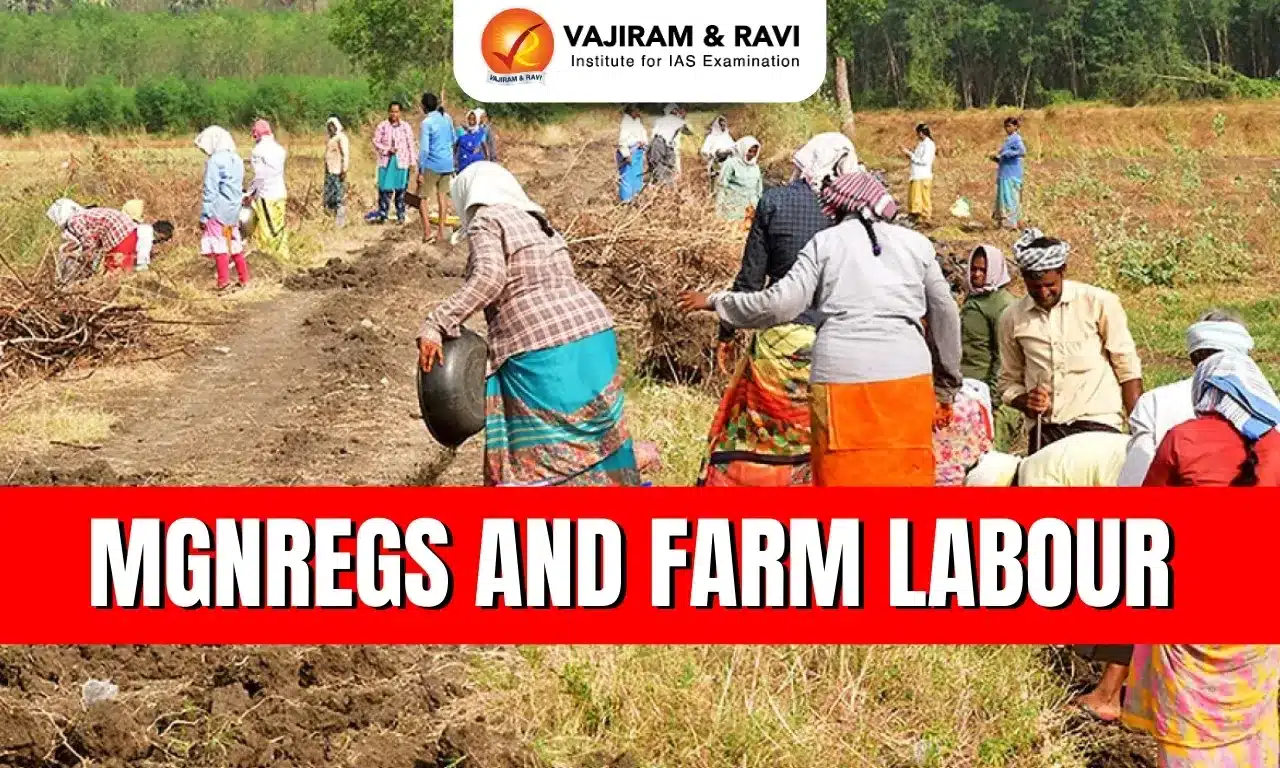
MGNREGS and Farm Labour Latest News
- The Viksit Bharat-Guarantee for Rozgar and Ajeevika Mission Gramin (VB-G RAM G) Bill proposes a 60-day pause on rural employment works during peak sowing and harvesting seasons.
- Notified in advance by States, the measure aims to ensure adequate farm labour availability.
- The Bill seeks to replace MGNREGA, which has long been criticised for contributing to agricultural labour shortages, a concern earlier raised even by former Agriculture Ministers.
Rural Wages Under MGNREGA: What the Data Show
- MGNREGA is often credited with tightening rural labour markets and strengthening workers’ bargaining power.
- However, this has not translated into a strong or sustained rise in wages.
- Labour Bureau data covering 25 occupations across 20 States show that all-India rural wage growth for male workers ranged between 3.6% and 6.4% annually over the past decade.
- In four of the ten years (2015-16, 2019-20, 2021-22 and 2022-23), nominal rural wage growth lagged behind consumer price inflation, implying a fall in real wages.
- Real wage growth exceeded 1% only in 2017-18.
- Agricultural wages grew faster than overall rural wages in eight out of ten years. Only in 2015-16 and 2019-20 did non-farm rural wages grow faster.
Limited Gains Despite MGNREGA
- Even agricultural wages merely kept pace with inflation, showing no significant surge over the past decade.
- Overall, the data suggest that despite MGNREGA, rural wage growth under the current government has remained modest and often inflation-adjusted stagnant.


Why Rural Wage Growth Has Remained Modest
- A key factor behind tepid rural wage growth is the sharp rise in women’s participation in the rural workforce.
- According to the Periodic Labour Force Survey, rural female LFPR rose from 24.6% in 2017-18 to 47.6% in 2023-24 — almost doubling in seven years, significantly expanding labour supply.
- Labour Force Participation Rate (LFPR) measures the share of people aged 15+ who are working or seeking work.
Role of Government Welfare Schemes
- The Economic Survey 2023-24 attributes this rise to schemes like Ujjwala, Har Ghar Jal, Saubhagya and Swachh Bharat, which reduced women’s unpaid household burdens by improving access to LPG, water, electricity and sanitation.
Expansion of Rural Labour Supply
- By freeing women’s time for paid work, these schemes increased the size of the rural workforce. Economically, this “rightward shift” in labour supply exerted downward pressure on wages.
Questioning the Farm Labour Shortage Narrative
- The data weakens the claim that MGNREGA created a widespread labour shortage. Increased female participation, especially in nearby farm work, may have offset workers drawn into MGNREGA.
- While farmers face seasonal labour shortages, directly blaming MGNREGA — and justifying work curbs during peak seasons — requires stronger, ground-level evidence rather than broad assumptions.
Alternative Causes of Farm Shortage
- Low Farm Wages: Agricultural wages are often lower than both MGNREGS wages and non-farm wages, making farm work less attractive.
- Poor Working Conditions: Farm labourers frequently suffer from health issues like musculoskeletal disorders due to harsh working conditions. MGNREGS work is often perceived as less toilsome with less supervision.
- Out-migration: A significant cause of labour shortage is the long-standing trend of rural out-migration to urban areas for better-paying jobs and opportunities, a trend that predates the implementation of NREGS.
- Increased Bargaining Power: MGNREGS has provided a baseline of employment security, increasing the bargaining power of rural workers for better wages in both the farm and non-farm sectors, which some farmers interpret as a “shortage”.
Conclusion
- Policy discussions have explored improved alignment with farm cycles, including temporary work suspensions during peak seasons or permitting MGNREGS activities on private farms for specific agricultural operations.
- While some farmers attribute labour shortages to MGNREGS, broader evidence points to deeper structural issues in agriculture and the availability of better work options for rural labourers.
Source: IE

 Last updated on Oct, 2026
→ UPSC 2027 Notification will be released on 13 January 2027 at upsconline.nic.in.
→ Check Nobel Prize 2026 Winners List here.
→ Download PIB PRiSM Monthly Magazine 2026 here.
→ Check UPSC Monthly Current Affairs Magazine The Recitals here.
→ Check out the latest UPSC Syllabus here.
→ Download UPSC Model Answers for Mains 2026
→ UPSC Mains Question Paper 2026 is out now for Essay & GS Paper 1, 2, 3 & 4.
→ UPSC Calendar 2027 has been released.
→ Enroll in Vajiram & Ravi’s UPSC Mains Test Series 2027 for structured answer writing practice, expert evaluation, and exam-oriented feedback.
→ Join Vajiram & Ravi’s UPSC Mentorship Program 2027 for personalized guidance, strategy planning, and one-to-one support from experienced mentors.
→ Go through the UPSC Mains Previous Year Papers to enhance your preparation.
→ UPSC has released UPSC Toppers List 2025 with the Civil Services final result on its official website.
→ Also check Best UPSC Coaching in India
MGNREGS and Farm Labour FAQs
Q1. Does MGNREGS significantly increase rural wages?+
Q2. Why have agricultural wages not risen sharply under MGNREGS?+
Q3. How has women’s labour force participation affected rural wages?+
Q4. Is MGNREGS the main reason for farm labour shortages?+
Q5. What policy solutions are being discussed?+
Tags: mains articles MGNREGS and farm labour upsc current affairs upsc mains current affairs