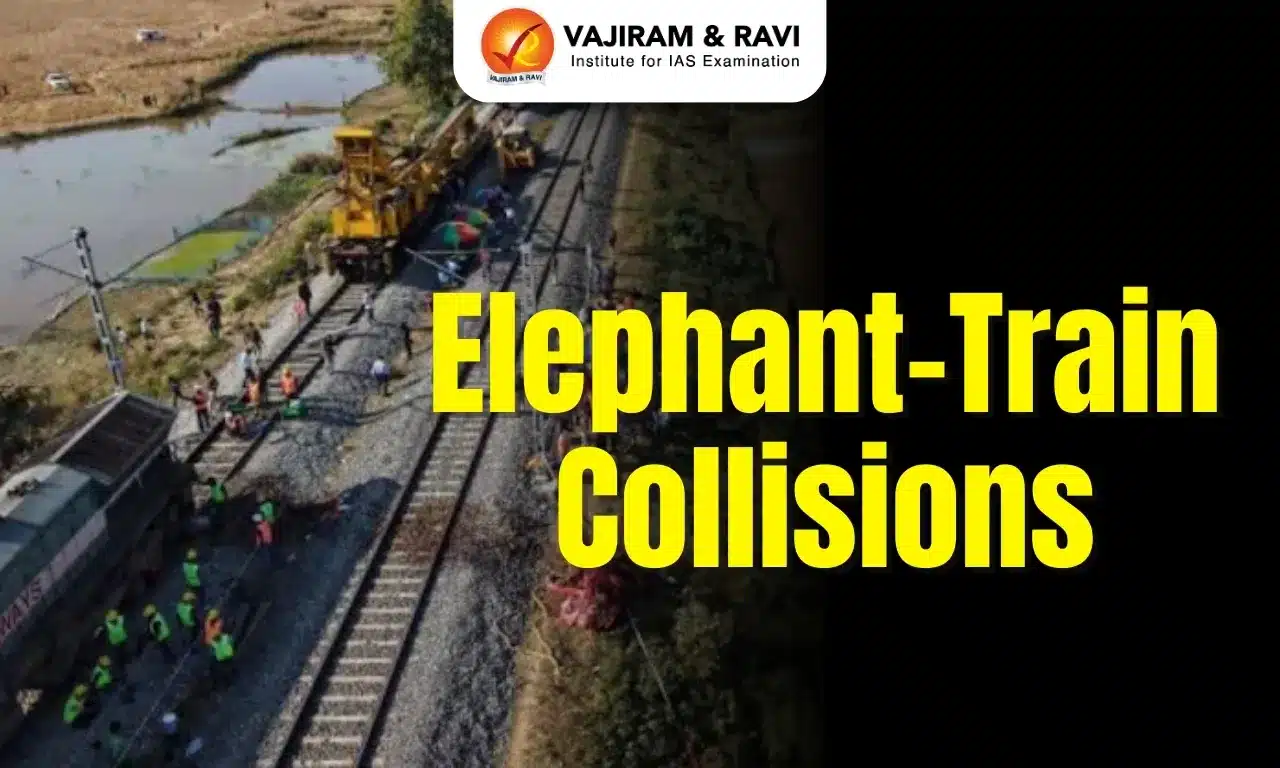
Elephant–Train Collisions Latest News
- Recently, seven elephants were killed when the Delhi-bound Rajdhani Express hit a herd in Assam’s Hojai district.
- The impact derailed the locomotive and five coaches, but no passengers were injured.
Elephant Deaths on Railway Tracks: Scale and Causes
- India is home to over half of the world’s Asian elephant population, and train collisions have emerged as a major human-caused threat to their survival.
- Railway accidents are among the leading anthropogenic causes of elephant deaths in the country.
Alarming Mortality Data
- Between 2010 and 2020, at least 1,160 elephants died due to non-natural causes.
- Electrocution was the biggest killer (741 deaths), followed by train hits (186 deaths).
- Notably, electrocution is often linked to high-voltage overhead railway lines, indirectly tying rail infrastructure to multiple causes of death.
Impact of Linear Transport Infrastructure (LTI)
- Railways, roads, and canals cutting through forests fragment elephant habitats.
- Such infrastructure can trap herds, restrict access to food and water, and increase stress, negatively affecting long-term health and survival.
Night-Time Collisions and Behavioural Factors
- Studies show that most train–elephant collisions occur at night.
- Male elephants are disproportionately affected, as they cross tracks more frequently, especially during crop-harvest seasons when they engage in crop-raiding, increasing exposure to railway lines.


Preventing Elephant–Train Collisions: Why Crossings Matter
- According to the Handbook to Mitigate the Impacts of Roads and Railways on Asian Elephants (2023) by the International Union for Conservation of Nature (IUCN), the most effective strategy is avoiding elephant habitats and migration corridors while planning infrastructure.
- Mitigation measures are not substitutes for careful route selection, but are necessary when avoidance is impractical.
Wildlife Crossing Structures: The Core Solution
- Well-designed wildlife crossing structures, combined with fencing, can reduce wildlife mortality by up to 98%.
- These crossings form the backbone of effective mitigation strategies for roads and railways cutting through elephant landscapes.
Types of Crossings and Design Principles
- Crossings can be underpasses (beneath bridges or flyovers) or overpasses (over tunnels or green bridges).
- The choice depends on terrain and animal behaviour. For elephants, openness is critical—they avoid confined spaces.
- The handbook recommends minimum heights of 6–7 metres, adjusted for crossing length, to ensure usage.
Placement Based on Elephant Movement
- Where and how many crossings are built matters as much as design.
- Camera traps and GPS telemetry are used to map elephant movement and identify collision hotspots.
- These data guide the optimal placement of crossings.
Fencing as a Support Tool
- Strategic fencing along high-risk stretches prevents elephants from straying onto tracks and gently channels them toward designated crossings, enhancing the effectiveness of the entire mitigation system.
Using Technology to Prevent Elephant–Train Collisions
- Role of Early-Warning Systems – Alongside habitat avoidance and physical measures like crossings and fencing, technology-based early-warning systems are emerging as effective non-structural solutions to reduce elephant–train accidents by alerting train operators in advance.
- Types of Sensor-Based Technologies – Early-warning systems can be locomotive-based or ground-based. Locomotive systems use Forward Looking Infrared (FLIR) cameras, capable of detecting obstructions up to 750 metres, even in poor visibility.
- Ground-based systems deploy cameras, acoustic, or seismic sensors at known elephant crossing points.
- AI and Machine Learning as Game Changers – Earlier, these systems were limited by the massive data they generated and difficulties in distinguishing real threats from false alarms.
- Artificial intelligence and machine learning now allow faster, more accurate analysis, greatly improving reliability and response time.
Indian Railways’ Pilot Initiatives
- Indian Railways has begun deploying AI-based early-warning systems, though adoption remains limited.
- In 2023, the Northeast Frontier Railway pioneered AI monitoring to protect elephants, followed by a similar rollout along the Kerala–Tamil Nadu border in 2024.
- Early results from these pilots have been encouraging, suggesting strong potential for wider implementation.

 Last updated on Sep, 2026
→ UPSC 2027 Notification will be released on 13 January 2027 at upsconline.nic.in.
→ Check out the latest UPSC Syllabus here.
→ Download UPSC Model Answers for Mains 2026
→ UPSC Mains Question Paper 2026 is out now for Essay & GS Paper 1, 2, 3 & 4.
→ UPSC Calendar 2027 has been released.
→ Enroll in Vajiram & Ravi’s UPSC Mains Test Series 2027 for structured answer writing practice, expert evaluation, and exam-oriented feedback.
→ Join Vajiram & Ravi’s UPSC Mentorship Program 2027 for personalized guidance, strategy planning, and one-to-one support from experienced mentors.
→ Go through the UPSC Mains Previous Year Papers to enhance your preparation.
→ UPSC has released UPSC Toppers List 2025 with the Civil Services final result on its official website.
→ Also check Best UPSC Coaching in India
Elephant–Train Collisions FAQs
Q1. Why are elephant–train collisions common in India?+
Q2. How serious is the elephant mortality caused by trains?+
Q3. How do railway lines affect elephant habitats?+
Q4. What role do wildlife crossings play in prevention?+
Q5. How can technology reduce elephant–train collisions?+
Tags: Elephant–train collisions mains articles upsc current affairs upsc mains current affairs