


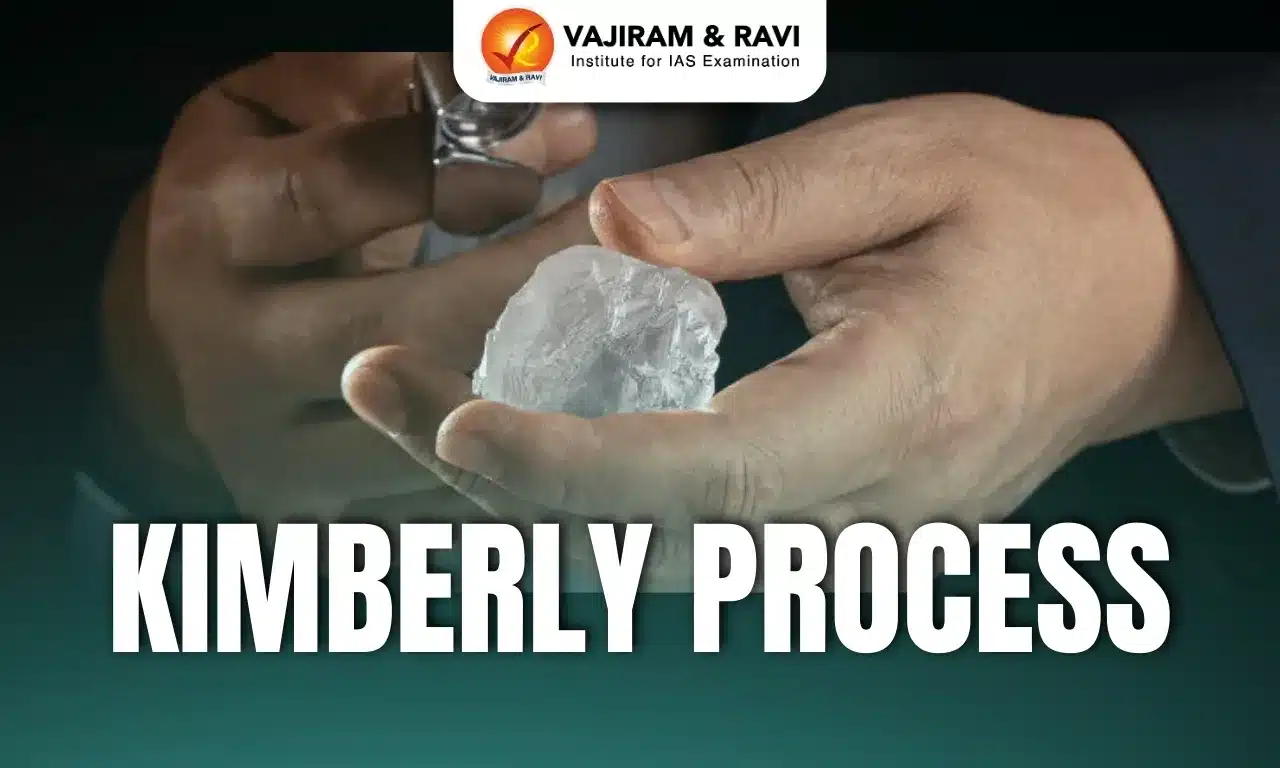
Kimberley Process Latest News
India has assumed the chair of the Kimberley Process (KP) for the year 2026.
About Kimberley Process
- It is a coalition of governments, civil society and the diamond industry to eliminate the trade in so-called conflict diamonds.
- Conflict diamonds are defined by the relevant United Nations Security Council resolution (UNSC resolution 1459) as “rough diamonds used by rebel movements or their allies to finance conflict aimed at undermining legitimate governments”.
- Based on a mandate from the United Nations, the Kimberley Process regulates the international trade in rough diamonds.
- Participants in the scheme are required to:
- Satisfy ‘minimum requirements’ and establish national legislation, institutions and import/export controls;
- Commit to transparent practices and to the exchange of critical statistical data;
- Trade only with other participants in the Scheme;
- Certify shipments as conflict-free.
- Currently it has 60 participants, representing 86 countries (with the EU as a single participant) which account for more than 99% of the global rough diamond production and trade.
- The KP meets twice a year at the Intersessional and Plenary meetings. It is chaired by a participating country on an annual, rotating basis.
- As a consensus-based body, the KP relies on the constructive engagement from all participants of the tripartite structure.


What is the Kimberley Process Certification Scheme (KPCS)?
- It is the mechanism the KP uses to prevent the trade of conflict diamonds.
- Under this scheme, the Government implements safeguards on shipments of rough diamonds and certifies the diamond as conflict-free.
- According to this Scheme, each rough diamond shipment must be accompanied by the Kimberley Process certificate and transported in a tamper-resistant container.
- The KP certificate states the authenticity of the rough diamond.
- Since 2003, India has been actively participating in the KPCS process.
- The Department of Commerce is the nodal Department.
- Gem & Jewellery Export Promotion Council (GJEPC) is designated as the KPCS Importing and Exporting Authority in India.
- GJEPC is responsible for issuing KP Certificates and is also the custodian of KP Certificates received in the country.
Source: TH

 Last updated on Sep, 2026
→ UPSC 2027 Notification will be released on 13 January 2027 at upsconline.nic.in.
→ Check out the latest UPSC Syllabus here.
→ Download UPSC Model Answers for Mains 2026
→ UPSC Mains Question Paper 2026 is out now for Essay & GS Paper 1, 2, 3 & 4.
→ UPSC Calendar 2027 has been released.
→ Enroll in Vajiram & Ravi’s UPSC Mains Test Series 2027 for structured answer writing practice, expert evaluation, and exam-oriented feedback.
→ Join Vajiram & Ravi’s UPSC Mentorship Program 2027 for personalized guidance, strategy planning, and one-to-one support from experienced mentors.
→ Go through the UPSC Mains Previous Year Papers to enhance your preparation.
→ UPSC has released UPSC Toppers List 2025 with the Civil Services final result on its official website.
→ Also check Best UPSC Coaching in India
Kimberley Process FAQs
Q1. What is the Kimberley Process (KP)?+
Q2. What does the Kimberley Process regulate?+
Q3. How many participants are currently part of the Kimberley Process?+
Q4. What is the Kimberley Process Certification Scheme (KPCS)?+
Tags: kimberly process prelims pointers upsc current affairs upsc prelims current affairs









