Katydids Latest News
Researchers recently identified three previously unknown species of meadow katydids, or long-horned grasshoppers, named Conocephalus usmanii, Conocephalus nagariensis, and Conocephalus ganderbali, in Jammu and Kashmir.
About Katydids
- Found on every continent except Antarctica, Katydids are a family of primarily nocturnal insects.
- There are more than 8,000 known species of Katydid, all of which belong to the family Tettigoniidae.
- Grasshoppers, locusts, crickets, and katydids belong to a group of insects known as orthopterans (meaning ‘straight wings’).
- They closely resemble grasshoppers and used to go by the name long-horned grasshoppers.
- However, in reality, they are more closely related to crickets, hence their other common name, the bush cricket.


Katydids Features
- Katydids vary greatly in size depending on the species. That said, most range between 0.2 inches to 5.1 inches long.
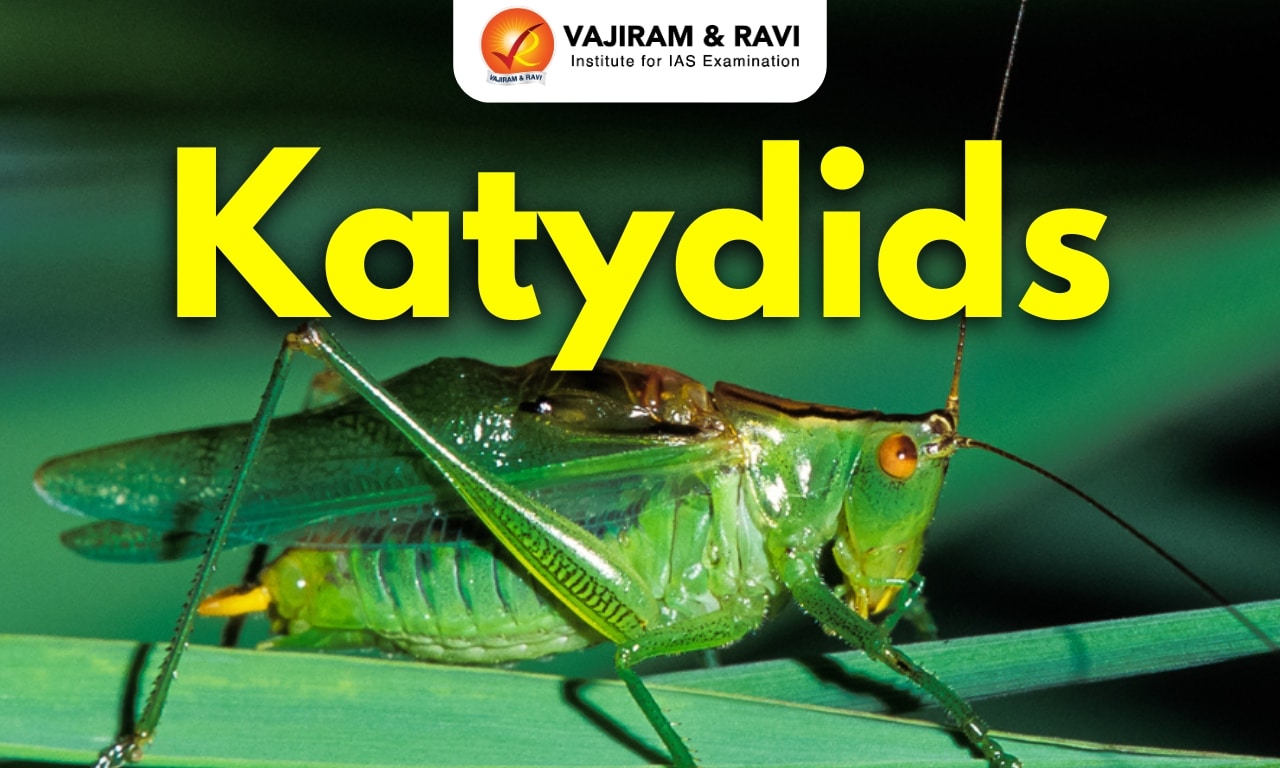
- The body generally resembles that of grasshoppers, but katydids have long, threadlike antennae instead of the grasshoppers’ short antennae.
- While most Katydids appear bright green or mimic the appearance of leaves, they come in a variety of colors, ranging from pink to yellow.
- Like grasshoppers and crickets, katydids make noise by rubbing body parts together — in their case, by moving a leg against a wing and producing a sound that resembles their name.
- They are famous for their ability to blend into their surroundings.
- Katydids have feet with four segments.
- The lifespan of a katydid is about a year.
- They are mostly herbivores, feeding on leaves, flowers, and fruit, but some eat small insects.
Key Facts about Meadow Katydids
- The meadow katydids are a group of about 20 species of slender, small-to medium-sized katydids found in grassy meadows near lakes and ponds.
- Genus: Orchelimum
- When disturbed, they enter the water, cling to underwater plants, and can remain submerged for several minutes.
- Abundant and widespread, meadow katydids have large orange eyes and a body that is brown on top and green on the bottom.
- They produce a song, consisting of clicks and buzzes, during the day or at night.
Conocephalus Nagariensis
- Found in the Budgam district, it is distinguished by its spindle-shaped appendages (cerci) and a stridulatory file containing exactly 34 teeth.
- It is dedicated to Dr. Rajendra Nagar, a researcher credited with discovering several other species of katydids across the country, and bears his name.
Conocephalus Ganderbali
- Discovered in the Ganderbal region, it is notably small and slender.
- It has a musical file of only 28 teeth and a unique V-shaped incision on its underbelly.
- Its name is derived from the Ganderbal district in Kashmir, the specific locality where the researchers first collected the specimens.
Conocephalus Usmanii
- It features a flat, elongated plate on its abdomen and a musical file with 36 teeth.
- It was named in honour of Professor Mohd Kamil Usmani, a scholar who has made significant contributions to the study of Orthoptera (the group of insects including grasshoppers and katydids) in India.
Source: RM

 Last updated on August, 2026
→ UPSC Mains 2026 commenced on 21st August 2026 and will continue through 30th August 2026, as per the official examination schedule.
→ UPSC Mains Question Paper 2026 is out now for Essay & GS Paper 1, 2, 3 & 4.
→ UPSC Mains GS Paper 1 2026 is out now.
→ UPSC Mains GS Paper 2 2026 is out now.
→ UPSC Mains GS Paper 3 2026 is out now.
→ UPSC Mains GS Paper 4 2026 is out now.
→ UPSC Mains Indian Language Paper & English Compulsory Paper are out now.
→ Check out the latest UPSC Syllabus 2026 here.
→ UPSC Mains Admit Card 2026 is now out.
→ Enroll in Vajiram & Ravi’s UPSC Mains Test Series 2027 for structured answer writing practice, expert evaluation, and exam-oriented feedback.
→ Join Vajiram & Ravi’s UPSC Mentorship Program 2027 for personalized guidance, strategy planning, and one-to-one support from experienced mentors.
→ Go through the UPSC Mains Previous Year Papers to enhance your preparation.
→ Download UPSC Mains Essay Paper 2025, UPSC Mains GS Paper-I 2025, UPSC Mains GS Paper-II 2025, UPSC Mains GS Paper-III 2025, UPSC Mains GS Paper-IV 2025, UPSC Mains English (Compulsory) Paper 2025, UPSC Mains Hindi (Qualifying) Paper 2025 here.
→ UPSC has released UPSC Toppers List 2025 with the Civil Services final result on its official website.
→ UPSC Calendar 2027 has been released.
→ Also check Best UPSC Coaching in India
Katydids FAQs
Q1. What are Katydids?+
Q2. How many species of katydids are known?+
Q3. To which insect group do grasshoppers, locusts, crickets, and katydids belong?+
Q4. What is another common name for katydids?+
Q5. What colors can katydids appear in?+
Tags: katydids prelims pointers upsc current affairs upsc prelims current affairs