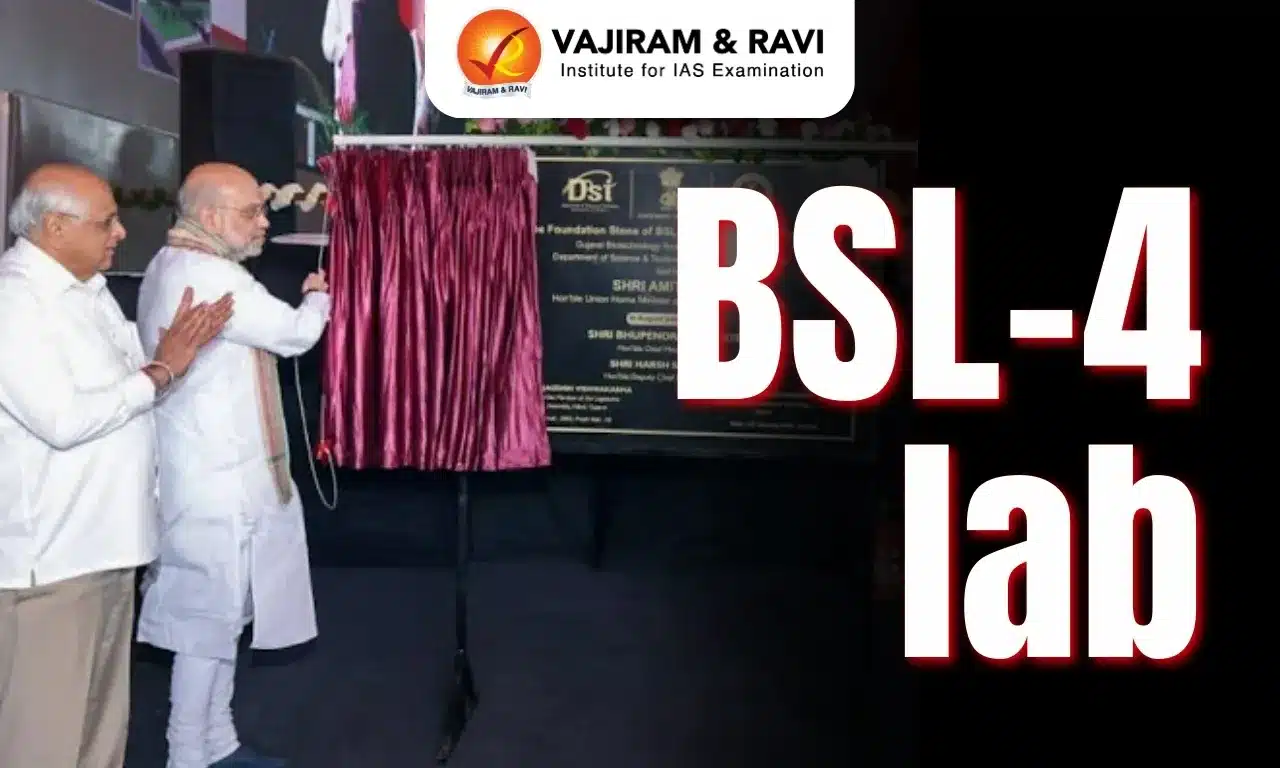
BSL-4 Lab Latest News
- Union Home Minister Amit Shah laid the foundation stone for India’s first state-funded Bio-Safety Level 4 (BSL-4) containment facility in Gandhinagar.
- Describing it as a “health shield” for the nation, he said the laboratory marks the start of a new era in India’s health security and biotechnology capabilities.
About BSL-4 Facility
- A Bio-Safety Level 4 (BSL-4) facility represents the highest level of biological containment, designed to safely handle the world’s most dangerous and highly infectious pathogens, many of which lack effective vaccines or treatments.
- Operating under stringent international safety standards, these laboratories enable advanced research on deadly diseases, including the development of diagnostics, vaccines, and therapeutics, as well as rapid outbreak investigation and response.
- India’s upcoming BSL-4 laboratory in Sector-28 of Gandhinagar, along with an Animal Bio-Safety Level (ABSL) facility, will serve as a strategic national asset for research on some of the deadliest known pathogens.
- This will strengthen the country’s health security and bio-preparedness.


Gujarat’s State-Funded BSL-4 Laboratory
- The BSL-4 laboratory being built in Gandhinagar, Gujarat, will be India’s first fully state-funded and state-controlled BSL-4 facility and the second civilian BSL-4 research lab in the country.
- Spread over 11,000 sq metres and costing ₹362 crore, it is being developed under the Gujarat State Biotechnology Mission.
Institutional Framework and Timeline
- The facility will operate under the Gujarat Biotechnology Research Centre, which already houses a BSL-2+ laboratory and played a key role during the Covid-19 pandemic by sequencing the SARS-CoV-2 genome.
- Planning for the BSL-4 lab began in mid-2022, with the foundation stone laid on January 13, 2026.
Infrastructure and Safety Standards
- The complex will include BSL-4, BSL-3, BSL-2, ABSL-4, and ABSL-3 laboratory modules, along with advanced utilities and support systems.
- It is being developed in line with international biosafety guidelines issued by the Centers for Disease Control and Prevention, National Institutes of Health, Department of Biotechnology, and Indian Council of Medical Research.
Role in Disease Control and Vaccine Research
- The lab will strengthen Gujarat’s and India’s capacity to respond in real time to outbreaks of deadly human diseases and zoonotic infections.
- It will also support advanced research into diagnostics, vaccines, and therapeutics.
- The ABSL-4 component will allow animal disease research and vaccine production using antibodies derived from animals—work that earlier required sending samples to ICAR–National Institute of High Security Animal Diseases.
National Facility and Expert Oversight
- The Department of Biotechnology has signed an MoU designating the lab as a national facility, ensuring guidance from expert institutions across India.
- Officials note that the lab will remove long-standing bottlenecks caused by the lack of BSL-4 infrastructure in the country.
Existing BSL-4 and ABSL-4 Facilities in India
- Civilian BSL-4 Laboratories – India currently has only one functional civilian BSL-4 laboratory, located at the National Institute of Virology in Pune, Maharashtra. This facility handles research on the most dangerous human pathogens.
- Defence-Sector BSL-4 Facility – In late 2024, the Defence Research and Development Organisation established its own BSL-4 laboratory in Gwalior, Madhya Pradesh, under the Defence Ministry, expanding India’s high-containment research capacity.
High-Security Animal Disease Laboratories
- India has two major laboratories studying high-risk zoonotic diseases:
- The National Institute of High Security Animal Diseases (ICAR–NIHSAD) in Bhopal, currently rated ABSL-3+, with plans announced in June 2025 to upgrade it to ABSL-4.
- The International Centre for Foot and Mouth Disease (ICAR–ICFMD) in Bhubaneswar, Odisha, which operates with an ABSL-3Ag rating.
Global Context
- Officials note that globally about 69 BSL-4 laboratories are operational or under development, underscoring India’s relatively limited but gradually expanding presence in high-containment biological research infrastructure.
India’s Expanding Biosafety Laboratory Network
- As of March 2025, the Ministry of Health and Family Welfare, through the Department of Health Research, has approved 165 biosafety laboratories under the Virus Research and Diagnostic Laboratories (VRDL) scheme.
- This includes 154 BSL-2 and 11 BSL-3 labs aimed at epidemic preparedness and disaster response.
- ICMR-Led Biosafety Facilities – Beyond VRDLs, the Indian Council of Medical Research has established 21 biosafety laboratories across its institutes, comprising 1 BSL-4, 8 BSL-3, and 12 BSL-2 facilities.
- Science & Technology–Supported Labs – Under the Department of Science and Technology, the Anusandhan National Research Foundation has funded 5 BSL/ABSL-3 laboratories through the Intensification of Research in High Priority Areas (IRHPA) programme.
Biotechnology, Agriculture, and Industrial Research
- The Department of Biotechnology has set up 26 biosafety laboratories across DBT institutes.
- The Indian Council of Agricultural Research has established 9 biosafety laboratories.
- The Council of Scientific and Industrial Research has created 11 biosafety laboratories across its network.
Overall Picture
- Together, these initiatives reflect a broad-based expansion of India’s biosafety infrastructure—anchored by BSL-2 and BSL-3 capacity—with targeted investments in high-containment labs to strengthen national preparedness for infectious disease threats.

 Last updated on Oct, 2026
→ UPSC 2027 Notification will be released on 13 January 2027 at upsconline.nic.in.
→ Check Nobel Prize 2026 Winners List here.
→ Download PIB PRiSM Monthly Magazine 2026 here.
→ Check UPSC Monthly Current Affairs Magazine The Recitals here.
→ Check out the latest UPSC Syllabus here.
→ Download UPSC Model Answers for Mains 2026
→ UPSC Mains Question Paper 2026 is out now for Essay & GS Paper 1, 2, 3 & 4.
→ UPSC Calendar 2027 has been released.
→ Enroll in Vajiram & Ravi’s UPSC Mains Test Series 2027 for structured answer writing practice, expert evaluation, and exam-oriented feedback.
→ Join Vajiram & Ravi’s UPSC Mentorship Program 2027 for personalized guidance, strategy planning, and one-to-one support from experienced mentors.
→ Go through the UPSC Mains Previous Year Papers to enhance your preparation.
→ UPSC has released UPSC Toppers List 2025 with the Civil Services final result on its official website.
→ Also check Best UPSC Coaching in India
BSL-4 Lab FAQs
Q1. What is a BSL-4 lab?+
Q2. Why is the Gujarat BSL-4 lab significant?+
Q3. Which institutions will operate the BSL-4 lab?+
Q4. How does the BSL-4 lab improve disease preparedness?+
Q5. How does the BSL-4 lab fit into India’s biosafety network?+
Tags: BSL-4 lab mains articles upsc current affairs upsc mains current affairs