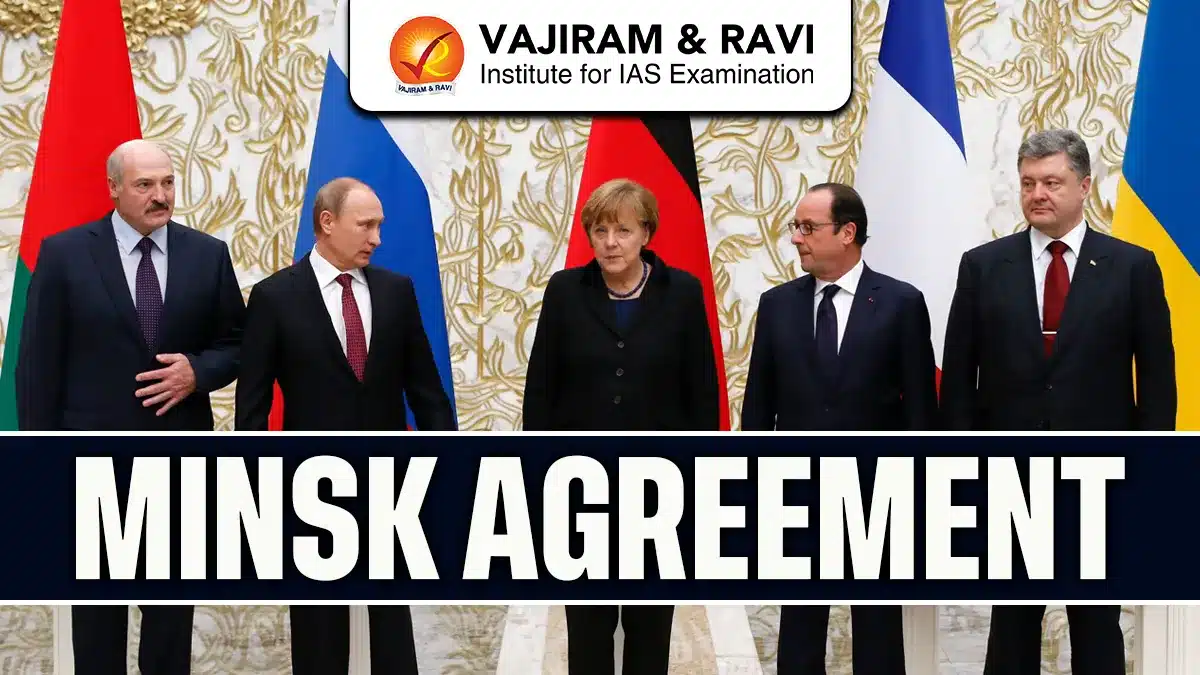
The Minsk Agreement refers to a set of peace agreements signed to end the armed conflict in eastern Ukraine between Ukrainian forces and Russian-backed separatists. These agreements became one of the most important diplomatic efforts in Europe after the Cold War and gained global attention again after Russia’s invasion of Ukraine in February 2022.
What Are the Minsk Agreements?
The Minsk Agreements were two peace deals signed in 2014 and 2015 in Minsk, the capital of Belarus. Their main aim was to stop fighting in the Donbas region of eastern Ukraine, where pro-Russian separatists had declared independence in the Donetsk and Luhansk regions. These agreements were negotiated by:
- Ukraine
- Russia
- OSCE (Organization for Security and Cooperation in Europe)
- Separatist representatives of Donetsk and Luhansk
Read about: Paris Agreement
Minsk Agreement Background
The Minsk Agreement emerged after the outbreak of armed conflict in eastern Ukraine in 2014, following Russia’s annexation of Crimea and the rise of pro-Russian separatist movements in Donetsk and Luhansk.
- In 2014, Ukraine faced political instability after the removal of President Viktor Yanukovych during the Euromaidan protests.
- Russia annexed Crimea soon after, escalating tensions with Ukraine and the West.
- Pro-Russian separatists declared independence in the Donetsk and Luhansk regions.
- Heavy fighting broke out between Ukrainian forces and separatist groups backed by Russia.
- Thousands of civilians were killed and displaced, creating a humanitarian crisis.
- To stop the conflict, negotiations were initiated involving Ukraine, Russia, OSCE, and later France and Germany.
- These efforts resulted in the signing of the Minsk Agreements in 2014 and 2015 to restore peace and stability in eastern Ukraine.


Minsk I Agreement (2014) Objectives
The Minsk I Agreement, signed in September 2014, was the first major attempt to end the armed conflict in eastern Ukraine between Ukrainian forces and Russian-backed separatists.
- To establish an immediate bilateral ceasefire between Ukrainian forces and separatist groups.
- To ensure monitoring and verification of the ceasefire by the OSCE.
- To promote decentralisation of power in Ukraine, granting special self-governance to certain areas of Donetsk and Luhansk.
- To create security zones along the Ukraine–Russia border under OSCE supervision.
- To ensure the release of hostages and illegally detained persons.
- To grant amnesty to individuals involved in the conflict, excluding serious crimes.
- To initiate inclusive national dialogue for political reconciliation.
- To improve the humanitarian situation in the conflict-affected Donbas region.
- To conduct early local elections in accordance with Ukrainian law.
- To ensure the withdrawal of illegal armed groups, military equipment, and foreign fighters from Ukrainian territory.
Read about: Shimla Agreement
Minsk II Agreement (2015) An Updated Peace Plan
The Minsk II Agreement, signed in February 2015, was a renewed diplomatic effort to end the ongoing conflict in eastern Ukraine after the failure of the first Minsk Agreement. It was negotiated under the Normandy Format, with mediation by France and Germany, and involved Ukraine, Russia, and representatives of the Donetsk and Luhansk regions.
Provisions of the Minsk II Agreement
- Implementation of an immediate and comprehensive ceasefire in the conflict zone.
- Withdrawal of heavy weapons by both sides to create a security buffer zone.
- Monitoring and verification by the OSCE to ensure compliance.
- Initiation of dialogue on interim self-government for Donetsk and Luhansk in accordance with Ukrainian law.
- Granting of special status to certain areas of eastern Ukraine.
- Amnesty and pardon for participants involved in the conflict.
- Exchange of hostages and prisoners on an “all for all” basis.
- Provision of humanitarian assistance to affected civilians.
- Restoration of social and economic links, including pensions and public services.
- Ukraine to regain control of its international borders after political reforms.
- Withdrawal of foreign armed formations, mercenaries, and military equipment.
- Constitutional reforms in Ukraine, focusing on decentralisation of power.
- Strengthening the role of the Trilateral Contact Group (Ukraine–Russia–OSCE) to oversee implementation.
Why Did the Minsk II Agreement Fail?
The Minsk II Agreement (2015) was designed to bring lasting peace to eastern Ukraine, but it ultimately failed due to political, military, and strategic disagreements between the parties involved. Despite international support, the agreement remained largely unimplemented on the ground.
Major Reasons for the Failure of Minsk II
- Lack of Mutual Trust: Ukraine and Russia consistently accused each other of violating the ceasefire, making cooperation impossible.
- Disagreement Over Sequence of Implementation: Ukraine wanted control of its international border first, while Russia insisted on political reforms and autonomy for Donbas before border control.
- Continued Ceasefire Violations: Fighting never completely stopped, especially in Donetsk and Luhansk, undermining confidence in the agreement.
- Ambiguous Provisions: Several clauses were vaguely worded, allowing both sides to interpret them differently, especially regarding autonomy and elections.
- Russia’s Strategic Interests: Russia viewed Minsk II as a tool to limit Ukraine’s NATO ambitions and maintain influence over Ukrainian politics.
- Weak Enforcement Mechanism: The OSCE had no military power to enforce compliance and could only monitor violations.
- Lack of Political Consensus in Ukraine: Many Ukrainians opposed granting special status to separatist regions, seeing it as a threat to sovereignty.
- External Geopolitical Tensions: Growing tensions between Russia and Western countries further reduced chances of successful implementation.
Minsk Agreement Significance
- The Minsk Agreements played a crucial role in temporarily reducing large-scale violence in eastern Ukraine and preventing the immediate escalation of the conflict into a full-scale international war.
- They provided a diplomatic framework for dialogue between Ukraine and Russia with the involvement of international mediators such as France, Germany, and the OSCE.
- The agreements highlighted the importance of multilateral diplomacy in resolving regional conflicts, even though their implementation remained weak.
- Minsk Agreements brought global attention to the security challenges in Eastern Europe and exposed the fragility of post–Cold War peace arrangements.
- They demonstrated the limitations of peace agreements that lack strong enforcement mechanisms and mutual political trust.
- The process underlined the strategic importance of Ukraine in European and global geopolitics.
- The failure of the agreements eventually contributed to the outbreak of the Russia-Ukraine war in 2022, reshaping global security dynamics.

 Last updated on Sep, 2026
→ UPSC 2027 Notification will be released on 13 January 2027 at upsconline.nic.in.
→ UPSC Mains Question Paper 2026 is out now for Essay & GS Paper 1, 2, 3 & 4.
→ UPSC Mains GS Paper 1 2026 is out now.
→ UPSC Mains GS Paper 2 2026 is out now.
→ UPSC Mains GS Paper 3 2026 is out now.
→ UPSC Mains GS Paper 4 2026 is out now.
→ UPSC Mains Indian Language Paper & English Compulsory Paper are out now.
→ Check out the latest UPSC Syllabus 2026 here.
→ UPSC Mains Admit Card 2026 is now out.
→ Enroll in Vajiram & Ravi’s UPSC Mains Test Series 2027 for structured answer writing practice, expert evaluation, and exam-oriented feedback.
→ Join Vajiram & Ravi’s UPSC Mentorship Program 2027 for personalized guidance, strategy planning, and one-to-one support from experienced mentors.
→ Go through the UPSC Mains Previous Year Papers to enhance your preparation.
→ Download UPSC Mains Essay Paper 2025, UPSC Mains GS Paper-I 2025, UPSC Mains GS Paper-II 2025, UPSC Mains GS Paper-III 2025, UPSC Mains GS Paper-IV 2025, UPSC Mains English (Compulsory) Paper 2025, UPSC Mains Hindi (Qualifying) Paper 2025 here.
→ UPSC has released UPSC Toppers List 2025 with the Civil Services final result on its official website.
→ UPSC Calendar 2027 has been released.
→ Also check Best UPSC Coaching in India
Minsk Agreement FAQs
Q1. What is the Minsk Agreement?+
Q2. How many Minsk Agreements were signed?+
Q3. Why were the Minsk Agreements signed?+
Q4. Who were the parties involved in the Minsk Agreements?+
Q5. What was the main aim of the Minsk Agreements?+
Tags: minsk agreement