Trade Agreement Latest News
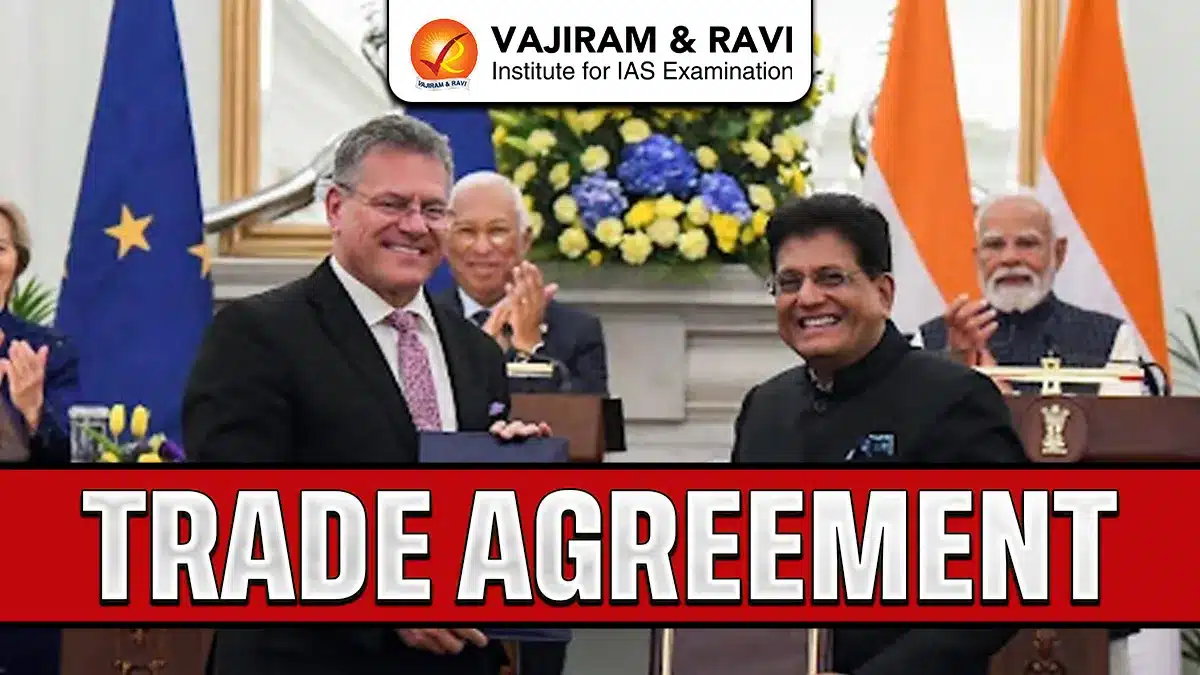
- India and the European Union have concluded negotiations on a long-pending Free Trade Agreement (FTA), described by leaders as the “mother of all deals”.
Background of India-EU Trade Relations
- India and the European Union are among the world’s largest economies and long-standing trading partners.
- The EU is India’s largest trading partner in goods, while India is a key market for EU exports and investments.
- Negotiations for a comprehensive trade agreement began in 2007 but faced repeated pauses due to differences over market access, regulatory standards, agriculture, automobiles, and services.
- Talks were revived in 2022 with a more pragmatic approach, leading to the conclusion of the FTA in January 2026 after nearly two decades.


Key Features of the India-EU Free Trade Agreement
- The India-EU FTA is one of the most ambitious trade agreements signed by India to date, covering goods, services, and investment-related issues.
- Tariff Liberalisation Commitments
- The EU has agreed to remove tariffs on 99.5% of the items India exports to the region, with most duties falling to zero immediately upon the agreement coming into force.
- On India’s side, tariff concessions have been offered on 97.5% of the traded value of EU exports, though with phased reductions for sensitive sectors.
- This asymmetrical liberalisation reflects India’s developmental concerns while ensuring substantial market access gains.
What India Gains from the Agreement
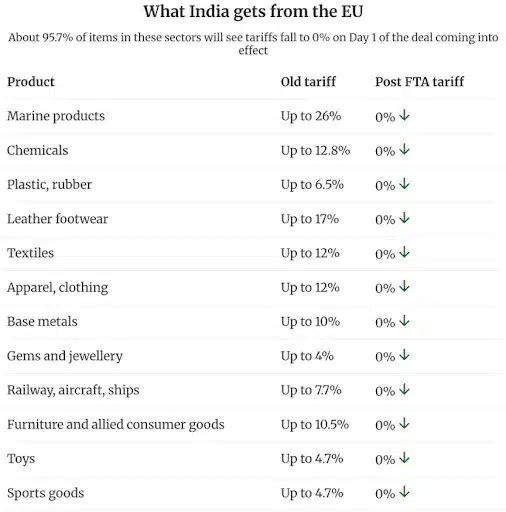
- India secures tariff reductions across 97% of tariff lines, covering 99.5% of trade value.
- About 90.7% of India’s exports will enjoy zero-duty access to the EU market from day one.
- Key beneficiaries include labour-intensive sectors such as textiles, apparel, leather and footwear, gems and jewellery, marine products, toys, sports goods, tea, coffee, and spices.
- These sectors are critical for employment generation and export-led growth.
- The EU has also made commitments across 144 services subsectors, including IT and IT-enabled services, professional services, education, and business services.
- This enhances opportunities for Indian professionals and firms in a high-income market and strengthens India’s position in global value chains.
What India Has Conceded
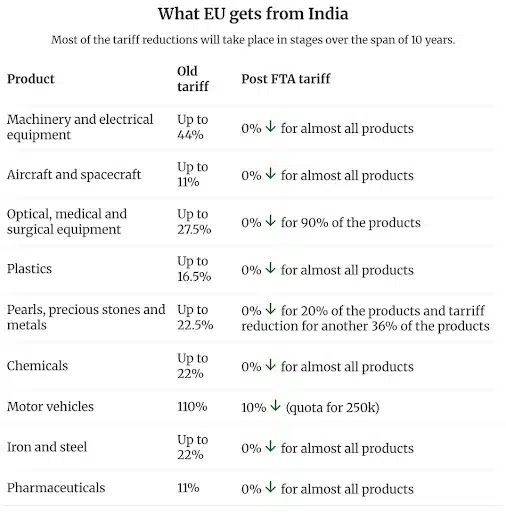
- India has agreed to duty elimination or reduction on 92.1% of tariff lines, covering 97.5% of EU exports.
- Nearly half of these tariff lines will see immediate duty elimination, while others will be phased out over 5, 7, or 10 years.
- High-technology imports from the EU, such as machinery, electrical equipment, medical devices, pharmaceuticals, aircraft components, and precision instruments, are expected to reduce input costs for Indian industry and support manufacturing competitiveness.
- Sensitive sectors like dairy and certain agricultural products have been excluded from full liberalisation to protect farmers’ livelihoods.
- Similarly, the EU has retained protections for products such as beef, sugar, rice, poultry, and milk powder.
Handling Sensitive and Contested Sectors
- Automobiles and wine were among the most contentious issues. A compromise was reached through quota-based systems.
- India agreed to lower import duties on European cars priced above Rs. 25 lakh from 110% to as low as 10%, subject to quotas and price-based categories.
- For wines, tariffs will be reduced from 150% to 20-30%, again under a quota mechanism.
- This approach balances consumer access and domestic industry protection.
Strategic and Geopolitical Significance
- For the EU, it reduces over-dependence on a limited set of global suppliers and strengthens supply chain resilience amid geopolitical uncertainties.
- For India, the agreement reinforces its image as a reliable economic partner and complements initiatives such as ‘Make in India’ and ‘Atmanirbhar Bharat’ by integrating domestic manufacturing with global markets.
Ratification and Implementation Process
- The concluded text will undergo legal scrubbing and translation before being sent to all 27 EU member states.
- Ratification by the European Parliament is required before the agreement enters into force. This process underscores the institutional complexity of EU trade governance.
Conclusion
- The India-EU Free Trade Agreement marks a watershed moment in India’s trade diplomacy.
- By opening markets while safeguarding sensitive sectors, the pact promises to boost exports, attract investment, generate employment, and deepen strategic ties between the two major economic blocs.
- Its successful implementation could serve as a template for India’s future trade agreements in an increasingly fragmented global trade environment.

 Last updated on Oct, 2026
→ UPSC 2027 Notification will be released on 13 January 2027 at upsconline.nic.in.
→ Asian Games 2026 are being held in Aichi-Nagoya, Japan, from 19 September to 4 October.
→ Check Nobel Prize 2026 Winners List here.
→ Download PIB PRiSM Monthly Magazine 2026 here.
→ Check UPSC Monthly Current Affairs Magazine The Recitals here.
→ Check out the latest UPSC Syllabus here.
→ Download UPSC Model Answers for Mains 2026
→ UPSC Mains Question Paper 2026 is out now for Essay & GS Paper 1, 2, 3 & 4.
→ UPSC Calendar 2027 has been released.
→ Enroll in Vajiram & Ravi’s UPSC Mains Test Series 2027 for structured answer writing practice, expert evaluation, and exam-oriented feedback.
→ Join Vajiram & Ravi’s UPSC Mentorship Program 2027 for personalized guidance, strategy planning, and one-to-one support from experienced mentors.
→ Go through the UPSC Mains Previous Year Papers to enhance your preparation.
→ UPSC has released UPSC Toppers List 2025 with the Civil Services final result on its official website.
→ Also check Best UPSC Coaching in India
Trade Agreement FAQs
Q1. What is the India-EU Free Trade Agreement?+
Q2. Why is the India-EU FTA called the ‘mother of all deals’?+
Q3. Which Indian sectors benefit the most from the agreement?+
Q4. How are sensitive sectors protected under the FTA?+
Q5. What is the strategic importance of the India-EU FTA?+
Tags: mains articles trade agreement upsc current affairs upsc mains current affairs