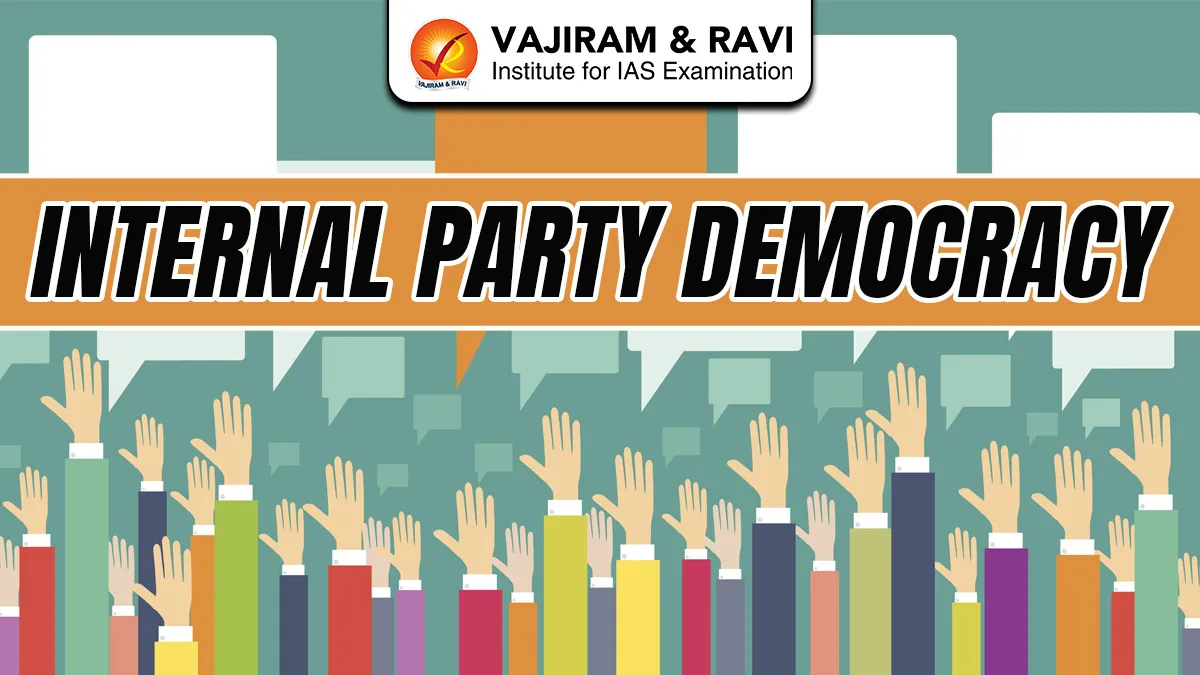
Internal party democracy means political parties adhere to the core principles of democracy in their internal structure like holding regular elections, active participation of its members in decision making and ensuring transparency, fairness, and accountability.
Internal Party Democracy Need
India is the largest representative democracy in the world where voters directly elect 543 Members of Parliament (MP), who represent them in the Lok Sabha, or the Lower House of Parliament, and act as the crucial link between the electorate and the government.
It is the political parties that form the government, man the Parliament and run the governance of the country. It is, therefore, necessary to introduce internal democracy, financial transparency and accountability in the working of the political parties.
A political party which does not respect democratic principles in its internal working cannot be expected to respect those principles in the governance of the country. It cannot be a dictatorship internally and democratic in its functioning outside.
Internal Party Democracy Benefits
- Prevent Centralisation of Power: Internal party democracy institutionalises collective leadership and intra-party checks and balances, curbing high-command culture.
- Strengthen Representative Democracy: Participatory internal processes ensure bottom-up representation, enhancing the representative legitimacy of political institutions.
- Uphold Constitution Morality: As per the National Commission to Review the Working of the Constitution (NCRWC) democratic functioning of parties helps in upholding constitutional morality.
- Prevent Nepotism and Favouritism: Democratic elections prevent nepotism and favouritism as it gives opportunity to every worker a fair and equal opportunity to rise through merit.
- Better Decision-Making: Internal deliberation and dissent foster informed, inclusive, and rational decision making.
- Ensure Transparency and Accountability: Codified procedures and internal elections enhance institutional transparency and answerability of party leadership.
- Reduction in Defections and Factionalism: Inclusive participation reduces alienation, thereby limiting factionalism and opportunistic political defections.


Internal Party Democracy Status in India
India’s multi-party democracy thrives on diversity but often sees political parties driven by individual charisma rather than internal democracy. Despite their role in upholding the nation’s democratic framework, many parties struggle to maintain democratic structures.
Reasons for Lack of Internal Party Democracy in India
- Absence of Statutory Mandate: There is no legal compulsion under the Representation of the People Act, 1951 to enforce internal elections or democratic procedures within political parties.
- Limited Regulatory Powers of the ECI: The Election Commission of India (Art. 324) can register parties but lacks adjudicatory and supervisory jurisdiction over intra-party democracy.
- High-Command Culture: Decision-making is concentrated in a few leaders, leading to centralisation of power (e.g., ticket distribution by party leaderships).
- Prevalence of Dynastic Politics: Leadership succession often follows hereditary lines, undermining meritocracy and Article 14–based equality of political opportunity.
- Weak Enforcement of Party Constitutions: Though parties claim internal elections on paper, procedural compliance remains nominal, with irregular or symbolic polls.
- Electoral Considerations: Electoral success prioritised over internal democracy leads to candidate selection based on winnability, resources, and caste equations rather than participation.
Internal Party Democracy Measures
- The 170th Report of the Law Commission recommended a dedicated Political Parties (Registration and Regulation) Act to introduce internal democracy, financial transparency, and accountability within party structures.
- The Law Commission (170th Report) recommended a separate Political Parties (Registration and Regulation) Act to institutionalise internal elections, transparency, and accountability.
- The Law Commission (255th Report) suggested that recognition and electoral benefits be conditional upon adherence to internal democracy and financial transparency.
- The Indrajit Gupta Committee on State Funding of Elections emphasised regulation of party finances to reduce money power and strengthen internal accountability.
- The Second Administrative Reforms Commission (ARC) highlighted the need for institutional grievance redressal mechanisms within political parties to manage dissent democratically.

 Last updated on Oct, 2026
→ UPSC 2027 Notification will be released on 13 January 2027 at upsconline.nic.in.
→ Asian Games 2026 are being held in Aichi-Nagoya, Japan, from 19 September to 4 October.
→ Check Nobel Prize 2026 Winners List here.
→ Download PIB PRiSM Monthly Magazine 2026 here.
→ Check UPSC Monthly Current Affairs Magazine The Recitals here.
→ Check out the latest UPSC Syllabus here.
→ Download UPSC Model Answers for Mains 2026
→ UPSC Mains Question Paper 2026 is out now for Essay & GS Paper 1, 2, 3 & 4.
→ UPSC Calendar 2027 has been released.
→ Enroll in Vajiram & Ravi’s UPSC Mains Test Series 2027 for structured answer writing practice, expert evaluation, and exam-oriented feedback.
→ Join Vajiram & Ravi’s UPSC Mentorship Program 2027 for personalized guidance, strategy planning, and one-to-one support from experienced mentors.
→ Go through the UPSC Mains Previous Year Papers to enhance your preparation.
→ UPSC has released UPSC Toppers List 2025 with the Civil Services final result on its official website.
→ Also check Best UPSC Coaching in India
Internal Party Democracy FAQs
Q1. What is internal party democracy?+
Q2. Why is internal party democracy needed in India?+
Q3. Is internal party democracy legally enforced in India?+
Q4. What are the major consequences of weak internal party democracy?+
Q5. What reforms are needed to strengthen internal party democracy?+
Tags: internal party democracy