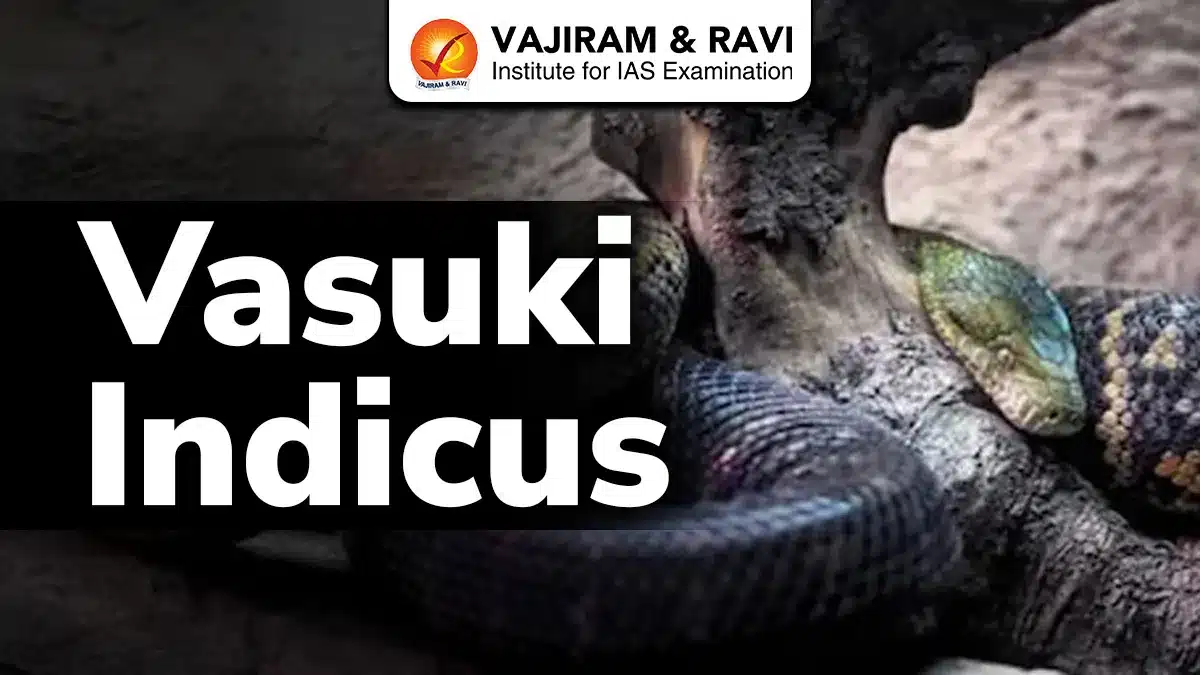
Vasuki Indicus is the recent scientific discovery unveiled by professors of IIT Roorkee which is an ancient snake species fossil, believed to be one of the largest ever to roam the earth.
Vasuki Indicus Background
The newly discovered snake used to live in the region of present-day Gujarat about 47 million years ago, during the Middle Eocene period. It was a member of now-extinct Madtsoiidae snake family representing a distinctive lineage from India.
About the discovery of Vasuki Indicus
- The fossil was a unique discovery, hence it was named after the mythical snake often depicted around the neck of Hindu god Shiva, symbolizing its cultural significance.
- The amazing discovery of the snake fossil of length 11-15 metres was made in the Panandhro Lignite Mine in Kutch, Gujarat.
- It was inferred from the fossil that the body of Vasuki Indicus was broad and cylindrical, pointing towards a robust and powerful build.
- From its size, it can considered a rival of the titleholder of the longest snake to ever roamed the earth “Titanoboa”.
- Scientists are of opinion that Vasuki was able to live due to its secretive hunting nature, like moving slowly and ambush for its prey.
- Due to its huge size it was a formidable predator in the ancient ecosystem.


Significance of the discovery
- The name not just reflects its Indian roots but also symbolises its close ties to the region’s rich cultural heritage.
- The discovery sheds light to the vibrant biodiversity which sustained the evolution of the such huge snakes during the Eocene period.
- It also gives insights about the geographical spread of the Madtsoiidae family, believed to be existed approximately 100 million years ago across the regions of Africa, Europe and India.
- The discovery is also significant to understand the ancient ecosystem of Indian subcontinent in which the evolutionary history of snakes flourished.
The discovery of such a huge fossil is a moment of pride for the IIT Roorkee’s commitment to advancing scientific knowledge and relentless pursuit of excellence in the research, giving a glance to our ancient rich and vibrant ecosystem and further expanding the scope for more such remarkable discoveries, which are yet to be unearthed.

 Last updated on Sep, 2026
→ UPSC 2027 Notification will be released on 13 January 2027 at upsconline.nic.in.
→ Asian Games 2026 are being held in Aichi-Nagoya, Japan, from 19 September to 4 October.
→ Check out the latest UPSC Syllabus here.
→ Download UPSC Model Answers for Mains 2026
→ UPSC Mains Question Paper 2026 is out now for Essay & GS Paper 1, 2, 3 & 4.
→ UPSC Calendar 2027 has been released.
→ Enroll in Vajiram & Ravi’s UPSC Mains Test Series 2027 for structured answer writing practice, expert evaluation, and exam-oriented feedback.
→ Join Vajiram & Ravi’s UPSC Mentorship Program 2027 for personalized guidance, strategy planning, and one-to-one support from experienced mentors.
→ Go through the UPSC Mains Previous Year Papers to enhance your preparation.
→ UPSC has released UPSC Toppers List 2025 with the Civil Services final result on its official website.
→ Also check Best UPSC Coaching in India
Vasuki Indicus FAQs
Q1. What is Vasuki Indicus?+
Q2. Where was Vasuki Indicus discovered?+
Q3. Is Vasuki Indicus the biggest snake?+
Q4. Is Vasuki Indicus still alive?+
Q5. Vasuki Indicus belonged to which family of snake?+
Tags: environment environment notes vasuki indicus