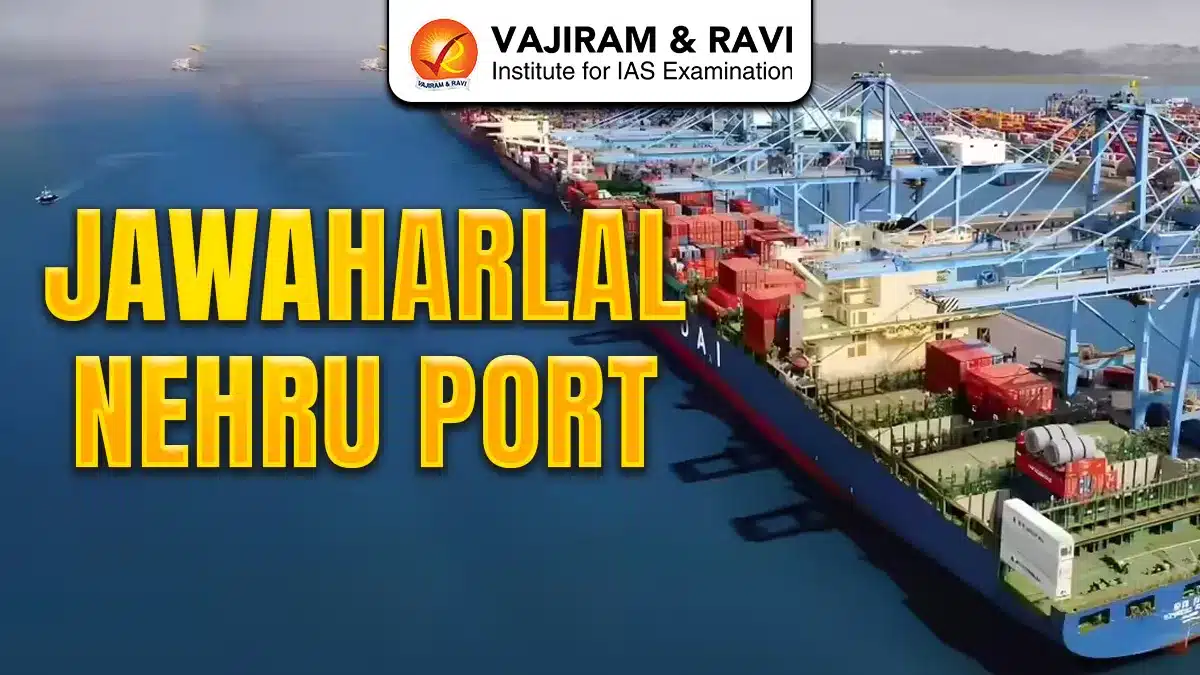
Jawaharlal Nehru Port, also known as Nhava Sheva Port, is India’s largest container port and a critical pillar of the country’s maritime trade system. It is located on the eastern coast of the Arabian Sea in Navi Mumbai in the Raigad district of Maharashtra. It was commissioned on 26 May 1989 and is owned by the Government of India. The port handles a major share of India’s containerized cargo and supports nearly 95% of India’s trade volume carried through sea routes which makes it strategically vital for national logistics and economic growth.
Jawaharlal Nehru Port
Jawaharlal Nehru Port is operated by the Jawaharlal Nehru Port Authority (JNPA) formerly known as Jawaharlal Nehru Port Trust (JNPT). The port functions as the main container gateway for western and northern India. It connects global shipping routes with India’s vast hinterland. The port operates five container terminals and serves as the terminal point of the Western Dedicated Freight Corridor. In 2024, it handled a record 7.05 million TEUs, working at over 90% capacity with 11% annual growth.
Jawaharlal Nehru Port Historical Background
Jawaharlal Nehru Port rapidly evolved into India’s premier container hub in the below mentioned gradual steps:
- Establishment: The port was inaugurated on 26 May 1989 to handle container traffic separately from Mumbai Port, ensuring faster turnaround and modern cargo handling using mechanized systems.
- Early Growth Phase: During the 1990s, the port expanded basic infrastructure and gradually shifted India’s container trade base towards Nhava Sheva, leveraging deeper drafts and planned layouts.
- Private Sector Entry: In July 2000, the commissioning of Nhava Sheva International Container Terminal marked India’s first privately operated container terminal, transforming port efficiency and operational benchmarks.
- Digital and Logistics Reforms: In 2006, the port implemented logistics data tagging of containers, a pioneering step in improving transparency, tracking and ease of doing business.
- Capacity Expansion Era: Between 2016 and 2021, the port consistently handled more than 4 million TEUs annually, establishing itself as India’s second largest container port after Mundra Port.
- Connectivity Strengthening: Over time, JNPT developed a full fledged customs house, 30 container freight stations and connectivity with 52 inland container depots across India.
- Modern Upgrade Phase: From 2023 onwards, terminals underwent major upgrades supported by a 131 million dollar Asian Development Bank loan to enhance berth capacity and energy efficient operations


Jawaharlal Nehru Port Features
The major highlighting features and specialities of the Jawaharlal Nehru Port has been listed below:
- Port Model: It is India’s first major port fully operating on the Landlord Model, where the port authority manages land while private operators run terminals.
- Container Terminals: The port operates five terminals including NSFT, NSICT, NSIGT, Gateway Terminals India and Bharat Mumbai Container Terminal, managed by global operators like DP World, APM Terminals and PSA International.
- Terminal Capacities: Bharat Mumbai Container Terminal alone has a planned capacity of 4.8 million TEUs annually with a quay length of 2,000 meters after full phase completion.
- High Throughput Handling: In 2023-24, the port handled 78.05 million tonnes of container cargo and 7.07 million tonnes of bulk cargo.
- Dedicated Freight Corridor Linkage: As the terminal of the Western Dedicated Freight Corridor, the port will increase rail handling capacity from 27 to nearly 100 trains per day.
- Hinterland Reach: Cargo movement covers Maharashtra, Gujarat, Madhya Pradesh, Karnataka and large parts of North India through road and rail networks.
- Logistics Ecosystem: The port hosts major logistics parks and operators such as Allcargo, Maharashtra State Warehousing Corporation, Continental Warehousing and Gateway District Park.
- Direct Port Delivery: JNPT pioneered the direct port delivery system to reduce dwell time, lower logistics costs and speed up cargo evacuation.
- Energy Efficient Upgrades: Terminal modernization includes energy efficient cranes, upgraded yards and digital systems to support sustainable port operations.
Jawaharlal Nehru Port Significance
Jawaharlal Nehru Port plays a great role in India’s trade, logistics efficiency and integration with global maritime networks. The importance of this port is highlighted below:
- Largest Container Gateway: It is India’s largest container port and is projected to become the first Indian port to achieve a global ranking by handling 10 million TEUs annually by 2027.
- Trade Contribution: India’s maritime sector handles about 95% of trade by volume and 70% by value, with JNPT contributing a major share of containerized trade.
- Economic Impact: The port supports exports such as textiles, pharmaceuticals, chemicals, carpets and engineering goods, while facilitating imports of machinery, plastics, oils and metals.
- Regional Development: Its location near Mumbai, Navi Mumbai and Pune provides proximity to industrial clusters, airports, financial centers and consumption markets.
- Capacity Utilization: Operating at over 90% capacity in 2024, the port reflects strong demand and efficient asset utilization in India’s logistics sector.
- Future Expansion Plans: Planned satellite development at Vadhavan Port and dry ports at Jalna and Wardha aim to ease congestion and enhance trade efficiency.
- Global Integration: With modern terminals and deep drafts, the port attracts large container vessels, improving India’s connectivity with international shipping routes.
- Strategic Logistics Hub: As a key node on the western coast, the port strengthens supply chain resilience and supports India’s long term port led development strategy.

 Last updated on Sep, 2026
→ UPSC 2027 Notification will be released on 13 January 2027 at upsconline.nic.in.
→ Check out the latest UPSC Syllabus here.
→ Download UPSC Model Answers for Mains 2026
→ UPSC Mains Question Paper 2026 is out now for Essay & GS Paper 1, 2, 3 & 4.
→ UPSC Calendar 2027 has been released.
→ Enroll in Vajiram & Ravi’s UPSC Mains Test Series 2027 for structured answer writing practice, expert evaluation, and exam-oriented feedback.
→ Join Vajiram & Ravi’s UPSC Mentorship Program 2027 for personalized guidance, strategy planning, and one-to-one support from experienced mentors.
→ Go through the UPSC Mains Previous Year Papers to enhance your preparation.
→ UPSC has released UPSC Toppers List 2025 with the Civil Services final result on its official website.
→ Also check Best UPSC Coaching in India
Jawaharlal Nehru Port FAQs
Q1. Where is Jawaharlal Nehru Port located?+
Q2. When was Jawaharlal Nehru Port commissioned?+
Q3. Why is Jawaharlal Nehru Port important for India’s trade?+
Q4. How many container terminals operate at Jawaharlal Nehru Port?+
Q5. What is the future capacity target of Jawaharlal Nehru Port?+
Tags: economy jawaharlal nehru port