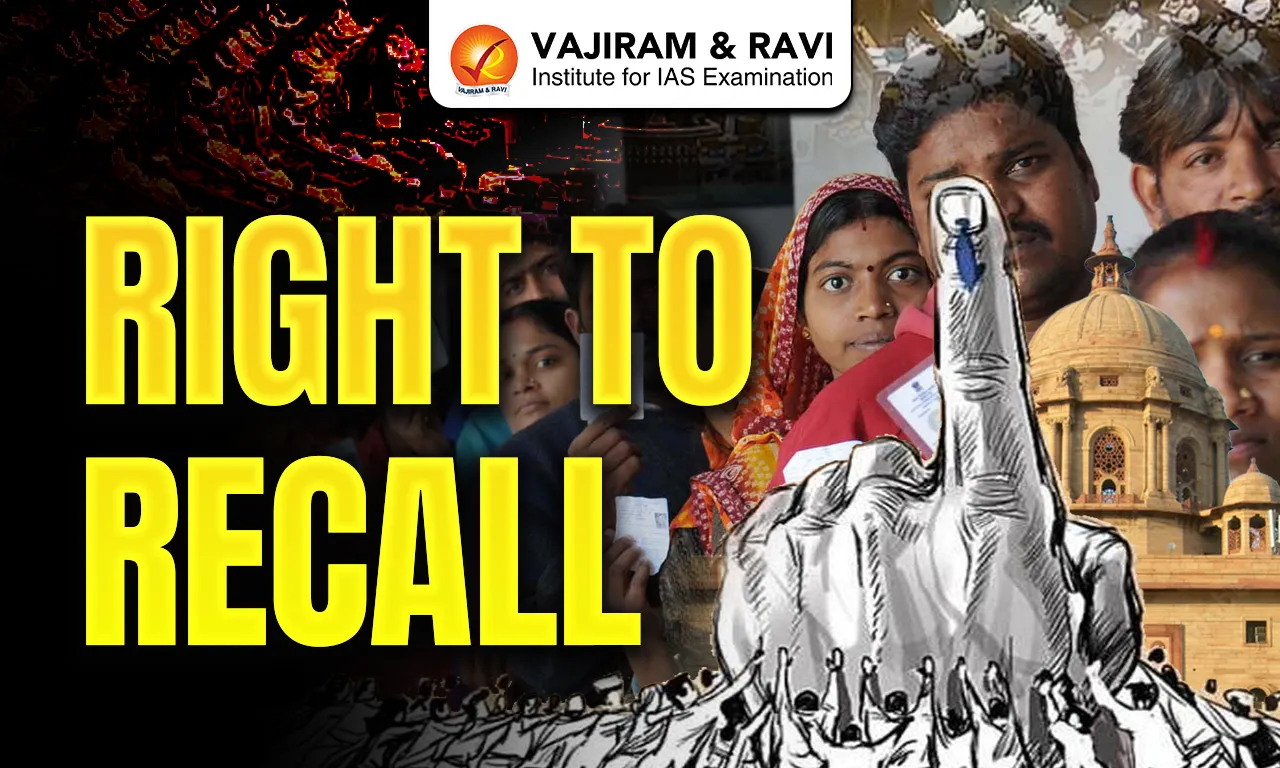
The Right to Recall (RTR) is a democratic tool that allows voters to remove an elected representative before the completion of their term. This mechanism ensures accountability and provides citizens the power to demand performance from their leaders.
In essence, the Right to Recall empowers citizens to de-elect MPs, MLAs, or local representatives if they fail to perform their duties or violate public trust. It acts as a direct democratic tool, complementing the general election process and strengthening governance.
Right to Recall History and Evolution
The concept of Right to Recall is not new to India. Its roots can be traced back to Vedic times, where the idea of Rajdharma allowed subjects to remove ineffective rulers. Over time, this evolved into a democratic demand in modern India.
- 1944: M.N. Roy proposed the Right to Recall, advocating decentralized governance where representatives could be both elected and removed based on performance.
- Constituent Assembly Debates: The Assembly discussed RTR as a legal remedy for voters, but Dr. B.R. Ambedkar opposed its inclusion.
- 1974: Jayaprakash Narayan supported RTR, emphasizing accountability of elected officials to their constituents.
- Lok Sabha Proposals:
- 1974: C.K. Chandrappan introduced a Constitutional Amendment Bill supporting RTR, backed by Atal Bihari Vajpayee. The bill, however, was not passed.
- 2017: Varun Gandhi proposed a private member bill to allow MPs/MLAs to be recalled within two years if 75% of voters were dissatisfied.
India and Right to Recall
-
- Democratic Tool: Right to Recallallows voters to remove an elected representative before the end of their term.
- National Status: Not implemented at the national level for MPs or MLAs; only exists for local bodies in some states.
- Historical Roots: Concept discussed since pre-independence; M.N. Roy (1944) and Jayaprakash Narayan (1974) advocated it.
- Legal Framework: The Representation of the People Act, 1951, allows removal only for specific offences, not general dissatisfaction.
- State-Level Implementation:
-
- Bihar: 20% of Panchayat voters can demand a recall.
- Chhattisgarh & Madhya Pradesh: RTR exists for local government representatives.
- Purpose: Ensures accountability, prevents false promises, strengthens citizen participation, and encourages honest governance.
- Challenges: Not widely implemented nationally due to legal, political, and administrative obstacles.
- Global Examples: Canada (British Columbia) and some US states have RTR for elected representatives based on misconduct or non-performance.
- Future Potential: If adopted nationally, it could enhance democratic accountability and reduce political corruption in India.


Right to Recall Advantages
The Right to Recall provides multiple benefits to citizens and strengthens democracy:
- Accountability of Representatives: Ensures that elected officials perform their duties sincerely or risk removal.
- Prevention of Corruption: Knowing they can be recalled, politicians are less likely to engage in corrupt practices.
- Enhanced Political Participation: Citizens feel empowered and become more involved in governance.
- Efficiency in Governance: Underperforming representatives can be removed quickly without waiting for regular elections.
- True Representation: Helps voters replace leaders who fail to deliver on election promises.
- Encourages Honest Politics: Discourages false promises and populist measures that do not align with constituents’ needs.
Right to Recall Disadvantages
Despite its advantages, Right to Recall poses certain challenges:
- Misuse Potential: Political rivals could manipulate recall petitions to remove opponents for non-performance reasons.
- Political Instability: Frequent recall threats may affect governance and decision-making.
- Costly and Time-Consuming: Recall elections require significant funds, administrative resources, and Election Commission involvement.
- Pressure on Representatives: Continuous need to please voters may hinder long-term policy-making.
- Undermines Independence: Officials may avoid making tough decisions to prevent recall.
Right to Recall in Kerala and Other States
The Kerala government has recommended implementing the Right to Recall across India, emphasizing its potential to enhance democratic accountability.
- Madhya Pradesh: Was the first state to introduce the Right to Recall in local bodies (Municipalities and Panchayats).
- Chhattisgarh: Section 47 of the Chhattisgarh Municipalities Act, 1961, allows for the recall of elected officials in local bodies due to non-performance.
- Bihar: The Bihar Panchayat Raj Act, 2006, and the Bihar Municipal Act, 2007, provide for the recall of panchayat members and councillors.

 Last updated on Oct, 2026
→ UPSC 2027 Notification will be released on 13 January 2027 at upsconline.nic.in.
→ Asian Games 2026 are being held in Aichi-Nagoya, Japan, from 19 September to 4 October.
→ Check Nobel Prize 2026 Winners List here.
→ Download PIB PRiSM Monthly Magazine 2026 here.
→ Check UPSC Monthly Current Affairs Magazine The Recitals here.
→ Check out the latest UPSC Syllabus here.
→ Download UPSC Model Answers for Mains 2026
→ UPSC Mains Question Paper 2026 is out now for Essay & GS Paper 1, 2, 3 & 4.
→ UPSC Calendar 2027 has been released.
→ Enroll in Vajiram & Ravi’s UPSC Mains Test Series 2027 for structured answer writing practice, expert evaluation, and exam-oriented feedback.
→ Join Vajiram & Ravi’s UPSC Mentorship Program 2027 for personalized guidance, strategy planning, and one-to-one support from experienced mentors.
→ Go through the UPSC Mains Previous Year Papers to enhance your preparation.
→ UPSC has released UPSC Toppers List 2025 with the Civil Services final result on its official website.
→ Also check Best UPSC Coaching in India
Right to Recall FAQs
Q1. What is the Right to Recall (RTR)?+
Q2. Is the Right to Recall implemented in India?+
Q3. Who proposed the Right to Recall in India?+
Q4. How does the recall process work?+
Q5. Can MPs and MLAs be recalled under current Indian law?+
Tags: right to recall