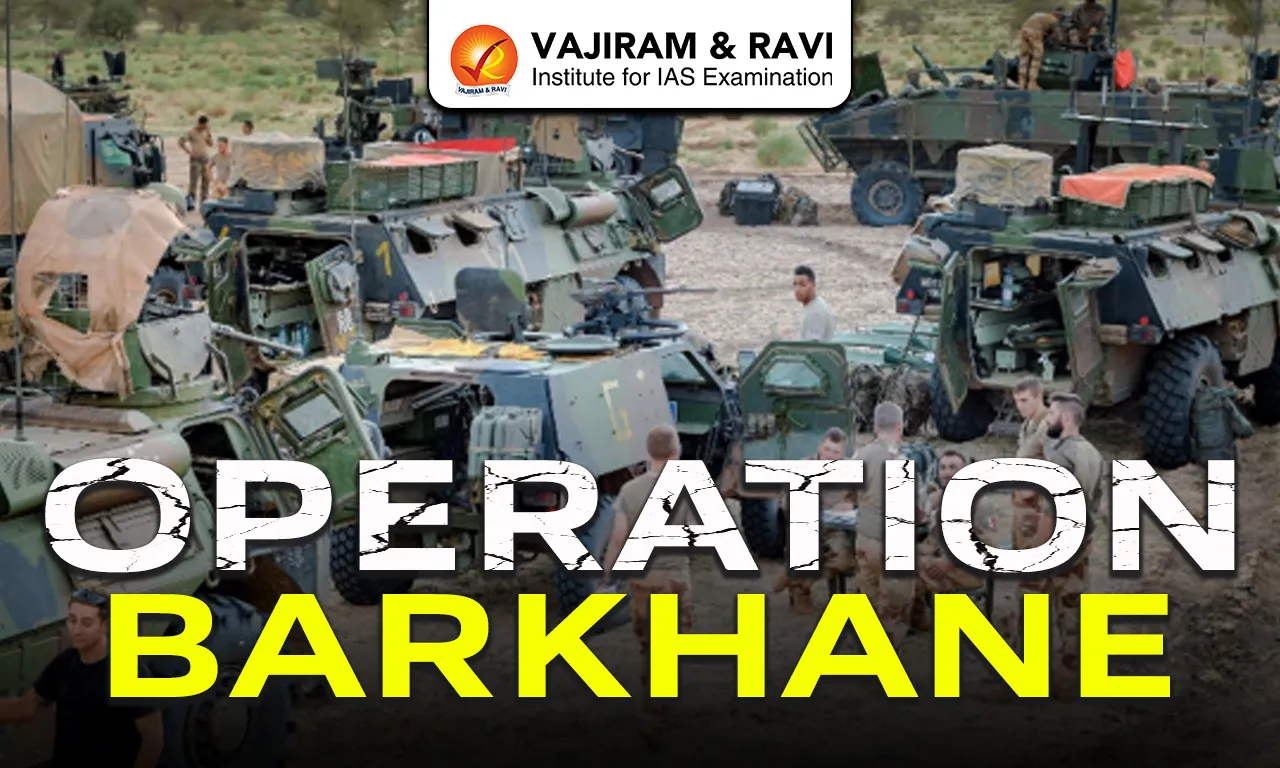
Operation Barkhane was a large-scale French counter-terrorism military operation conducted in the Sahel region of Africa from August 2014 to November 2022. It aimed to combat Islamist extremist groups operating across the Sahara-Sahel belt.
Operation Barkhane Background
The background of Operation Barkhane lies in the growing terrorism and political instability in the Sahel region of Africa after 2011.
The fall of the government in Libya during the Arab Spring led to the spread of weapons and armed fighters across nearby countries. Many fighters returned to northern Mali, where a rebellion started in 2012. In the same year, a military coup in Mali weakened the government. As a result, extremist groups linked to Al-Qaeda captured important cities like Timbuktu and Gao. To stop these groups from taking control of the entire country, France launched Operation Serval in 2013. This operation successfully pushed back the terrorists. However, the problem did not end because these extremist groups were operating across borders in countries like Niger, Burkina Faso, and Chad. Since terrorism in the region had become a regional issue and not just a Mali problem, France started Operation Barkhane in 2014 to fight terrorism across the whole Sahel region.
Operation Barkane Key Features
- The main objectives were to eliminate extremist groups, prevent the creation of terrorist safe havens, support and train local security forces, and ensure regional stability.
- Operation Barkane covered five Sahel countries: Mali, Niger, Burkina Faso, Chad, and Mauritania.
- Its headquarters was located in N’Djamena, Chad.
- The operation was coordinated with the G5 Sahel Joint Force and the UN peacekeeping mission MINUSMA.
- The key terrorist groups targeted included Al-Qaeda in the Islamic Maghreb (AQIM), Islamic State in the Greater Sahara (ISGS), and Jama’at Nusrat al-Islam wal-Muslimin (JNIM).
- About 5,100 French troops were deployed and the operation used drones, fighter jets, helicopters, armored vehicles, and special forces. It focused on intelligence-based targeted strikes and cross-border mobility.Despite eliminating several militant leaders, insecurity continued to spread in the region.
- After the military coups in Mali in 2020 and 2021, anti-French sentiment grew among the people and the new leadership. Relations between France and the Malian government became increasingly tense, making continued military cooperation difficult. As a result, France decided to withdraw its troops, and Operation Barkhane officially ended in November 2022.


 Last updated on Sep, 2026
→ UPSC 2027 Notification will be released on 13 January 2027 at upsconline.nic.in.
→ Asian Games 2026 are being held in Aichi-Nagoya, Japan, from 19 September to 4 October.
→ Check out the latest UPSC Syllabus here.
→ Download UPSC Model Answers for Mains 2026
→ UPSC Mains Question Paper 2026 is out now for Essay & GS Paper 1, 2, 3 & 4.
→ UPSC Calendar 2027 has been released.
→ Enroll in Vajiram & Ravi’s UPSC Mains Test Series 2027 for structured answer writing practice, expert evaluation, and exam-oriented feedback.
→ Join Vajiram & Ravi’s UPSC Mentorship Program 2027 for personalized guidance, strategy planning, and one-to-one support from experienced mentors.
→ Go through the UPSC Mains Previous Year Papers to enhance your preparation.
→ UPSC has released UPSC Toppers List 2025 with the Civil Services final result on its official website.
→ Also check Best UPSC Coaching in India
Operation Barkhane FAQs
Q1. What was Operation Barkhane?+
Q2. Why was Operation Barkhane launched?+
Q3. Which countries were covered under Operation Barkhane?+
Q4. Which terrorist groups were targeted in Operation Barkhane?+
Q5. Why did Operation Barkhane end in 2022?+
Tags: international relations international relations notes operation barkhane