Board of Peace Latest News
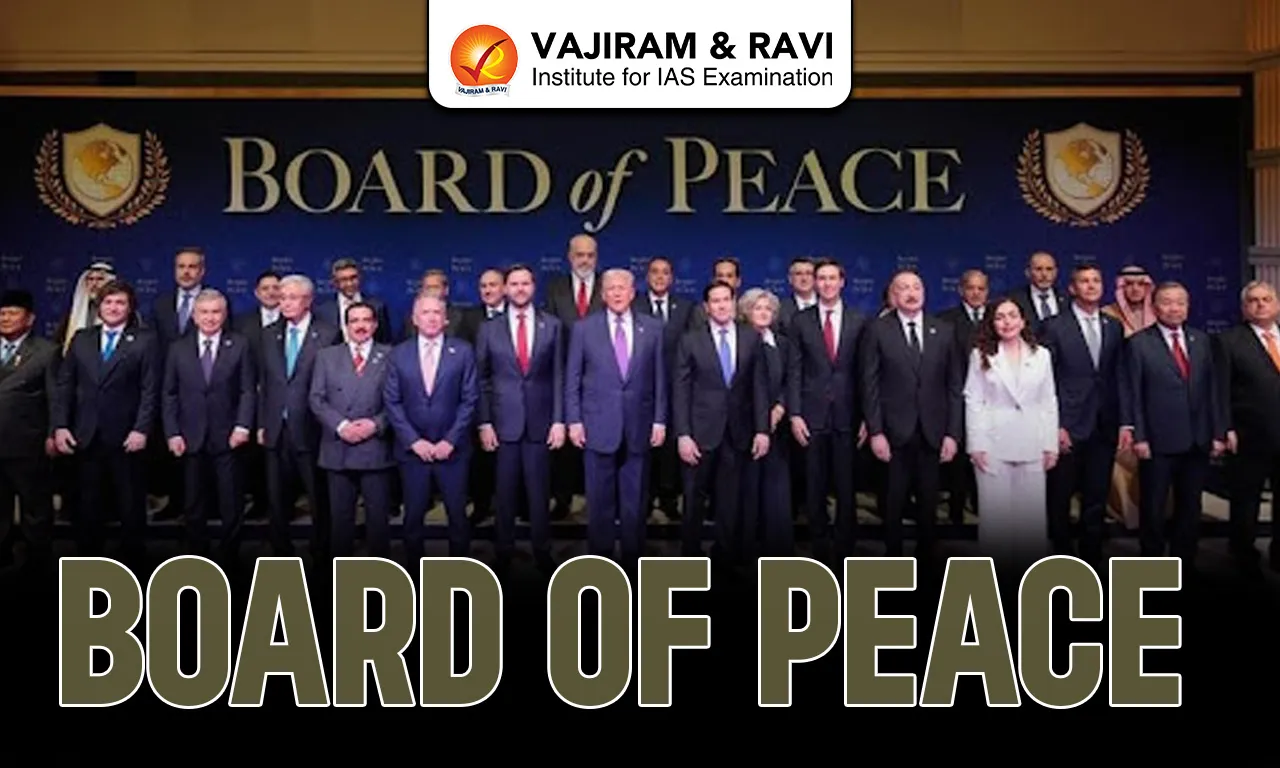
- The US President Donald Trump’s “Board of Peace” held its first meeting in Washington to discuss Gaza’s reconstruction, with India participating as an observer.
- New Delhi said it supports the Gaza Peace Plan and efforts aligned with UNSC Resolution 2803.
- Initially announced to end the Israel-Gaza war, the board’s expanded mandate to address “global conflict” has drawn criticism for potentially sidelining the UN.
- While 27 countries joined the body, India chose not to become a member. By attending as an observer, India signalled cautious engagement—supporting diplomatic efforts without fully endorsing a controversial initiative, especially amid evolving ties with the US.
Composition of the Board of Peace
- The 27-member board includes key West Asian nations such as Israel, Egypt, Jordan, Saudi Arabia, UAE, Qatar, Turkey, and Bahrain.
- Other members include Argentina, Hungary, Vietnam, Cambodia, and Pakistan, whose Prime Minister Shehbaz Sharif attended the inaugural meeting.
Observer Participation
- Twenty-two countries joined as observers, including the UK, Germany, Italy, Norway, Switzerland, Poland, the Netherlands, Japan, Oman, and the European Union.
- India participated as an observer, represented by its Deputy Chief of Mission in Washington, Namgya Khampa, after weighing diplomatic considerations.


Financial Commitments Announced
- Pledges from Members – President Trump announced that nine member countries had collectively pledged $7 billion for Gaza’s relief and reconstruction efforts.
- US Contribution – The United States pledged an additional $10 billion for the Board of Peace, though specific allocations were not detailed. Trump described the funding as an investment in regional stability and harmony.
Observer Status as a Strategic Off-Ramp
- India initially stayed away when President Trump unveiled the Board of Peace in Davos, choosing to assess its membership and direction.
- With the first meeting held, the board’s composition has become clearer—featuring key West Asian states, Trump’s ideological allies, and countries seeking closer ties with the US, but notably excluding permanent UN Security Council members such as Russia, China, France, and the UK, which limits its legitimacy.
- New Delhi is also weighing the initiative’s durability, viewing it largely as Trump’s personal project that may lose relevance after his term.
- Concerns about policy unpredictability further shape India’s cautious approach.
- By participating as an observer, India maintains diplomatic engagement while preserving flexibility and an exit option.
Balancing Multilateral Commitments
- India is cautious that the Board of Peace could evolve into a parallel platform that sidelines the United Nations.
- Although Trump has said the board will work “in conjunction with the UN,” its broad mandate and vague charter raise concerns in New Delhi.
- While initially framed around Gaza’s reconstruction, the board’s charter does not explicitly limit its scope.
- Trump has described it as a body “for the world,” prompting worries that it could intervene in other conflicts.
India-Pakistan Factor
- Trump’s Mediation Claims – Trump reiterated claims that he prevented escalation between India and Pakistan, including alleged tariff threats—assertions India has consistently rejected.
- Why Observer Status Matters – With Pakistan a board member, India sees value in maintaining observer status to monitor discussions and prevent any attempts to internationalise the India-Pakistan issue. Staying completely out could risk being excluded from potential decisions.
Regional Diplomacy and Strategic Interests
- Upcoming Diplomatic Engagements – India’s participation comes ahead of the Prime Minister’s visit to Israel and ongoing ceasefire negotiations. India continues to support a two-state solution and seeks regional stability.
- Economic Stakes – Peace in West Asia would advance initiatives such as the India-Middle East-Europe Economic Corridor. Observer status provides India a strategic vantage point without committing to formal negotiations.
Calibrated Outreach to Trump
- As India and the United States work to stabilise ties—finalising an interim trade deal framework and cooperating on initiatives like Pax Silica—New Delhi is mindful of President Trump’s unpredictability.
- Joining the Board of Peace as an observer allows India to avoid signalling disengagement or slighting Washington, while still limiting formal commitment.
- The move reflects a cautious diplomatic balance: maintaining goodwill with the US without fully endorsing a controversial initiative.

 Last updated on August, 2026
→ UPSC Mains Question Paper 2026 is out now for Essay & GS Paper 1, 2, 3 & 4.
→ UPSC Mains GS Paper 1 2026 is out now.
→ UPSC Mains GS Paper 2 2026 is out now.
→ UPSC Mains GS Paper 3 2026 is out now.
→ UPSC Mains GS Paper 4 2026 is out now.
→ UPSC Mains Indian Language Paper & English Compulsory Paper are out now.
→ Check out the latest UPSC Syllabus 2026 here.
→ UPSC Mains Admit Card 2026 is now out.
→ Enroll in Vajiram & Ravi’s UPSC Mains Test Series 2027 for structured answer writing practice, expert evaluation, and exam-oriented feedback.
→ Join Vajiram & Ravi’s UPSC Mentorship Program 2027 for personalized guidance, strategy planning, and one-to-one support from experienced mentors.
→ Go through the UPSC Mains Previous Year Papers to enhance your preparation.
→ Download UPSC Mains Essay Paper 2025, UPSC Mains GS Paper-I 2025, UPSC Mains GS Paper-II 2025, UPSC Mains GS Paper-III 2025, UPSC Mains GS Paper-IV 2025, UPSC Mains English (Compulsory) Paper 2025, UPSC Mains Hindi (Qualifying) Paper 2025 here.
→ UPSC has released UPSC Toppers List 2025 with the Civil Services final result on its official website.
→ UPSC Calendar 2027 has been released.
→ Also check Best UPSC Coaching in India
Board of Peace FAQs
Q1. Why did India join the Board of Peace as an observer?+
Q2. Who are the main members of the Board of Peace?+
Q3. Why is India cautious about the Board of Peace?+
Q4. How does Pakistan’s membership affect India’s decision?+
Q5. How does this relate to India-US ties?+
Tags: Board of Peace mains articles upsc current affairs upsc mains current affairs