SANKALP Scheme Latest News
- The Public Accounts Committee (PAC) has criticised the government for poorly planned and slow SANKALP Scheme Implementation, citing findings from a CAG report.
Overview of the SANKALP Scheme
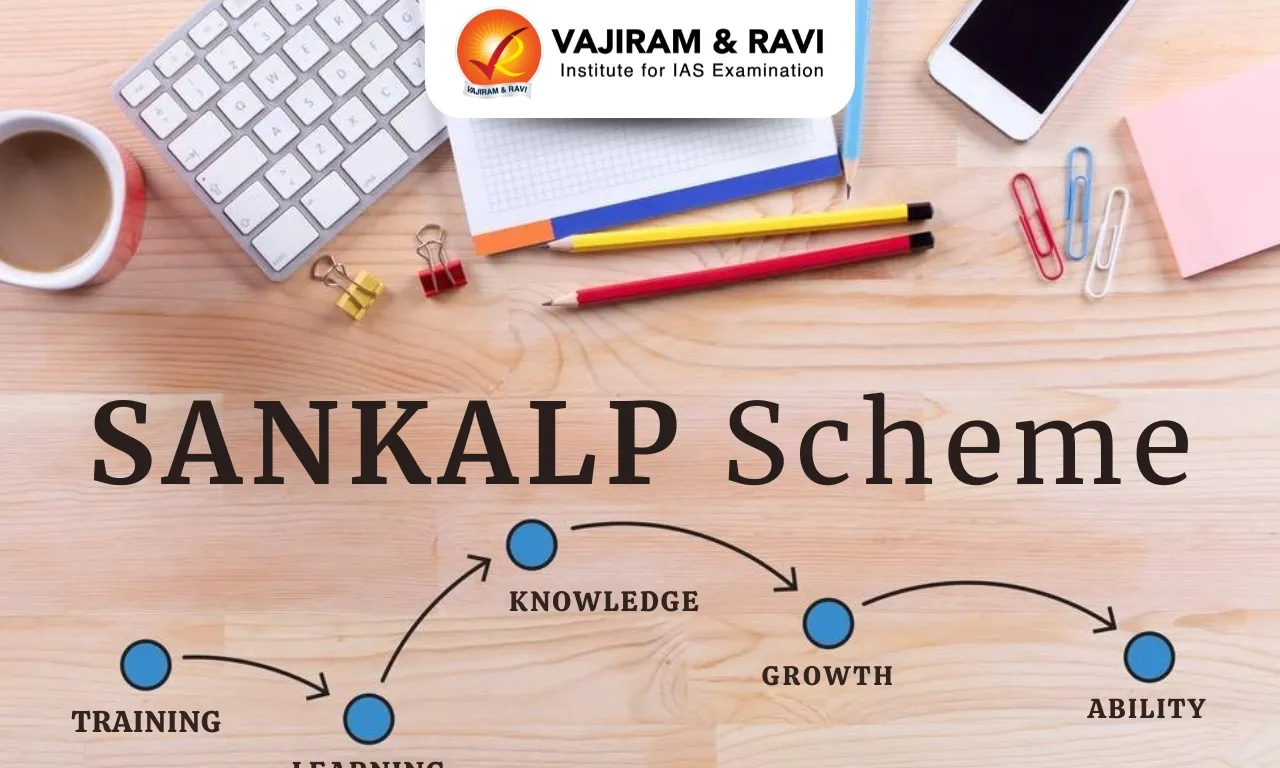
- The Skill Acquisition and Knowledge Awareness for Livelihood Promotion (SANKALP) scheme is a flagship programme of the Ministry of Skill Development and Entrepreneurship.
- It was approved by the Cabinet Committee on Economic Affairs (CCEA) in October 2017 with a total outlay of Rs. 4,455 crore.
- The scheme was launched in January 2018 and was originally scheduled for completion by March 2023. It was later extended to March 2024.
- SANKALP was designed to strengthen short-term skill training across India through:
- Improved institutional frameworks
- Better industry linkages
- Inclusion of marginalised communities
- Enhanced monitoring and governance systems
- The broader objective was to improve employability outcomes and create a more demand-driven skilling ecosystem aligned with industry requirements.


Funding Structure of the Scheme
- The financial design of SANKALP involved a mix of domestic and external funding sources:
- Rs. 3,300 crore through a World Bank loan
- Rs. 660 crore through State leverage
- Rs. 495 crore through industry participation
- The scheme aimed to use outcome-based financing and performance-linked incentives to strengthen skill development at both national and State levels.
- However, the Comptroller and Auditor General (CAG) found significant shortfalls in financial utilisation and implementation efficiency.
CAG Findings on Financial and Physical Progress
- According to the CAG report examined by the PAC, only 44% of the budgeted provision under the SANKALP scheme was disbursed between 2017-18 and 2023-24.
- Further, against the first tranche of the World Bank loan of $250 million, Rs. 1,606.15 crore (86%) was disbursed by the World Bank. However, the Ministry utilised only Rs. 850.71 crore as of December 2023. The CAG also highlighted:
- Weak adherence to implementation guidelines
- Sluggish pace of execution
- Lack of preparedness before commencement of the loan period
- The audit pointed to “non-preparedness” within the Ministry as a key reason for delays.
Observations of the Public Accounts Committee
- The Public Accounts Committee described the scheme’s implementation as “lackadaisical”.
- During its examination of the CAG report, the PAC raised several critical concerns:
- Absence of Central Monitoring Mechanism
- Members questioned why there was no robust central monitoring system to track implementation across States.
- Given that skill development involves coordination between the Centre, States, and private sector partners, monitoring gaps can significantly undermine outcomes.
- Lack of Due Diligence
- The Committee flagged inadequate due diligence before the rollout of the scheme. This suggests that institutional readiness and administrative capacity were not fully assessed prior to loan utilisation.
- Missing Roadmap for School-Level Skilling
- MPs also noted the absence of a clear roadmap to integrate skilling into the school curriculum from primary to higher secondary levels.
- This is particularly significant in light of the National Education Policy (NEP) 2020, which emphasises vocational education from an early stage. The lack of alignment between skilling schemes and education reform weakens long-term employability goals.
Broader Context of Skill Development in India
- India’s demographic dividend presents both an opportunity and a challenge. With a large youth population entering the workforce, skill development is central to economic growth and social mobility.
- Schemes such as Pradhan Mantri Kaushal Vikas Yojana (PMKVY) and SANKALP aim to improve the quality, scale, and relevance of skill training. However, issues such as the following continue to affect the outcomes:
- Fragmented implementation
- Weak industry alignment
- Inadequate monitoring
- Underutilisation of funds
- The SANKALP experience underscores the importance of institutional preparedness, data-driven evaluation, and inter-ministerial coordination.
Source: TH

 Last updated on August, 2026
→ UPSC Mains Question Paper 2026 is out now for Essay & GS Paper 1, 2, 3 & 4.
→ UPSC Mains GS Paper 1 2026 is out now.
→ UPSC Mains GS Paper 2 2026 is out now.
→ UPSC Mains GS Paper 3 2026 is out now.
→ UPSC Mains GS Paper 4 2026 is out now.
→ UPSC Mains Indian Language Paper & English Compulsory Paper are out now.
→ Check out the latest UPSC Syllabus 2026 here.
→ UPSC Mains Admit Card 2026 is now out.
→ Enroll in Vajiram & Ravi’s UPSC Mains Test Series 2027 for structured answer writing practice, expert evaluation, and exam-oriented feedback.
→ Join Vajiram & Ravi’s UPSC Mentorship Program 2027 for personalized guidance, strategy planning, and one-to-one support from experienced mentors.
→ Go through the UPSC Mains Previous Year Papers to enhance your preparation.
→ Download UPSC Mains Essay Paper 2025, UPSC Mains GS Paper-I 2025, UPSC Mains GS Paper-II 2025, UPSC Mains GS Paper-III 2025, UPSC Mains GS Paper-IV 2025, UPSC Mains English (Compulsory) Paper 2025, UPSC Mains Hindi (Qualifying) Paper 2025 here.
→ UPSC has released UPSC Toppers List 2025 with the Civil Services final result on its official website.
→ UPSC Calendar 2027 has been released.
→ Also check Best UPSC Coaching in India
SANKALP Scheme FAQs
Q1. What is the SANKALP scheme?+
Q2. What was the total outlay of the SANKALP scheme?+
Q3. What did the CAG report highlight about the scheme?+
Q4. What concerns did the PAC raise?+
Q5. Why is SANKALP significant for India’s development?+
Tags: mains articles SANKALP scheme upsc current affairs upsc mains current affairs