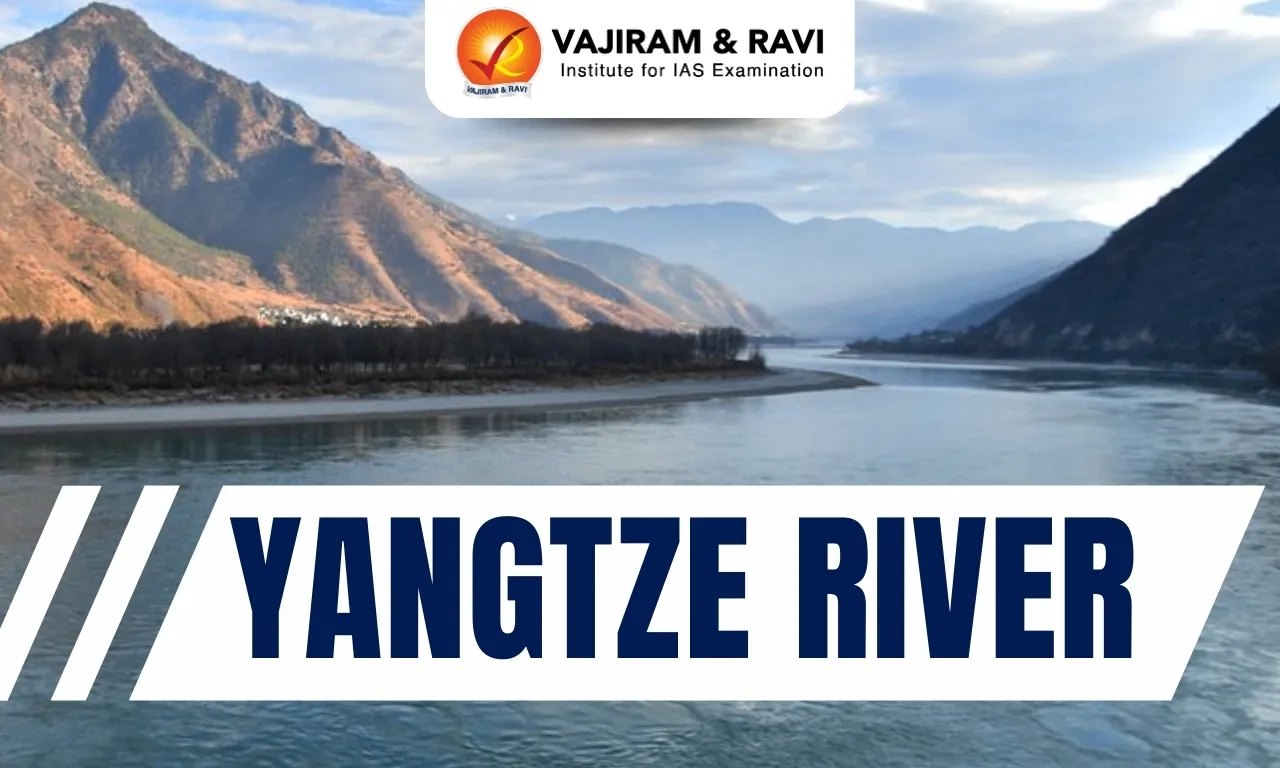
The Yangtze River is the longest river in China and the third-longest river in the world after the Nile River and the Amazon River. It has a total length of about 6,300 kilometres, making it the most important river system in China. It is the country’s most important river system, serving as a major waterway, agricultural region, and home to nearly one-third of China’s population.
Yangtze River Origin and Course
- The Yangtze River originates from glaciers in the Tanggula Mountains on the Tibetan Plateau.
- It flows eastward across China before emptying into the East China Sea.
- The river flows through several provinces and major cities including Chongqing, Wuhan, and Shanghai.
Yangtze River Major Tributaries
The Yangtze River has eight major tributaries that contribute to its large water volume.
- Left bank tributaries include: Yalung River, Min River, Jialing River and Han River.
- Right bank tributaries include: Wu River, Yuan River, Xiang River, Gan River.
These tributaries form a vast river network that supports agriculture and water supply in different regions.


Yangtze River Basin
- Yangtze river basin supports nearly one-third of China’s population and plays a crucial role in agriculture, transportation, and economic development.
- Its river basin is around 1.8 million sq km – almost a fifth of China’s land area.
- The Yangtze basin is often referred to as China’s great granary. It contributes nearly half of the country’s total crop production.
- Major crops grown in the region include Rice, Wheat, Cotton, Corn, Barley, Beans.
- The fertile soil, abundant rainfall, and extensive irrigation systems make the basin one of the most productive agricultural regions in Asia.
- The Yangtze River basin is the economic backbone of China.
- It supports major industries, trade, and transportation routes.
- The river is widely used for inland water transport, connecting several industrial cities and ports.
Yangtze River Ecological Importance
The Yangtze River basin is rich in biodiversity and supports many plant and animal species. It provides habitat for rare and endangered species such as the Yangtze Finless Porpoise. Wetlands and lakes connected to the river are important for migratory birds and aquatic ecosystems.
Yangtze River Dams
The Yangtze River has several large dams built mainly for hydroelectric power generation, flood control, irrigation, and improved navigation. These dams play an important role in China’s economic development and energy production.
- Three Gorges Dam: The world’s largest hydroelectric dam (22,500 MW), completed in 2006; built for power generation, flood control, and improved navigation.
- Baihetan Dam: second-largest hydropower station in the world (after Three Gorges)
- Gezhouba Dam: The first major dam on the Yangtze, completed in 1988.
- Xiluodu Dam: One of the largest hydropower stations on the upper Yangtze (Jinsha River section); completed in 2014.
- Xiangjiaba Dam: A major hydropower project completed in 2012 that contributes significantly to electricity production.
- Wudongde Dam: A modern hydroelectric dam completed in 2020 as part of China’s large-scale renewable energy development.
Yangtze River Navigation and Transport
- Yangtze River is the principal inland waterway of China.
- About 2,700 km of the river is intensively used for navigation.
- Large cargo ships can travel deep into the interior, connecting inland cities to coastal ports.
- The river is also connected to the Grand Canal, one of the longest artificial canals in the world, linking northern and southern China.

 Last updated on August, 2026
→ UPSC Mains Question Paper 2026 is out now for Essay & GS Paper 1, 2, 3 & 4.
→ UPSC Mains GS Paper 1 2026 is out now.
→ UPSC Mains GS Paper 2 2026 is out now.
→ UPSC Mains GS Paper 3 2026 is out now.
→ UPSC Mains GS Paper 4 2026 is out now.
→ UPSC Mains Indian Language Paper & English Compulsory Paper are out now.
→ Check out the latest UPSC Syllabus 2026 here.
→ UPSC Mains Admit Card 2026 is now out.
→ Enroll in Vajiram & Ravi’s UPSC Mains Test Series 2027 for structured answer writing practice, expert evaluation, and exam-oriented feedback.
→ Join Vajiram & Ravi’s UPSC Mentorship Program 2027 for personalized guidance, strategy planning, and one-to-one support from experienced mentors.
→ Go through the UPSC Mains Previous Year Papers to enhance your preparation.
→ Download UPSC Mains Essay Paper 2025, UPSC Mains GS Paper-I 2025, UPSC Mains GS Paper-II 2025, UPSC Mains GS Paper-III 2025, UPSC Mains GS Paper-IV 2025, UPSC Mains English (Compulsory) Paper 2025, UPSC Mains Hindi (Qualifying) Paper 2025 here.
→ UPSC has released UPSC Toppers List 2025 with the Civil Services final result on its official website.
→ UPSC Calendar 2027 has been released.
→ Also check Best UPSC Coaching in India
Yangtze River FAQs
Q1. Which is the longest river in China?+
Q2. Where does the Yangtze River originate?+
Q3. Why is the Yangtze River basin important for China? +
Q4. Which is the largest dam built on the Yangtze River?+
Q5. Why is the Yangtze basin called China’s “great granary”?+
Tags: yangtze river