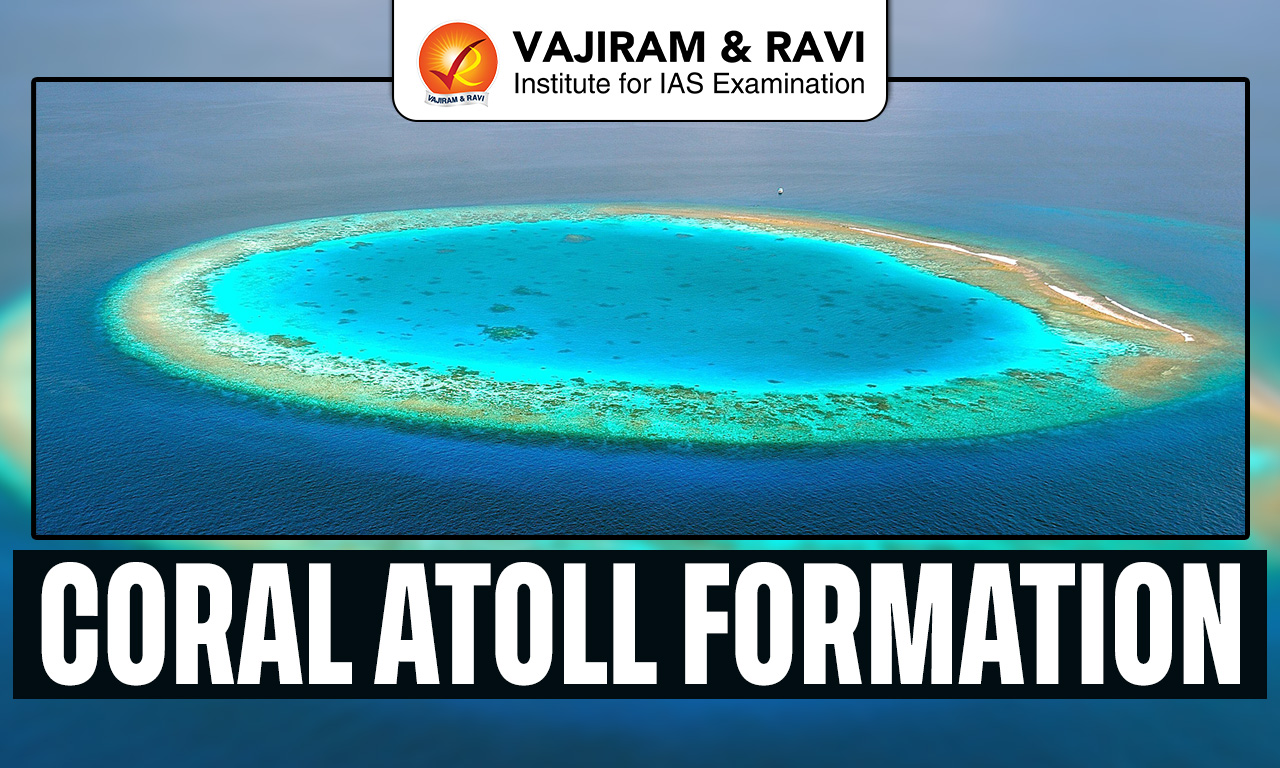
Coral Atoll Formation refers to the natural process through which Coral Atolls develop in warm tropical oceans. These landforms generally consist of a circular coral reef surrounding a central Lagoon. Coral atolls form gradually over a very long period due to the growth of coral reefs and changes in the underlying landforms. They are commonly found in tropical regions of oceans such as the Indian Ocean and the Pacific Ocean, and represent important marine ecosystems as well as distinctive coastal landforms.
Coral Atoll Formation
An Atoll is a circular or ring-shaped coral reef found in the ocean. It surrounds a central Lagoon, which is a body of water enclosed by the reef. The lagoon inside an atoll can be quite deep, usually about 80-150 metres, and it often connects with the open sea through small channels that cut across the reef. Most atolls are found far away from large land areas in the open ocean. They usually develop on underwater features such as submerged islands or volcanic cones, which provide a base where corals can grow and gradually form a reef structure.
Atolls may appear in three different forms.
- A true atoll, where a circular coral reef surrounds a lagoon and no island exists inside it.
- An atoll with an island, where a small island is present within the ring of coral reef.
- A coral island or atoll island, which forms when sand and coral fragments are deposited on the reef by waves, creating small islands on top of the reef.
Formation Process
- The formation of coral atolls is explained by the theory proposed by Charles Darwin through his coral reef subsidence theory.
- Coral reefs first grow around a volcanic island, forming fringing reefs.
- Over time, the volcanic island slowly sinks below sea level due to geological processes.
- Meanwhile, corals continue to grow upward towards sunlight.
- Eventually, the volcanic island completely disappears beneath the ocean, leaving a ring-shaped coral reef surrounding a central lagoon.
- This process takes thousands to millions of years.
Distribution of Coral Atolls
- Atolls are most commonly found in the Pacific Ocean, where their number is greater than in any other ocean. Some well-known examples include atolls near Fiji and the Funafuti Atoll. In India, several coral atolls are located in the Lakshadweep Islands.
- In the South Pacific region, many atolls are found in the middle of the ocean and occur in island groups such as French Polynesia, Marshall Islands, Micronesia, and the Cook Islands.
- The Indian Ocean also has many atoll formations. Important examples can be seen in the Maldives, the Chagos Archipelago, Seychelles, and the Cocos (Keeling) Islands.


Conditions Required for Coral Atoll Formation
- Warm Ocean Water: Coral reefs grow best in warm tropical waters. The water temperature is usually between 20°C and 32°C.
- Shallow Water: Corals need sunlight to grow because tiny algae living in corals use sunlight for photosynthesis. Therefore, corals mostly grow in shallow water, generally less than 50-55 metres deep.
- Clear and Salty Water: The water must be clear so that sunlight can reach the corals. It should also have normal ocean salinity (salt content).
- Submerged Volcanic Base: Atolls usually form on top of a sinking volcanic island or underwater mountain. As the island slowly sinks, the corals keep growing upward.
- Availability of Nutrients: Small marine organisms such as plankton provide nutrients that help corals grow and develop.
- Low Pollution and Sediments: Corals grow best in clean water with little pollution or sediments, because too much mud or silt can cover the corals and block sunlight.
Coral Atolls Significance
- Rich Marine Biodiversity: Coral Atolls support diverse marine life such as fish, corals, sea turtles, and sharks. These ecosystems act as breeding and feeding grounds for many marine species.
- Protection of Coastlines: Coral reefs around atolls help reduce the impact of strong ocean waves and storms. They act as natural barriers that protect nearby islands and coastal areas from erosion.
- Support for Fisheries: Atolls provide rich fishing grounds. Many coastal and island communities depend on these areas for fish and other marine resources for their livelihood.
- Tourism and Economic Importance: The clear waters, coral reefs, and lagoons of atolls attract tourists for activities like snorkeling, diving, and boating. Tourism in places such as the Maldives is largely based on coral atolls.
- Scientific and Environmental Importance: Atolls help scientists study coral reef ecosystems, ocean processes, and climate change.
- Indicators of Climate Change: Since atolls are low-lying landforms, they are very sensitive to sea-level rise. Changes in these ecosystems help scientists understand the impacts of global climate change on coastal regions.

 Last updated on August, 2026
→ UPSC Mains 2026 commenced on 21st August 2026 and will continue through 30th August 2026, as per the official examination schedule.
→ UPSC Mains Question Paper 2026 is out now for Essay & GS Paper 1, 2, 3 & 4.
→ UPSC Mains GS Paper 1 2026 is out now.
→ UPSC Mains GS Paper 2 2026 is out now.
→ UPSC Mains GS Paper 3 2026 is out now.
→ UPSC Mains GS Paper 4 2026 is out now.
→ UPSC Mains Indian Language Paper & English Compulsory Paper are out now.
→ Check out the latest UPSC Syllabus 2026 here.
→ UPSC Mains Admit Card 2026 is now out.
→ Enroll in Vajiram & Ravi’s UPSC Mains Test Series 2027 for structured answer writing practice, expert evaluation, and exam-oriented feedback.
→ Join Vajiram & Ravi’s UPSC Mentorship Program 2027 for personalized guidance, strategy planning, and one-to-one support from experienced mentors.
→ Go through the UPSC Mains Previous Year Papers to enhance your preparation.
→ Download UPSC Mains Essay Paper 2025, UPSC Mains GS Paper-I 2025, UPSC Mains GS Paper-II 2025, UPSC Mains GS Paper-III 2025, UPSC Mains GS Paper-IV 2025, UPSC Mains English (Compulsory) Paper 2025, UPSC Mains Hindi (Qualifying) Paper 2025 here.
→ UPSC has released UPSC Toppers List 2025 with the Civil Services final result on its official website.
→ UPSC Calendar 2027 has been released.
→ Also check Best UPSC Coaching in India
Coral Atolls Formation FAQs
Q1. What is a Coral Atoll?+
Q2. How are coral atolls formed?+
Q3. Who explained the formation of coral atolls?+
Q4. Where are coral atolls mainly found?+
Q5. What are the main parts of a coral atoll?+
Tags: coral atoll formation physical geography