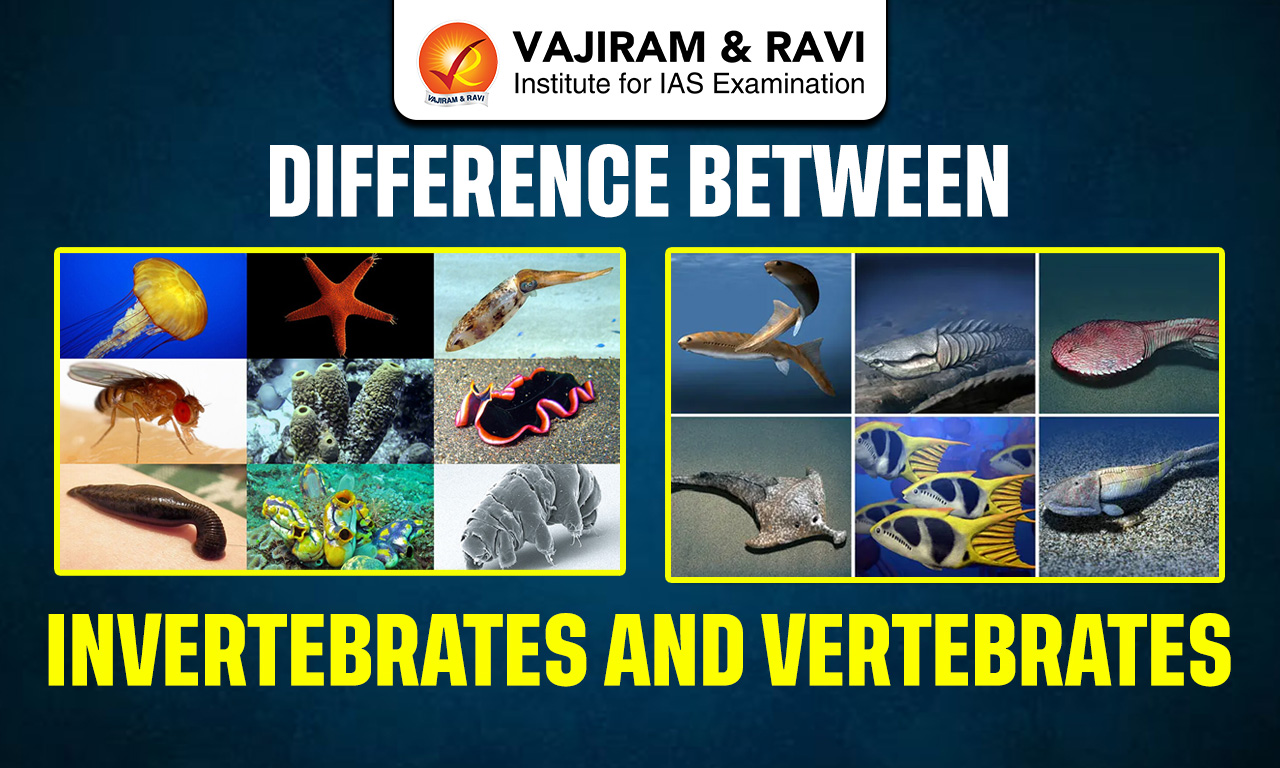
Difference Between Invertebrates and Vertebrates is based on backbone presence. Invertebrates lack a spinal column, while vertebrates possess it. Around 1.37 million animal species are identified, with nearly 97% invertebrates and only about 3% vertebrates.
Difference Between Invertebrates and Vertebrates
The Difference Between Invertebrates and Vertebrates highlights structural, physiological and functional variations between these two major animal groups as tabulated below:
| Difference Between Invertebrates and Vertebrates | ||
|
Aspect |
Invertebrates |
Vertebrates |
|
Backbone |
These animals do not have a backbone or vertebral column. e.g., worms, insects |
These animals have a well developed backbone or spine., e.g., mammals, birds |
|
Skeleton |
They usually have an external exoskeleton made of chitin, while some may not have any skeleton at all. |
They possess an internal skeleton made of bone or cartilage. |
|
Body Size |
Most of them are small in size, although some, like the colossal squid, can grow up to about 46 feet. |
They are generally larger in size and have a strong body structure. |
|
Circulation |
They mostly have an open circulatory system where blood flows freely in the body cavity. |
They have a closed circulatory system that allows efficient transport of blood. |
|
Nervous System |
Their nervous system is simple and less organized. |
Their nervous system is complex and includes a brain and spinal cord. |
|
Eyes |
Compound eyes are commonly found, especially in insects and arthropods. |
They do not have compound eyes and instead have advanced visual organs. |
|
Symmetry |
Their body symmetry can be radial or bilateral, as seen in starfish and insects. |
Their body structure shows strictly bilateral symmetry. |
|
Nutrition |
They may follow autotrophic, parasitic, or heterotrophic modes of nutrition. |
They mainly follow a heterotrophic mode of nutrition. |
|
Diversity |
Over 1.25 million species of invertebrates are found and are highly diverse. |
This group includes around 62,000 species worldwide. |
|
Examples |
Sponges, arthropods, molluscs, etc. |
Fish, amphibians, reptiles, birds, mammals, etc. |


 Last updated on Sep, 2026
→ UPSC 2027 Notification will be released on 13 January 2027 at upsconline.nic.in.
→ Asian Games 2026 are being held in Aichi-Nagoya, Japan, from 19 September to 4 October.
→ Check out the latest UPSC Syllabus here.
→ Download UPSC Model Answers for Mains 2026
→ UPSC Mains Question Paper 2026 is out now for Essay & GS Paper 1, 2, 3 & 4.
→ UPSC Calendar 2027 has been released.
→ Enroll in Vajiram & Ravi’s UPSC Mains Test Series 2027 for structured answer writing practice, expert evaluation, and exam-oriented feedback.
→ Join Vajiram & Ravi’s UPSC Mentorship Program 2027 for personalized guidance, strategy planning, and one-to-one support from experienced mentors.
→ Go through the UPSC Mains Previous Year Papers to enhance your preparation.
→ UPSC has released UPSC Toppers List 2025 with the Civil Services final result on its official website.
→ Also check Best UPSC Coaching in India
Difference Between Invertebrates and Vertebrates FAQs
Q1. What is the key Difference Between Invertebrates and Vertebrates? +
Q2. Which group has more species: invertebrates or vertebrates? +
Q3. How does the circulatory system differ in Invertebrates and Vertebrates? +
Q4. Which among Invertebrates and Vertebrates has a more complex nervous system? +
Q5. What are the common examples of Invertebrates and Vertebrates? +
Tags: biology difference between invertebrates and vertebrates zoology