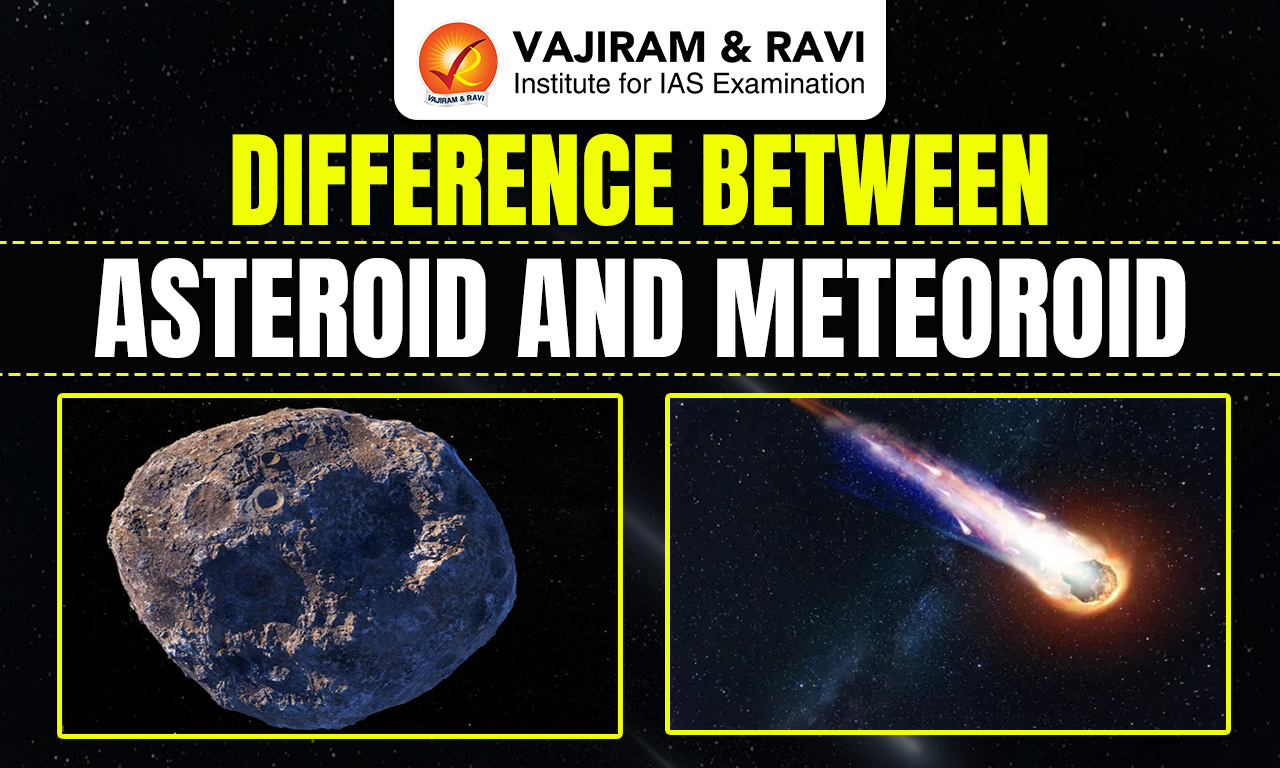
Asteroids and meteoroids are both small objects found in space, but they are different in size and nature. Asteroids are larger rocky bodies that orbit the Sun, mostly found in regions like the asteroid belt. Meteoroids are much smaller pieces of rock or spatial matter, often formed from broken parts of asteroids or comets.
Difference between Asteroid And Meteoroid
The key differences between them are discussed below.
| Difference between Asteroid And Meteoroid | ||
|
Aspect |
Asteroid |
Meteoroid |
|
Meaning |
Asteroids are large rocky bodies that orbit the Sun and are often called minor planets. |
Meteoroids are small pieces of rock or spatial matter that travel through space. |
|
Size |
Much larger, usually ranging from a few meters to hundreds of kilometers in diameter. |
Much smaller, usually from tiny dust particles to a few meters in size. |
|
Origin |
Formed from leftover material during the formation of planets in the early solar system. |
Formed from fragments of asteroids or comets that have broken apart. |
|
Orbit |
Move in stable and well-defined orbits around the Sun. |
Also orbit the Sun but can easily change their path due to gravity or collisions. |
|
Location |
Mostly found in the asteroid belt between Mars and Jupiter, though some exist elsewhere. |
Found throughout the solar system and may enter Earth’s atmosphere. |
|
Behavior in Atmosphere |
Remain in space and do not produce light. |
Burn due to friction when entering Earth’s atmosphere, creating shooting stars (meteors). |
|
Stability |
Generally stable and do not change their paths frequently. |
Less stable and more likely to collide with planets or other objects. |
|
Composition |
Mainly made of rock and metals like iron and nickel. |
Made of rock, metal, or a mixture of both, depending on their origin. |
|
Impact |
Rarely collide with Earth due to their stable orbits. |
Can enter Earth’s atmosphere and sometimes reach the surface as meteorites. |
About Asteroids
- Asteroids are small rocky objects that move around the Sun. They are mostly found in a region called the asteroid belt, which lies between the planets Mars and Jupiter. These objects can be very small, just a few meters wide, or very large, reaching hundreds of kilometers in size.
- Asteroids are mainly made of rock and metal, such as iron and nickel, similar to the materials found on Earth and other rocky planets. They are often called “minor planets” because they are larger than meteoroids but smaller than planets. Most asteroids do not have an atmosphere, but larger ones have enough gravity to attract nearby objects, and some even have small moons.
- These space rocks were formed about 4.6 billion years ago during the early formation of the solar system. At that time, dust and gas came together to form planets, but some leftover material did not become part of any planet. Over time, this leftover material broke into pieces due to collisions, forming the asteroids we see today.
- Asteroids usually follow stable paths (orbits) around the Sun, so they rarely collide with planets. Scientists study asteroids because they provide important information about how the solar system formed and evolved over time.


About Meteoroids
- Meteoroids are very small pieces of rock or metal that travel through space. They are much smaller than asteroids and can range in size from tiny dust particles to a few meters wide. Most meteoroids come from broken pieces of asteroids or comets due to collisions or other space forces.
- When a meteoroid enters the Earth’s atmosphere, it heats up due to friction and burns, creating a bright streak of light in the sky. This glowing trail is called a meteor, often known as a “shooting star.” Most meteoroids burn up completely before reaching the ground. However, if a part of it survives and lands on Earth, it is called a meteorite.
- Meteoroids are usually harmless because they are small and burn up in the atmosphere. But larger ones can cause explosions in the air, producing shock waves and sometimes damage on the ground.

 Last updated on Oct, 2026
→ UPSC 2027 Notification will be released on 13 January 2027 at upsconline.nic.in.
→ Check Nobel Prize 2026 Winners List here.
→ Download PIB PRiSM Monthly Magazine 2026 here.
→ Check UPSC Monthly Current Affairs Magazine The Recitals here.
→ Check out the latest UPSC Syllabus here.
→ Download UPSC Model Answers for Mains 2026
→ UPSC Mains Question Paper 2026 is out now for Essay & GS Paper 1, 2, 3 & 4.
→ UPSC Calendar 2027 has been released.
→ Enroll in Vajiram & Ravi’s UPSC Mains Test Series 2027 for structured answer writing practice, expert evaluation, and exam-oriented feedback.
→ Join Vajiram & Ravi’s UPSC Mentorship Program 2027 for personalized guidance, strategy planning, and one-to-one support from experienced mentors.
→ Go through the UPSC Mains Previous Year Papers to enhance your preparation.
→ UPSC has released UPSC Toppers List 2025 with the Civil Services final result on its official website.
→ Also check Best UPSC Coaching in India
Difference between Asteroid And Meteoroid
Q1. What is an asteroid?+
Q2. What is a meteoroid?+
Q3. What is the main difference between an asteroid and a meteoroid?+
Q4. What happens when a meteoroid enters Earth’s atmosphere?+
Q5. What is a meteorite?+
Tags: Difference between Asteroid And Meteoroid geography geography notes