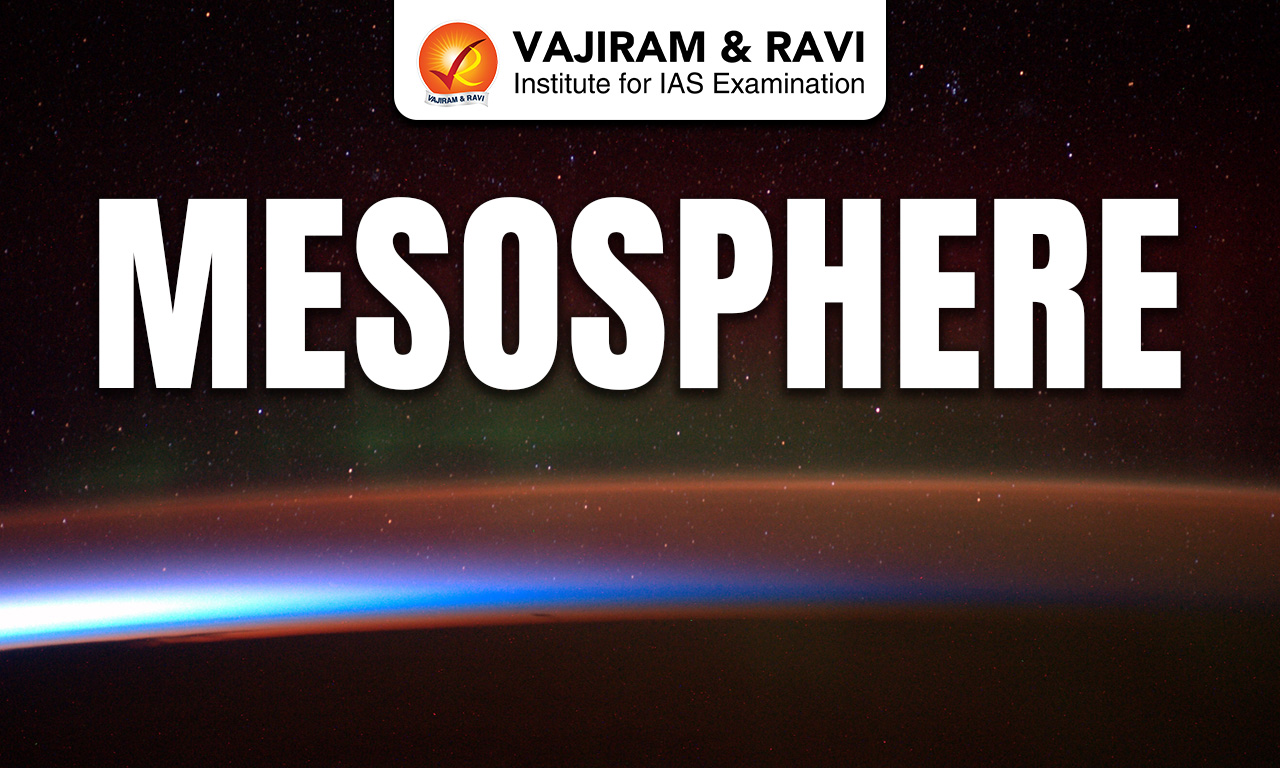
The Mesosphere is the third atmospheric layer above Earth’s surface. It is located after the troposphere and stratosphere. It extends roughly from 50 to 85 km altitude and lies between the Stratopause and Mesopause. This layer is known for decreasing temperature with height and is considered the coldest region of the atmosphere. It also acts as a transition zone before the thermosphere and plays a key role in atmospheric structure and processes.
Mesosphere Features
The Mesosphere is a cold, thin and less explored atmospheric layer marked by falling temperatures, meteor burning and unique high altitude phenomena.
- Location: It begins at the stratopause and ends at the mesopause, forming part of the “middle atmosphere” along with the stratosphere and spans roughly 12 to 80 km above Earth.
- Altitudinal Extent: The Mesosphere extends from about 50-65 km to nearly 85-100 km. Its limits vary with latitude and season, being higher in winter and tropics and lower in summer and polar regions.
- Temperature Characteristics: Temperature decreases with height due to reduced ozone absorption and CO2 cooling. At the mesopause, temperatures can fall below -90°C, making it the coldest atmospheric region.
- Meteor Activity: Most meteors burn up in this layer due to friction with gases, producing visible “shooting stars.” Around 40,000 tons of meteoric material enter Earth’s atmosphere daily.
- Low Density and Pressure: The Mesosphere has extremely thin air with very low pressure, nearly 1/100000th of surface atmospheric pressure.
- Chemical Composition: Gases like oxygen, nitrogen and carbon dioxide exist in mixed form. Metal atoms like iron and potassium are present due to meteoric disintegration.
- Noctilucent Clouds Formation: Rare high altitude clouds called noctilucent or polar mesospheric clouds form near the poles at very low temperatures, appearing as blue white luminous clouds during twilight.
- Electrical Phenomena: Unique discharges such as sprites and ELVES occur above thunderclouds, appearing as red flashes or expanding rings in the upper Mesosphere region.
- Atmospheric Circulation: Strong zonal winds, gravity waves and planetary waves influence circulation. These waves transfer energy from lower layers and drive mesospheric dynamics.
- Exploration: The Mesosphere is difficult to study as aircraft and balloons cannot reach it, while satellites orbit above it. This makes it the least explored layer, sometimes called the “Ignorosphere.”


 Last updated on Sep, 2026
→ UPSC 2027 Notification will be released on 13 January 2027 at upsconline.nic.in.
→ Asian Games 2026 are being held in Aichi-Nagoya, Japan, from 19 September to 4 October.
→ Check out the latest UPSC Syllabus here.
→ Download UPSC Model Answers for Mains 2026
→ UPSC Mains Question Paper 2026 is out now for Essay & GS Paper 1, 2, 3 & 4.
→ UPSC Calendar 2027 has been released.
→ Enroll in Vajiram & Ravi’s UPSC Mains Test Series 2027 for structured answer writing practice, expert evaluation, and exam-oriented feedback.
→ Join Vajiram & Ravi’s UPSC Mentorship Program 2027 for personalized guidance, strategy planning, and one-to-one support from experienced mentors.
→ Go through the UPSC Mains Previous Year Papers to enhance your preparation.
→ UPSC has released UPSC Toppers List 2025 with the Civil Services final result on its official website.
→ Also check Best UPSC Coaching in India
Mesosphere FAQs
Q1. What is the Mesosphere? +
Q2. Why is the Mesosphere the coldest layer? +
Q3. Where do meteors burn up in the Mesosphere? +
Q4. What are noctilucent clouds found in the Mesosphere? +
Q5. Why is the Mesosphere called the “Ignorosphere”? +
Tags: geography mesosphere