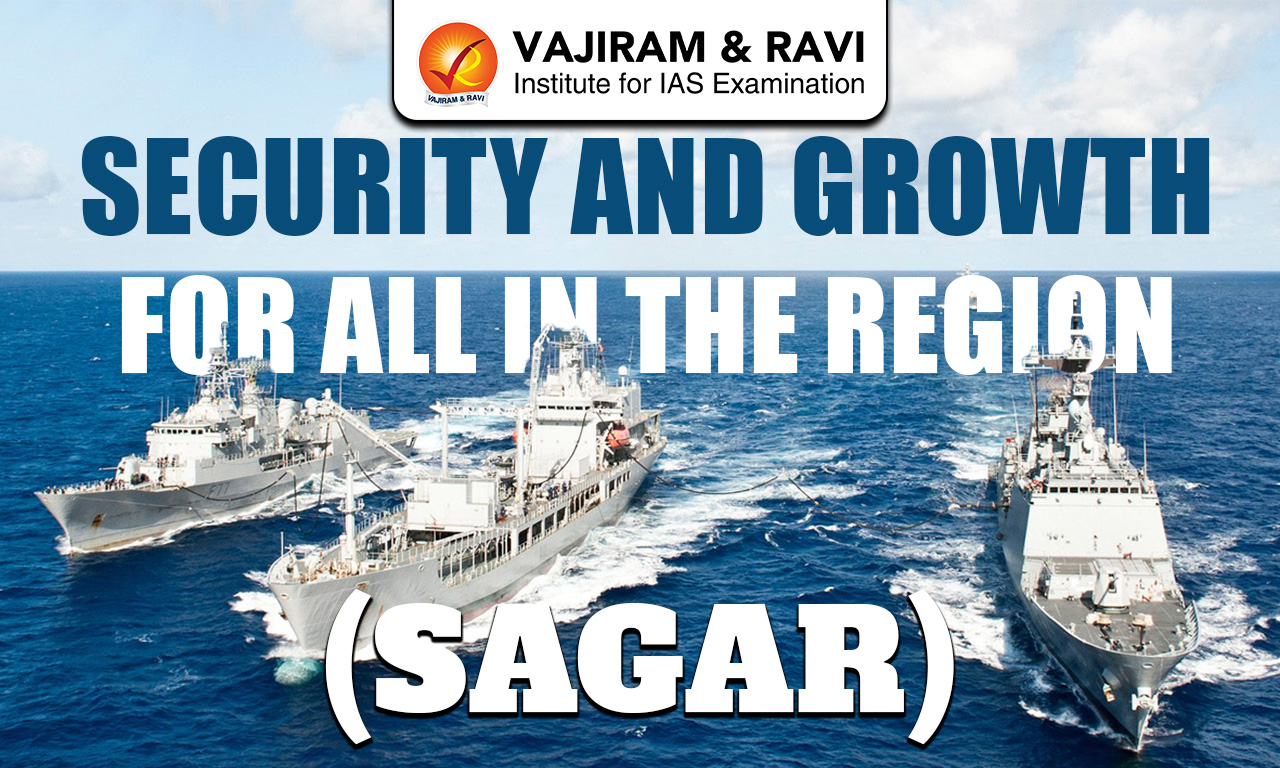
Security and Growth for All in the Region (SAGAR) is India’s strategic maritime initiative that reflects its vision of a safe, secure, and prosperous Indian Ocean Region (IOR). It underscores India’s role as a responsible maritime power, focusing on cooperation, capacity building, and sustainable development among littoral states.
Security and Growth for All in the Region (SAGAR) Background
SAGAR (Security and Growth for All in the Region) emerged as India’s response to the increasing strategic and economic importance of the Indian Ocean Region, which carries a major share of global trade and energy flows. The rise of non-traditional threats such as piracy, maritime terrorism, and illegal fishing, along with frequent natural disasters, highlighted the need for a coordinated maritime security framework.
Simultaneously, China’s expanding footprint particularly through its “String of Pearls” strategy of developing ports and strategic nodes across the Indian Ocean raised concerns about strategic encirclement and influence, prompting India to articulate a cooperative and inclusive alternative. The vast yet underutilised potential of the Blue Economy further necessitated a sustainable development approach for regional countries. In addition, the need to uphold a rules-based maritime order under the United Nations Convention on the Law of the Sea became crucial to ensure stability and prevent conflicts. Overall, SAGAR reflects India’s intent to act as a responsible maritime power by ensuring security, fostering cooperation, and promoting inclusive growth in the Indian Ocean Region.
Core Pillars of Security and Growth for All in the Region (SAGAR)
Core pillars of Security and Growth for All in the Region (SAGAR) reflect an integrated approach.
Maritime Security and Safety
This pillar forms the foundation of SAGAR, as secure seas are essential for stability and economic activity. India acts as a “net security provider” in the Indian Ocean Region, extending support not only to its own maritime boundaries but also to neighbouring littoral and island states. This includes:
- Surveillance of sea lanes,
- Prevention of piracy and trafficking, and
- Rapid response during natural disasters through humanitarian assistance.
- India also focuses on strengthening the capabilities of smaller nations by providing training, equipment, and technical support.
Economic Development and Blue Economy
Security and Growth for All in the Region (SAGAR) promotes the concept of the Blue Economy, which focuses on the responsible use of marine resources for development.
It includes sectors such as fisheries, marine biotechnology, offshore energy, and coastal tourism. India supports Indian Ocean countries by helping them build infrastructure, improve fisheries management, and develop marine-based industries.
Connectivity and Trade
Recognising the Indian Ocean as a major global trade corridor, this pillar emphasises improving maritime connectivity and infrastructure. Efficient ports, shipping routes, and logistics networks are vital for economic integration and regional prosperity.
Respect for International Law and Rules-Based Order
A key principle of SAGAR is adherence to international maritime laws to ensure peace and stability.
- India advocates for freedom of navigation, peaceful resolution of disputes, and respect for sovereignty.
- The United Nations Convention on the Law of the Sea provides the legal framework governing ocean use and maritime rights.
By supporting such norms, India promotes a rules-based order and counters unilateral or aggressive actions in maritime regions.
Cooperative and Inclusive Regional Architecture
This pillar reflects the idea that maritime security and development should be based on cooperation rather than competition. India works with regional and global partners to build an inclusive framework for the Indian Ocean Region.
It actively participates in organisations such as the Indian Ocean Rim Association and the Indian Ocean Naval Symposium, while also engaging in strategic groupings like the Quadrilateral Security Dialogue. These efforts strengthen trust, coordination, and collective security.


Key Initiatives under Security and Growth for All in the Region (SAGAR)
Security and Growth for All in the Region (SAGAR) is operationalised through a range of strategic, security, connectivity, and developmental initiatives that collectively strengthen India’s role as a net security provider and a key partner in the Indian Ocean Region.
Information Fusion Centre – Indian Ocean Region (IFC-IOR):
- The Information Fusion Centre – Indian Ocean Region is a flagship initiative to enhance Maritime Domain Awareness (MDA) in the Indian Ocean Region.
- It acts as a nodal hub for real-time information sharing on shipping movements, maritime threats, and illegal activities.
- By integrating inputs from multiple countries and agencies, it enables coordinated responses to piracy, trafficking, and security challenges.
It operationalises India’s role as a “net security provider” and strengthens trust among partner nations.
Coastal Surveillance Radar System (CSRS):
- India has established an extensive network of coastal surveillance radars across Indian Ocean littoral states such as Maldives, Mauritius, Seychelles, and Sri Lanka.
- These radars monitor vessel movements within Exclusive Economic Zones (EEZs) and help detect suspicious activities.
Humanitarian Assistance and Disaster Relief (HADR) Missions:
- HADR showcases India’s capacity as a first responder in the region.
- Missions such as Operation Dost (2023) for earthquake relief and Operation Kaveri (2023) for evacuation from Sudan highlight India’s rapid deployment capability.
- These efforts not only provide immediate relief but also enhance India’s soft power and credibility as a reliable partner in times of crisis.
Sagarmala Project:
The Sagarmala Project is a domestic initiative with strong external implications under SAGAR.
- It focuses on port modernisation, coastal economic zones, and improved logistics connectivity.
- By enhancing port efficiency and reducing logistics costs, it strengthens India’s position as a maritime trade hub and supports regional connectivity in the Indian Ocean.
Project Mausam:
- The Project Mausam aims to revive ancient maritime trade routes and cultural linkages across the Indian Ocean.
- It highlights India’s historical connections with East Africa, the Middle East, and Southeast Asia, thereby reinforcing cultural diplomacy alongside economic engagement under SAGAR.
Mission SAGAR (from 2020 onwards):
- Mission SAGAR was launched during the COVID-19 pandemic to provide food, medicines, and medical assistance to Indian Ocean countries.
- It has since expanded to include multiple phases of outreach, covering nations such as Maldives, Mauritius, Madagascar, and Comoros.
- This initiative reflects India’s commitment to inclusive growth and regional solidarity.
Indo-Pacific Oceans Initiative (IPOI)
- IPOI complements SAGAR by providing a broader Indo-Pacific framework focusing on maritime security, disaster risk reduction, sustainable marine resource use, and capacity building.
- It brings together like-minded countries to cooperate in managing common maritime challenges and strengthens India’s strategic outreach beyond the Indian Ocean.
Chabahar Port Development
India’s development of Chabahar Port in Iran is a strategically significant initiative that enhances connectivity to Afghanistan and Central Asia, bypassing Pakistan. It strengthens India’s trade and strategic access to Eurasia while contributing to regional economic integration under SAGAR.
QUAD Cooperation:
- Through the Quadrilateral Security Dialogue, India collaborates with the US, Japan, and Australia on maritime security, resilient supply chains, and disaster response.
- QUAD initiatives such as maritime domain awareness and infrastructure coordination reinforce SAGAR’s objectives in the Indo-Pacific.
Indian Ocean Rim Association (IORA) Engagement
- India plays an active role in the Indian Ocean Rim Association, promoting economic cooperation, maritime safety, and sustainable development.
- Through IORA, India supports capacity building, trade facilitation, and policy coordination among member states.
MAHASAGAR Doctrine (2024-2025)
- MAHASAGAR stands for Mutual and Holistic Advancement for Security Across the Regions. It is the operational framework of SAGAR, designed to translate India’s strategic maritime vision into practical, action-oriented measures.
Security and Growth for All in the Region (SAGAR) Significance
SAGAR is significant as it:
- Ensures Regional Maritime Security: India acts as a “net security provider,” safeguarding sea lanes, combating piracy, and providing humanitarian assistance, thus enhancing stability in the Indian Ocean Region.
- Promotes Economic Growth and Blue Economy: SAGAR supports sustainable development of fisheries, ports, marine resources, and renewable ocean energy, helping littoral states utilise their Exclusive Economic Zones productively.
- Strengthens Regional Connectivity and Trade: Through initiatives like the Sagarmala Project and port development assistance, SAGAR improves maritime trade, logistics, and cultural linkages across the region.
- Upholds a Rules-Based Maritime Order: SAGAR reinforces adherence to international law, freedom of navigation, and peaceful dispute resolution under the United Nations Convention on the Law of the Sea, countering unilateral or aggressive claims.
- Enhances Multilateral and Bilateral Cooperation: By engaging with IORA, IONS, and the Quad, SAGAR fosters collective security, joint capacity building, and stronger diplomatic partnerships.
- Boosts India’s Strategic Influence: SAGAR consolidates India’s leadership in the Indian Ocean Region, projecting it as a reliable partner for smaller nations while countering extra-regional influence.
- Strengthens Disaster Response and Humanitarian Outreach: Through HADR operations and initiatives like Mission SAGAR, India provides timely assistance to crisis-affected countries, enhancing regional goodwill and soft power.
Security and Growth for All in the Region (SAGAR) Challenges
Despite its strategic coherence, SAGAR faces several implementation challenges that limit its effectiveness in the Indian Ocean Region.
- Limited Financial Capacity: India’s financial resources are constrained compared to China’s BRI-scale infrastructure investments. Delays in port development, connectivity projects, and capacity-building initiatives allow China to fill the strategic gap. For example, Sri Lanka’s decision to lease Hambantota Port to China for 99 years partly reflects India’s slower delivery of alternative offers.
- Political Volatility in Neighbouring Countries: Domestic political dynamics in regional states can disrupt SAGAR initiatives. Anti-India sentiment in the Maldives during the Yameen era, Bangladesh’s balancing act between India and China, and Nepal’s drift toward China have periodically affected the continuity of India’s maritime engagements.
- Perception Challenges: India’s approach is sometimes perceived as interventionist, generating mistrust among smaller neighbours and weakening the cooperative spirit envisioned under SAGAR.
- Weak Multilateral Institutional Framework: The Indian Ocean Region lacks a dedicated regional organisation with binding commitments. Unlike ASEAN or the EU, platforms such as the Indian Ocean Rim Association have limited enforcement capacity, making SAGAR largely a bilateral initiative rather than a fully institutionalised multilateral framework.
- Naval and Operational Constraints: SAGAR’s ambition to act as a “net security provider” strains India’s naval capacity. The Indian Navy is still modernising and faces resource constraints in sustaining deployments across the vast Indian Ocean.

 Last updated on Sep, 2026
→ UPSC 2027 Notification will be released on 13 January 2027 at upsconline.nic.in.
→ Asian Games 2026 are being held in Aichi-Nagoya, Japan, from 19 September to 4 October.
→ Check out the latest UPSC Syllabus here.
→ Download UPSC Model Answers for Mains 2026
→ UPSC Mains Question Paper 2026 is out now for Essay & GS Paper 1, 2, 3 & 4.
→ UPSC Calendar 2027 has been released.
→ Enroll in Vajiram & Ravi’s UPSC Mains Test Series 2027 for structured answer writing practice, expert evaluation, and exam-oriented feedback.
→ Join Vajiram & Ravi’s UPSC Mentorship Program 2027 for personalized guidance, strategy planning, and one-to-one support from experienced mentors.
→ Go through the UPSC Mains Previous Year Papers to enhance your preparation.
→ UPSC has released UPSC Toppers List 2025 with the Civil Services final result on its official website.
→ Also check Best UPSC Coaching in India
Security and Growth for All in the Region (SAGAR) FAQs
Q1. What is Security and Growth for All in the Region (SAGAR)?+
Q2. Why was Security and Growth for All in the Region (SAGAR) launched?+
Q3. What are the core pillars of Security and Growth for All in the Region (SAGAR)?+
Q4. What are the key initiatives under Security and Growth for All in the Region (SAGAR)?+
Q5. What challenges does Security and Growth for All in the Region (SAGAR) face?+
Tags: security and growth for all in the region