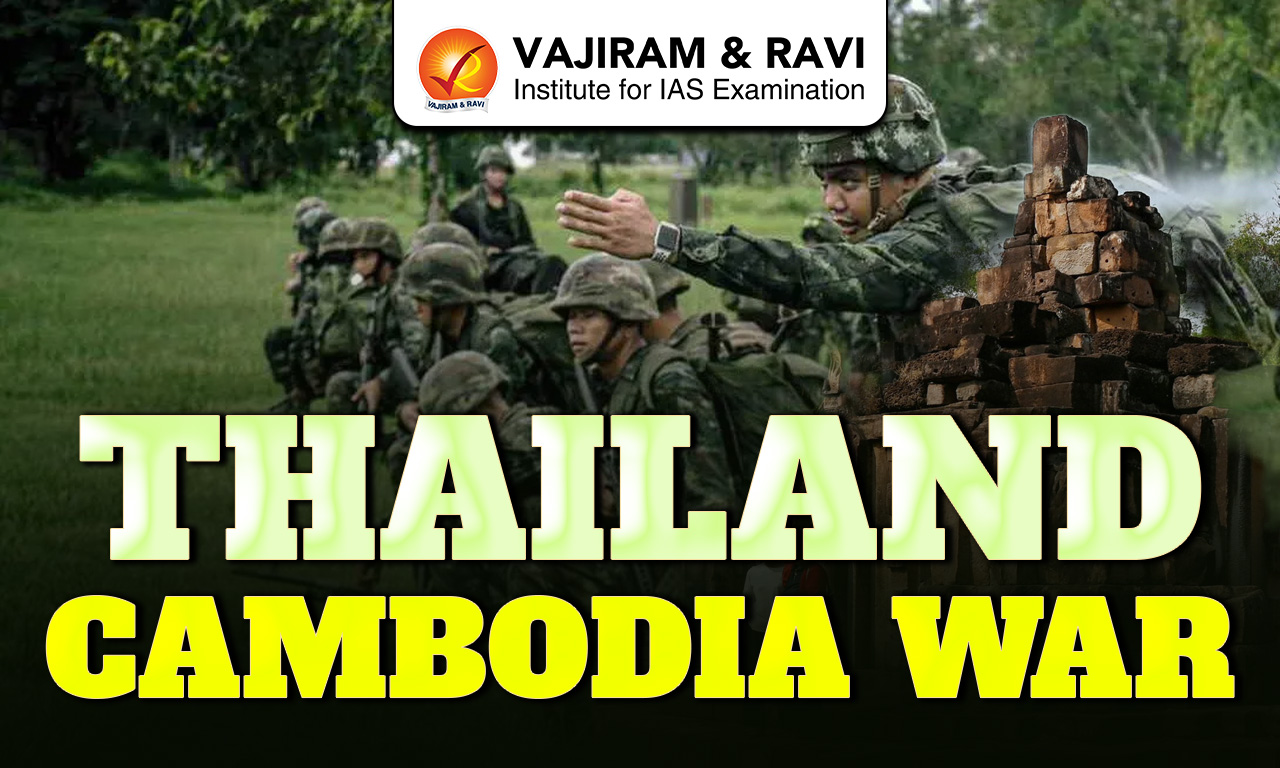
The Thailand Cambodia War refers to the escalation of a long standing border dispute into direct armed conflict in 2025, marked by intense military engagements, airstrikes and large scale displacement. The dispute has been rooted in historical territorial disagreements with the conflict intensified in July 2025 and again in December 2025. This involves modern warfare tactics and international diplomatic interventions, making it one of the most serious regional security crises in mainland Southeast Asia in recent years.
Thailand Cambodia War Background
The Thailand Cambodia War originates from historical boundary disputes, colonial era treaties and unresolved sovereignty issues over strategic and cultural sites.
- Colonial era boundary ambiguity: The 1904 and 1907 treaties between Siam and French Indochina created unclear borders, as maps prepared by French authorities lacked precision, leading to overlapping territorial claims in highland areas.
- Preah Vihear dispute: The Temple of Preah Vihear became central after the International Court of Justice awarded it to Cambodia in 1962, but left surrounding land undefined, creating continued friction.
- Post independence tensions: After Cambodia’s independence in 1953, both nations asserted sovereignty over adjoining areas, especially strategic cliffs and access routes near the temple.
- 2008-2011 clashes: Renewed military confrontations involving artillery and troop deployments highlighted the volatility of the region and resulted in casualties and displacement on both sides.
- Nationalism and politics: Domestic political narratives in both countries intensified the dispute, linking territorial claims with national pride and historical identity.
- Strategic geography: The disputed areas overlook important regions like Khao Phra Wihan National Park, increasing their military and symbolic significance.
Thailand Cambodia War Reason
The Thailand Cambodia War resulted from multiple immediate triggers and long term disputes involving territory, military actions and political tensions.
- Landmine incidents: On 23 July 2025, a Thai soldier was severely injured by a PMN 2 landmine in Nam Yuen district, triggering escalation and accusations of treaty violations.
- Rocket attacks allegation: Thailand claimed Cambodia used BM 21 rocket launchers targeting civilian areas, including hospitals and gas stations, escalating the conflict into full scale war.
- Disputed temple sites: Key flashpoints included Prasat Ta Muen Thom and Preah Vihear temple areas, both culturally significant and strategically located along the border.
- Emerald Triangle tensions: The tri border region saw repeated skirmishes, including a 10 minute clash on 28 May 2025 that killed a Cambodian soldier.
- Military buildup: Both nations increased troop deployments and defensive infrastructure, indicating preparation for possible escalation before July 2025.
- Diplomatic breakdown: Closure of border checkpoints and expulsion of diplomats reduced communication channels, worsening mistrust and hostility.
- Political instability in Thailand: A leaked phone call involving Paetongtarn Shinawatra triggered a domestic crisis, weakening political stability during the conflict.
- Economic retaliation: Cambodia imposed trade restrictions, including bans on Thai imports, while Thailand tightened border controls and financial scrutiny.
Also Check: India Singapore Relations


Thailand Cambodia War Events
The Thailand Cambodia War involved multiple phases of escalation, including major battles, airstrikes and ceasefire negotiations.
- July 24 escalation: Full scale clashes began with artillery exchanges and airstrikes, including deployment of F 16 jets by Thailand for the first time since the 1987-88 conflict.
- Civilian impact: Rocket attacks damaged hospitals and infrastructure, with over 200,000 civilians displaced across both countries.
- Operation Yuttha Bodin: Thailand launched coordinated land and air offensives targeting Cambodian military positions.
- Naval operations: The Royal Thai Navy conducted operations like Trat Phikhat Phairi 1 to repel Cambodian advances in coastal regions.
- First ceasefire: On 28 July 2025, both nations agreed to a ceasefire following international pressure and mediation efforts.
- August tensions: Continued landmine incidents, drone surveillance and troop movements kept tensions high despite ceasefire.
- December clashes: Fighting resumed on 7 December with airstrikes, artillery fire and Thailand launching Operation Sattawat.
- Strategic captures: Thai forces seized key hills and localities in northern Cambodia, strengthening their tactical position.
- Final ceasefire: A second ceasefire on 27 December ended major hostilities, though tensions persisted.
Thailand Cambodia War Current Status
The Thailand Cambodia War has formally de-escalated but remains fragile with lingering tensions and sporadic incidents.
- Ceasefire agreement: A ceasefire signed on 27 December 2025 remains in effect as of March 2026, including a 72 hour monitoring mechanism.
- Continued mistrust: Both sides continue to accuse each other of ceasefire violations, including troop movements and landmine placements.
- Military presence: Troops remain deployed along contested zones, maintaining high alert levels despite reduced active combat.
- Prisoner release: Thailand released 18 Cambodian soldiers captured during July clashes as a confidence building measure.
- Sporadic clashes: Minor incidents, including firing and mortar shelling, continue to occur, reflecting unresolved tensions.
- Border restrictions: Movement across border checkpoints remains limited, affecting trade and civilian mobility.
Also Check: India ASEAN Relations
Thailand Cambodia War Impacts
The Thailand Cambodia War had severe humanitarian, economic and regional security consequences.
- Human displacement: Over 200,000 civilians were displaced in July alone, with total displacement exceeding 500,000 by December.
- Casualties: More than 100 deaths were reported, including soldiers and civilians, with independent estimates suggesting higher figures.
- Infrastructure damage: Hospitals, homes and public facilities were destroyed, with damages in Thailand alone estimated at 285 million baht.
- Economic disruption: Trade restrictions and border closures affected industries, agriculture and services in both countries.
- Migration crisis: Cambodian migrant workers in Thailand faced violence and discrimination, increasing humanitarian concerns.
- Environmental damage: Forest fires and military activities damaged ecosystems along the border region.
- Political instability: The conflict contributed to leadership changes and political crises, particularly in Thailand.
- Regional insecurity: The conflict raised concerns about stability in Southeast Asia, affecting investor confidence and tourism.
Thailand Cambodia War International Concerns
Global and regional actors played significant roles in mediation, humanitarian response and diplomatic pressure.
- ASEAN mediation: ASEAN urged ceasefire and facilitated negotiations, including observer teams for monitoring.
- United Nations involvement: United Nations called for restraint, while Cambodia sought intervention through the Security Council.
- United States role: Donald Trump mediated talks and encouraged ceasefire, linking diplomacy with trade considerations.
- Malaysia facilitation: Anwar Ibrahim hosted peace talks in Putrajaya and Kuala Lumpur, leading to ceasefire agreements.
- China’s engagement: China hosted informal discussions and supported dialogue, emphasizing peaceful resolution and regional stability.
- Legal mechanisms: Cambodia sought resolution through the International Court of Justice, while Thailand preferred bilateral negotiations.
- Global reactions: Countries including India, Japan and Australia issued advisories and called for peaceful resolution, highlighting international concern.
Also Check: India South Africa Relations

 Last updated on Sep, 2026
→ UPSC 2027 Notification will be released on 13 January 2027 at upsconline.nic.in.
→ Asian Games 2026 are being held in Aichi-Nagoya, Japan, from 19 September to 4 October.
→ Check out the latest UPSC Syllabus here.
→ Download UPSC Model Answers for Mains 2026
→ UPSC Mains Question Paper 2026 is out now for Essay & GS Paper 1, 2, 3 & 4.
→ UPSC Calendar 2027 has been released.
→ Enroll in Vajiram & Ravi’s UPSC Mains Test Series 2027 for structured answer writing practice, expert evaluation, and exam-oriented feedback.
→ Join Vajiram & Ravi’s UPSC Mentorship Program 2027 for personalized guidance, strategy planning, and one-to-one support from experienced mentors.
→ Go through the UPSC Mains Previous Year Papers to enhance your preparation.
→ UPSC has released UPSC Toppers List 2025 with the Civil Services final result on its official website.
→ Also check Best UPSC Coaching in India
Thailand Cambodia War FAQs
Q1. When did the Thailand Cambodia War start?+
Q2. What was the main cause of the Thailand Cambodia War?+
Q3. How many people were affected by the conflict?+
Q4. What role did the international community play in the Thailand Cambodia War?+
Q5. What is the current status of the Thailand Cambodia War?+
Tags: international relations thailand cambodia war