Piped Natural Gas Latest News
- India is accelerating the shift towards piped natural gas (PNG) to reduce LPG import dependence and improve energy security.
Types of Cooking and Transport Fuels
- India uses multiple forms of gaseous fuels for domestic and industrial purposes.
- Liquefied Petroleum Gas (LPG) is a mixture of propane and butane obtained during oil refining and natural gas processing.
- Liquefied Natural Gas (LNG) is natural gas cooled to extremely low temperatures to convert it into liquid form for transport.
- Piped Natural Gas (PNG) is natural gas supplied directly to households through pipelines.
- Compressed Natural Gas (CNG) is natural gas compressed for use as a vehicular fuel.
- Each of these fuels differs in storage, transport, and usage. LPG is cylinder-based, while PNG is pipeline-based, making it more continuous and convenient.


Transport and Distribution Mechanisms
- The logistics of fuel distribution differ significantly across fuel types.
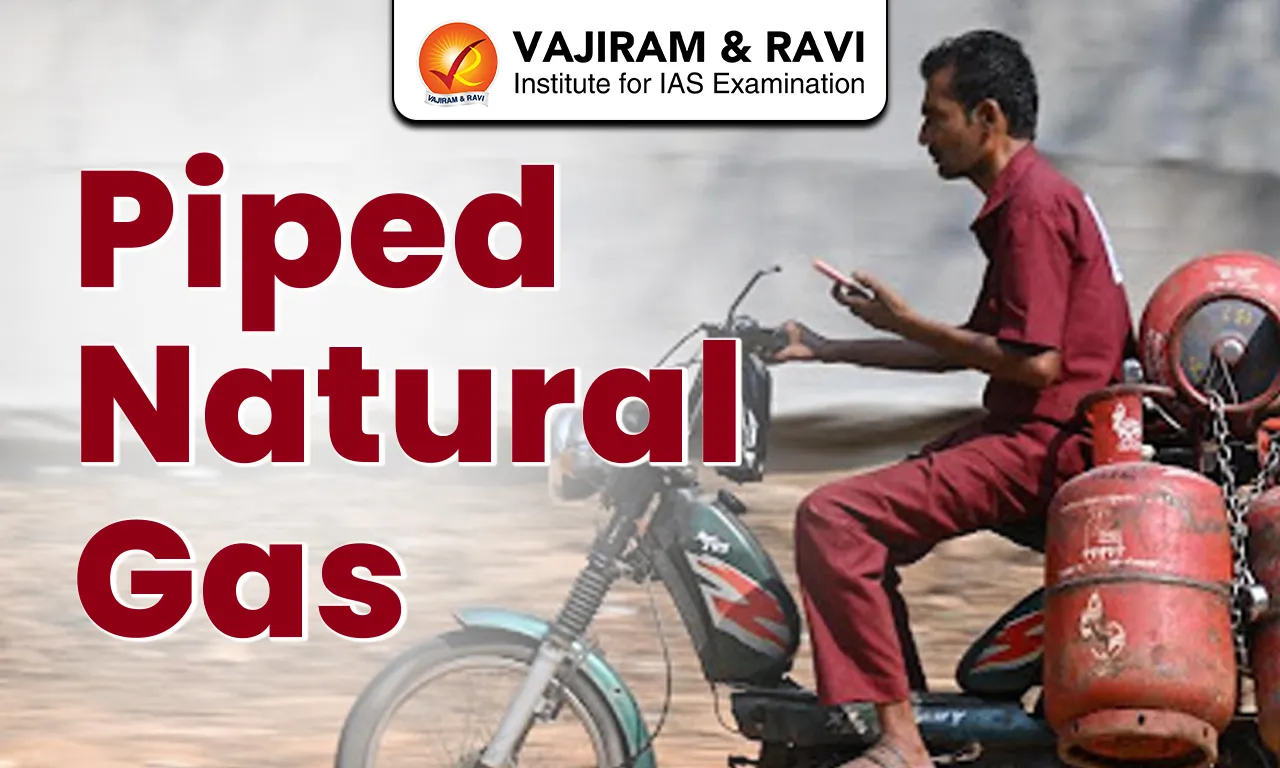
- LPG is transported in cylinders after being liquefied and pressurised, and delivered physically to households.
- LNG is transported through specialised carriers at extremely low temperatures and later regasified.
- PNG is delivered through underground pipelines directly to consumers.
- Pipeline-based delivery reduces handling and storage risks while ensuring an uninterrupted supply.
Why LPG Became Dominant in India
- India adopted LPG as the primary cooking fuel due to logistical convenience.
- Cylinder-based delivery is easier to implement compared to building an extensive pipeline network.
- This made LPG suitable for rapid expansion, especially under schemes like PM Ujjwala Yojana.
- However, LPG supply chains are vulnerable to disruptions, especially due to import dependence.
News Summary
- The Union Govt is actively promoting piped natural gas as an alternative to LPG, driven by concerns over import dependence and global disruptions.
- India currently has around 33 crore LPG connections. Officials estimate that domestic natural gas production could potentially support up to 30 crore connections if households transition to PNG.
- One of the key reasons behind this push is India’s heavy reliance on LPG imports.
- Nearly three-fifths of LPG demand is met through imports, with about 90% routed through the Strait of Hormuz, which has been affected by geopolitical tensions.
- In contrast, LNG imports are more diversified globally, making natural gas a more secure option.
- The government is also taking policy measures to accelerate PNG adoption. It is expected that around 15 lakh new PNG connections will be added in the near term.
- A major policy shift includes discouraging dual connections. Households may be required to transition fully to PNG where available, leading to an increase in PNG adoption.
- Currently, PNG connections have crossed 1.5 crore and are expected to reach 2 crore soon. The government aims to expand this to 12 crore connections by 2034.
- To support this expansion, India is rapidly developing pipeline infrastructure. The existing pipeline network spans about 25,000 km, with an additional 10,500 km under construction.
Advantages of PNG
- Energy Security. Reduces dependence on LPG imports and vulnerable supply routes.
- Convenience. Provides an uninterrupted supply without cylinder replacement.
- Cost Efficiency. Lower logistics and handling costs in the long run.
- Environmental Benefits. Natural gas burns cleaner than LPG and reduces emissions.
- These advantages align with India’s broader goals of energy transition and sustainability.
Challenges in PNG Expansion
- High initial investment in pipeline infrastructure.
- Difficulties in land acquisition and approvals.
- Uneven geographical coverage.
- Limited awareness and technical readiness among industrial users.
- Additionally, India’s LNG system operates on a “just-in-time” model with limited storage, making it vulnerable to supply disruptions.
Way Forward
- India must adopt a balanced approach for gas-based energy transition.
- Expand pipeline infrastructure to underserved regions.
- Increase domestic natural gas production.
- Strengthen LNG import and storage capacity.
- Improve regulatory coordination for faster approvals.
- Promote awareness and technical support for industries.
Source: TH

 Last updated on Sep, 2026
→ UPSC 2027 Notification will be released on 13 January 2027 at upsconline.nic.in.
→ Asian Games 2026 are being held in Aichi-Nagoya, Japan, from 19 September to 4 October.
→ Check out the latest UPSC Syllabus here.
→ Download UPSC Model Answers for Mains 2026
→ UPSC Mains Question Paper 2026 is out now for Essay & GS Paper 1, 2, 3 & 4.
→ UPSC Calendar 2027 has been released.
→ Enroll in Vajiram & Ravi’s UPSC Mains Test Series 2027 for structured answer writing practice, expert evaluation, and exam-oriented feedback.
→ Join Vajiram & Ravi’s UPSC Mentorship Program 2027 for personalized guidance, strategy planning, and one-to-one support from experienced mentors.
→ Go through the UPSC Mains Previous Year Papers to enhance your preparation.
→ UPSC has released UPSC Toppers List 2025 with the Civil Services final result on its official website.
→ Also check Best UPSC Coaching in India
Piped Natural Gas FAQs
Q1. What is piped natural gas (PNG)?+
Q2. Why is India promoting PNG over LPG?+
Q3. What is the target for PNG connections in India?+
Q4. What is a major challenge in PNG expansion?+
Q5. How does PNG benefit the environment?+
Tags: mains articles piped natural gas upsc current affairs upsc mains current affairs