Jyotirao Phule Latest News
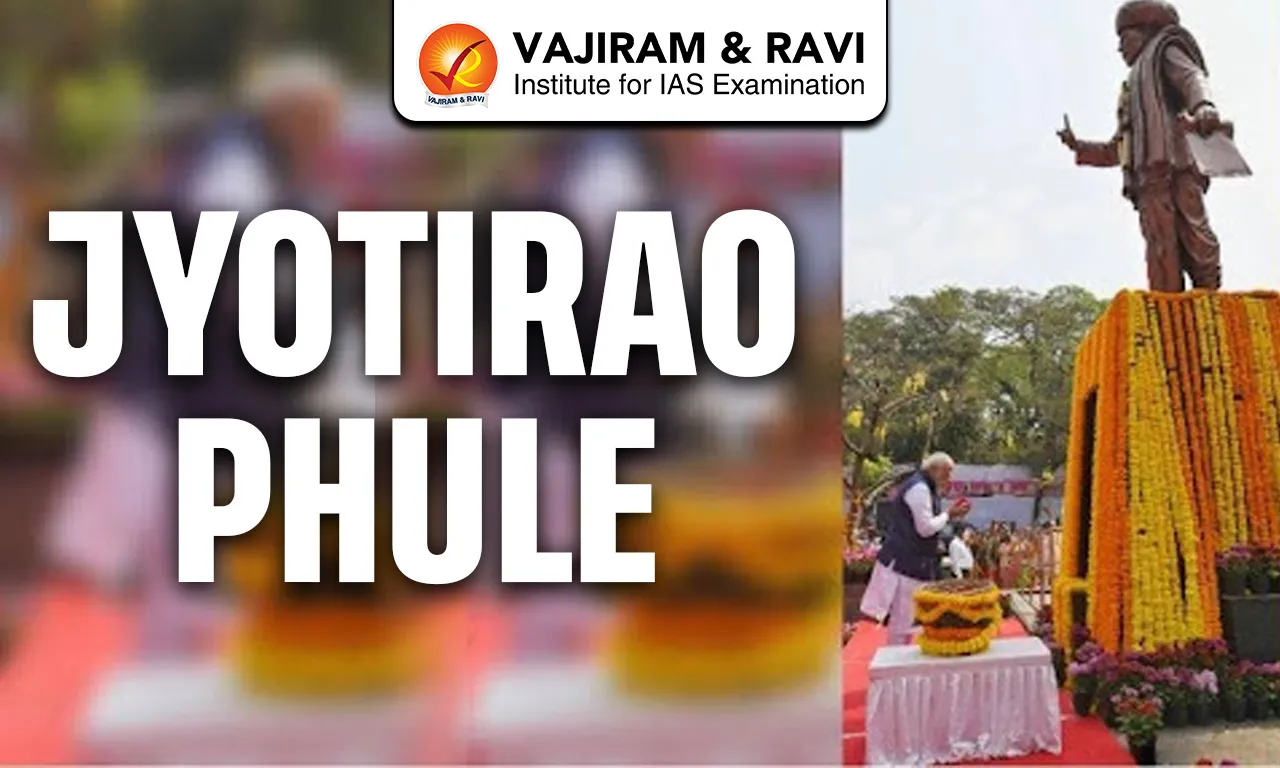
- PM Modi paid tribute to Jyotirao Phule on his birth anniversary (April 11), marking the beginning of his 200th birth anniversary celebrations and highlighting his enduring legacy in social reform.
Jyotirao Phule (1827–1890)
- Jyotirao Phule is a central figure in Indian social reform history.
- He is widely regarded as one of the earliest and most radical voices against caste oppression and patriarchy in 19th-century India.
Early Life and Background
- Born on 11 April 1827 in Pune, Maharashtra, into the Mali (gardener) caste — a lower-caste community — Phule experienced caste discrimination firsthand from an early age.
- Despite initial obstacles, he pursued education and was deeply influenced by the egalitarian ideals of Thomas Paine’s The Rights of Man and the American anti-slavery movement.
- His exposure to these ideas shaped his lifelong crusade against Brahminical social order.
Key Areas of Work
- Education for the Marginalised – In 1848, he opened the first school for girls in Pune at Bhide Wada — a radical act in 19th-century India. He subsequently opened schools for lower-caste children and untouchables. His wife, Savitribai Phule, became India’s first female teacher and was his closest partner in this mission.
- Women’s Empowerment – In 1863, he established a home for the care of upper-caste widows and their newborns, challenging the social stigma attached to widow remarriage and pregnancy outside wedlock.
- Fight Against Caste System – He rejected the authority of the Vedas and Manusmriti as instruments of upper-caste domination. He was among the first reformers to draw a direct link between caste oppression and economic exploitation of the peasantry and labouring classes.
Satyashodhak Samaj (1873)
- Phule founded the Satyashodhak Samaj (Society of Truth Seekers) in 1873 — one of the most significant social reform organisations of 19th-century India.
- Its core objectives were to liberate untouchables, promote rational thinking, and establish direct communion with God without priestly intermediaries.
- The Samaj conducted marriages without Brahmin priests, a practice known as Satyashodhak marriages.
Books and Literary Works
- Tritiya Ratna (1855)
- Gulamgiri (Slavery) — 1873
- Shetkaryaca Asud (Cultivator’s Whipcord) — 1883
- Sarvajanik Satyadharma Pustak (1889)
Legacy and Recognition
- In 1888, Phule was conferred the title “Mahatma” by a public gathering in Pune — decades before Gandhi received the same title.
- He is regarded as a forerunner of B.R. Ambedkar, who acknowledged Phule as one of his three greatest influences (alongside the Buddha and Kabir).
- The Government of India has honoured him as one of the makers of modern India.


Key Highlights of the Speech by PM Modi
- Phule as a Catalyst for Social Change – PM Modi described Phule as a reformer who believed that societal change must emerge from within, inspiring generations through thought, action, and commitment to justice.
- Central Role of Education in Reform – Education was at the heart of Phule’s vision. He pioneered schools for girls and marginalised communities, emphasising that knowledge is a shared resource and a tool for equality and empowerment.
- Champion of Equality and Social Justice – Phule worked tirelessly for the poor, farmers, and marginalised, advocating dignity, equal rights, and social harmony. His founding of the Satyashodhak Samaj institutionalised these ideals.
- Contribution of Savitribai Phule – PM Modi also honoured Savitribai Phule, a pioneer in women’s education, who carried forward Phule’s mission and sacrificed her life while serving plague victims.
- Contemporary Relevance and Policy Inspiration – The Prime Minister linked Phule’s ideas to present-day initiatives focused on education, innovation, and youth empowerment, highlighting their continued relevance in nation-building.
- Call for Renewal of Social Commitment – The bicentenary is seen as an opportunity to renew commitment to education, justice, and social reform, reinforcing the belief that society can transform itself through collective effort.
Source: IE

 Last updated on Sep, 2026
→ UPSC 2027 Notification will be released on 13 January 2027 at upsconline.nic.in.
→ Asian Games 2026 are being held in Aichi-Nagoya, Japan, from 19 September to 4 October.
→ Check out the latest UPSC Syllabus here.
→ Download UPSC Model Answers for Mains 2026
→ UPSC Mains Question Paper 2026 is out now for Essay & GS Paper 1, 2, 3 & 4.
→ UPSC Calendar 2027 has been released.
→ Enroll in Vajiram & Ravi’s UPSC Mains Test Series 2027 for structured answer writing practice, expert evaluation, and exam-oriented feedback.
→ Join Vajiram & Ravi’s UPSC Mentorship Program 2027 for personalized guidance, strategy planning, and one-to-one support from experienced mentors.
→ Go through the UPSC Mains Previous Year Papers to enhance your preparation.
→ UPSC has released UPSC Toppers List 2025 with the Civil Services final result on its official website.
→ Also check Best UPSC Coaching in India
Jyotirao Phule FAQs
Q1. Who was Jyotirao Phule?+
Q2. What were Jyotirao Phule’s key contributions?+
Q3. What is Satyashodhak Samaj?+
Q4. How did Jyotirao Phule contribute to women’s education?+
Q5. Why is Jyotirao Phule relevant today?+
Tags: Jyotirao Phule mains articles upsc current affairs upsc mains current affair